Exhibitions
Le Large champions the link between art and the machine
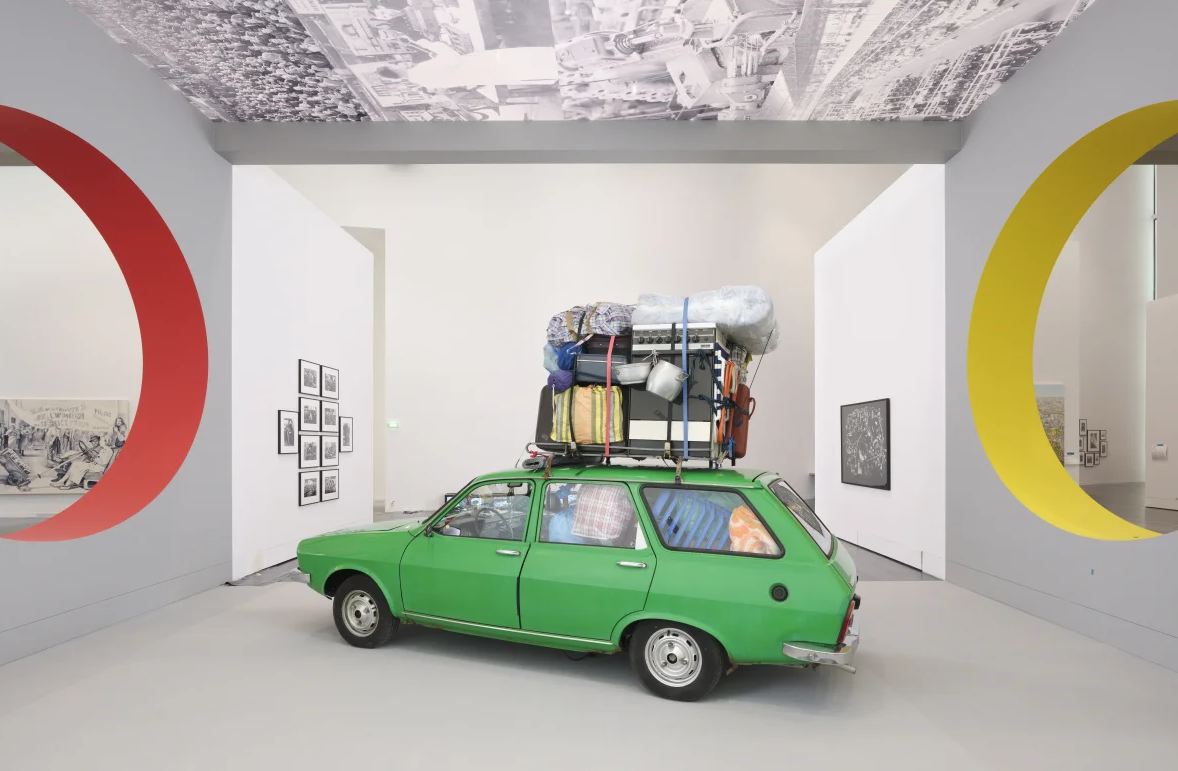
Renault's industrial history finds a new form of expression at Le Large, a contemporary art center located on Île Seguin, southwest of Paris, which opens with an exhibition dedicated to exploring the relationships between humankind, machines, and industrial society. The building, designed by Spanish architects Carme Pigem and Ramón Vilalta of RCR Arquitectes, establishes a dialogue between the memory of a place marked by automotive production and the creative possibilities offered by contemporary art.
The inaugural exhibition, Moteur Imaginaire ( The Imaginary Engine ), will be on view until March 7, 2027, and brings together 120 works by 55 artists from 23 countries. Curated by Cecilia Alemani, an Italian specialist based in New York and a leading figure in international curating, the exhibition combines historical pieces from the Renault Art and Culture Fund collection with new creations commissioned from 17 contemporary artists. The result offers an interpretation of the automobile that transcends its functional dimension, addressing it as a symbol of innovation, progress, and freedom, but also as an agent of technological, environmental, and urban transformation.
The choice of Île Seguin was no accident. In 1919, Louis Renault acquired this territory, which would eventually house one of France's largest automobile manufacturing plants. For decades, the factory was much more than just an assembly line. The company developed a unique relationship with artistic creation, especially from the 1930s onward, when it began collecting contemporary works. This connection intensified in the following decades through initiatives that allowed various artists access to surplus materials and industrial machinery to experiment with new languages and processes.
Among the artists who found a field of exploration in that environment were the Swiss sculptor Jean Tinguely, the Venezuelan artist Jesús Rafael Soto, and the American Robert Rauschenberg. The factory thus became a space for exchange between engineering, industry, and artistic imagination. Some of the works were even integrated into the workspaces themselves: the cafeteria housed a chromatic mural by Julio Le Parc, while the restaurant incorporated screen-printed Formica panels by the Hungarian painter Simon Hantaï. For years, industrial production and aesthetic experimentation shared the same stage.
The old factory was demolished in 2004, but its legacy remains an essential part of the island's identity. Le Large reclaims this memory and projects it into the present, highlighting industry's capacity to generate creative contexts and new forms of collaboration. The inaugural exhibition draws precisely on this heritage to establish connections between historical works in the Renault collection and contemporary practices.
The exhibition highlights the works of Jean Tinguely, whose mechanical universe finds a direct correspondence with the history of the site. His sculpture Pit Stop incorporates components of the Renault RE40 Formula 1 car, transforming elements linked to motorsport into sculptural material. Also featured is Le Mur Bleu by Jean Dubuffet, a large-format work made from the factory's stock of epoxy resin. Julio Le Parc's chromatic intervention, with its gradations of color and suggestion of movement, completes this dialogue between perception, materiality, and energy.
The historical selection also includes works by artists such as Victor Vasarely and Robert Doisneau, whose approaches to abstraction, imagery, and modernity contribute to a broader understanding of a collection linked to the evolution of 20th-century visual culture. In contrast, the newer works introduce other perspectives on technology, labor, and the social consequences of production systems.
The factory, the engine, and the assembly line function as metaphors for the constant tension between individual creativity and collective organization. The relationships between workers, tools, and production mechanisms are permeated by issues such as fatigue, wear and tear, and the physical limitations of the body. Some compositions of mechanical and robotic tools evoke both moments of pause and exhaustion, placing the human experience at the heart of a transforming technological landscape.
With this inaugural exhibition, Le Large aims to reconnect industrial history with artistic experimentation, while also contributing to the regeneration of Île Seguin. The new center is integrated into a territory whose identity was defined for decades by automobile manufacturing and which is now seeking new cultural and urban uses. The architecture by RCR Arquitectes provides the framework for this transition, connecting past and present without detaching the project from its context.
The initiative also marks a new phase in the automotive group's cultural policy. Created in June 2024, the Renault Fund for Art and Culture aims to support contemporary urban creation and showcase the company's art collection. Moteur Imaginaire inaugurates this chapter by recovering works, experiences, and materials that demonstrate how industry can become a space for thought and experimentation.

You may be
interested
...