Exhibitions
Alexis Rom claims the graphic memory in Mosaic Art
'Afers gráficos' brings together in Girona original screen prints and illuminated signs that recover the visual imagery of the fifties and sixties.
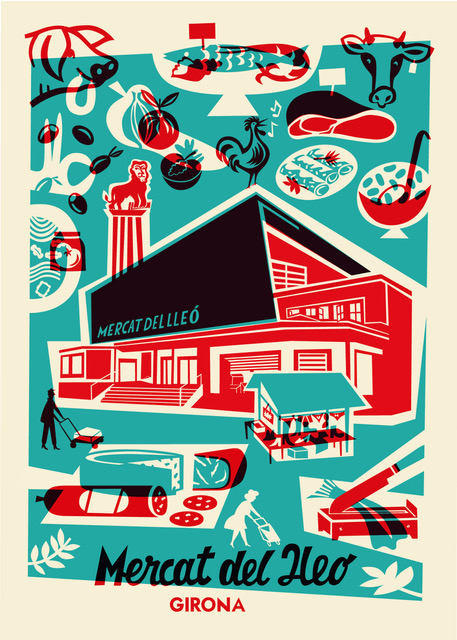
Everyday graphics are transformed into artistic matter in the hands of Alexis Rom (Barcelona, 1971). A form that dialogues with another, a color that alters the balance of the composition or a letter that introduces a new rhythm are some of the elements that articulate his creative universe, halfway between drawing, illustration and design. This research is the protagonist of Afers gráfics , the exhibition that Mosaic Art presents in Girona coinciding with the Sant Narcís Fairs.
Inaugurated on October 22, the exhibition brings together a dozen illuminated signs, all unique examples, and a selection of manual screenprints produced in limited and numbered editions. The works have been made directly by the artist, who combines the technical mastery of printing with an intuitive, playful and free approach to images. The exhibition can be visited until November 21, with the gallery activity also open on November 1, coinciding with the traditional Drawing and Painting Fair .
Rom's work starts from a familiar visual repertoire that, decontextualized and reorganized, acquires new meanings. His aesthetic evokes advertising, commercial establishments and popular culture of the mid-20th century, with compositions of two or three colors in which every detail, texture and superposition contributes to constructing the image. The result oscillates between recognition and surprise, with humor and nostalgia as essential ingredients.
Among his references are Stuart Davis, an American artist who incorporated signs of popular culture into a painting of rhythms and colors close to musical language, and Corita Kent, who explored the expressive possibilities of screen printing based on advertising fragments, signs and everyday messages. These affinities help to understand a practice in which graphics are not only a formal resource, but also a way of thinking and interpreting the environment.
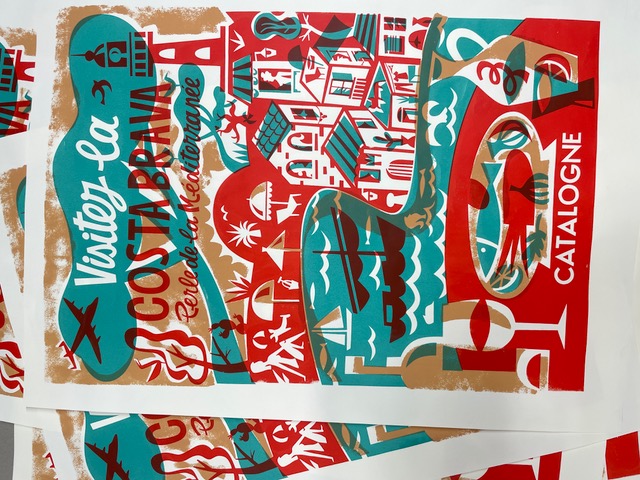
In Afers gráfics , screen prints coexist with illuminated signs, which recover the presence of old shop and bar advertisements, those urban elements capable of defining the character of an establishment and becoming fixed in the collective memory. Figures such as the silhouette of a waiter at the Bar Central, the stars of a variety magazine or the scenes of tables standing in front of Mediterranean landscapes refer to a shared imaginary, reinterpreted with a look that avoids simple nostalgic reproduction.
The link with Girona is made concrete in two editions created especially for the exhibition. The first is Mercat del Lleó. Girona , a series of 50 copies that pays homage to the municipal market, its stallholders and the role that this space plays in the identity of the city. The second, Visitez la Costa Brava, Perle de la Méditerranée , consists of 25 copies and adopts the language of classic tourist advertising aimed at the French public.
With these pieces, Rom claims the capacity of images to activate personal and collective memories. His work recovers a graphic associated with a period and specific ways of life, but also proposes a pause in the face of contemporary visual saturation. Instead of seeking spectacularity, he bets on the evocative power of objects, signs and everyday scenes, transformed into small icons of a shared sentimental landscape.


You may be
interested
...