Exhibitions
The secret memory of matter in Solange de Pessoa
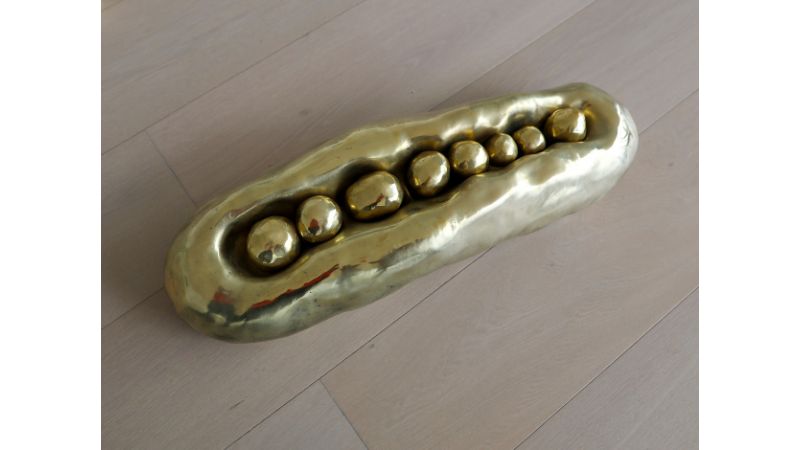
There are materials that seem to retain the memory of what they once were. In the work of Solange Pessoa (Ferros, Brazil, 1961), hair, wax, leather, blood, and minerals cease to be mere physical elements, acquiring a dimension that oscillates between the corporeal, the ritualistic, and the transcendent. Her work delves into a territory where nature is not a landscape to be contemplated from the outside, but a living force that permeates bodies, transforms materials, and connects different temporalities. With *Of Day or of Night* , the Botín Centre in Santander presents, for the first time in Spain, an exhibition dedicated to this artist, whose multidisciplinary practice occupies a unique place in the contemporary Brazilian art scene.
Curated by Bárbara Rodríguez Muñoz, director of exhibitions and the Botín Centre's collection, the exhibition brings together works from different periods, from the research developed during the 1990s to new formal elaborations created in the current decade. The exhibition includes pieces from the artist's studio and from institutional and private collections, as well as two installations conceived specifically for the center's architecture and surroundings. Open to the public from October 10, 2026, to March 28, 2027, the exhibition offers an exploration of a trajectory in which material experimentation is not merely an aesthetic choice, but a form of knowledge.
Since the 1980s, Pessoa has developed a language that encompasses sculpture, painting, drawing, video, performance, and installation. This diversity of media reflects a persistent investigation into memory, life cycles, spirituality, and the relationship between humankind and the natural world. In his works, forms seem to emerge from a realm prior to rational classification: imaginary organisms, vestiges of ancient ceremonies, or presences that allude to both birth and decay. The unsettling coexists with the sacred, and sensory attraction with a certain unease in the face of the physical reality of matter.
Pessoa's universe is deeply rooted in Minas Gerais, a Brazilian territory of great mineral wealth and biodiversity, also marked by colonial history and the legacy of the so-called Mining Baroque. Its rivers, mountains, mines, and cultural traditions constitute a horizon of references that the artist reworks without resorting to a descriptive representation of the landscape. The land appears as an active entity, laden with historical traces and symbolic energies. The organic and mineral materials she incorporates into her works function as fragments of this environment, but also as repositories of time: they preserve traces of transformation, wear, and disappearance.
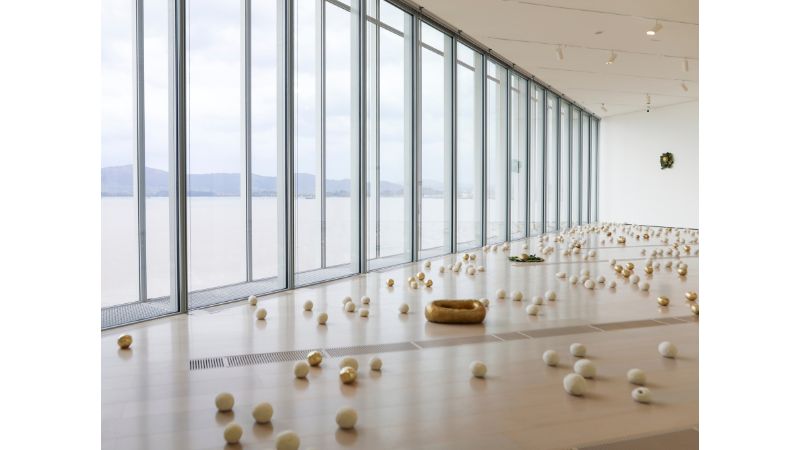
This relationship with the land takes on a particularly significant dimension in a practice that avoids separating nature and culture, body and landscape. Matter is not presented as a neutral support at the service of a preconceived idea; it is matter itself that produces meaning. Its textures, densities, sheens, and opacities articulate an experience that sometimes precedes any interpretation. In contrast to an artistic tradition that has often situated spirituality in the realm of the image or representation, Pessoa seems to seek the transcendent in the physical presence of things, in their capacity to contain that which cannot be fully explained.
The title , Of Day or Night, points precisely to this suspension of stable categories. Light and darkness, human and animal, sacred and profane, dream and wakefulness are not organized as opposing terms, but as forces that mutually influence one another. In the curator's words, one of the most fascinating aspects of Pessoa's work lies in the fact that the spiritual never appears separate from the physical, but rather emerges from the intensity of matter itself. The exhibition thus proposes an experience in which oppositions lose their rigidity and give way to a space of ambiguity and contemplation.
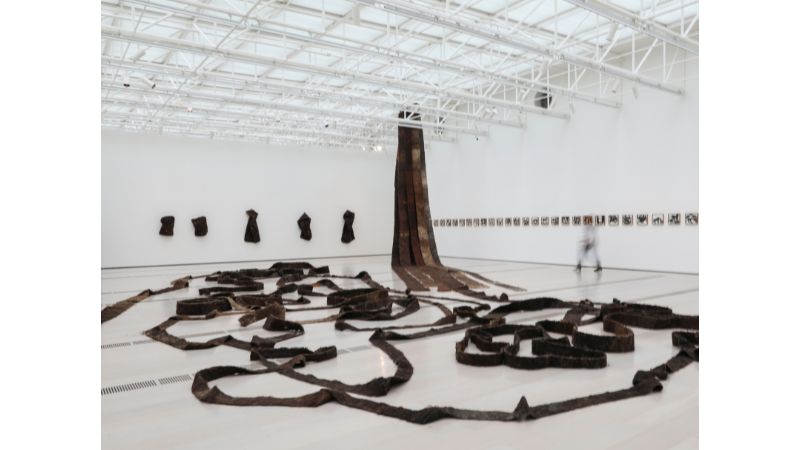
This ambiguity is not merely a poetic device. It constitutes one of the critical cores of his work. Pessoa's works resist a univocal interpretation and challenge the modern separation between the natural and the cultural, the primitive and the contemporary, the rational and the intuitive. His imagery draws on diverse references, from indigenous cosmogonies and African traditions to colonial Baroque, Brazilian Modernism, Land Art , Arte Povera, Surrealism, and prehistoric symbolism. However, these influences do not appear as recognizable quotations or as an ordered iconographic repertoire, but rather as elements subjected to a process of appropriation and transformation.
In this sense, his practice can be related to the tradition of cultural anthropophagy formulated by Brazilian modernism: the critical assimilation of heterogeneous languages and heritages to produce a unique voice. Pessoa incorporates Indigenous, African, and European references without establishing a stable hierarchy among them. His work does not seek to reconstruct an uncontaminated origin, but rather to activate the coexistence of different cultural memories. This operation is especially relevant in a context where narratives about identity, territory, and heritage demand new forms of interpretation that do not reduce historical complexity to a linear genealogy.
The dialogue with the Minas Gerais Baroque and with the work of Aleijadinho, one of its key figures, allows us to delve deeper into this relationship. The sculptures and architectural projects of this artist, linked to the historic city of Ouro Preto, are a benchmark for their expressive intensity, their twists and turns, and their conception of form as a vehicle for spiritual experience. Pessoa shares with the Baroque an inclination towards excess, accumulation, and the tension between physical presence and transcendence. But where Baroque sculpture is typically articulated through religious figures and narratives, his work shifts the center of gravity towards an organic corporeality, less stable and more difficult to decipher.
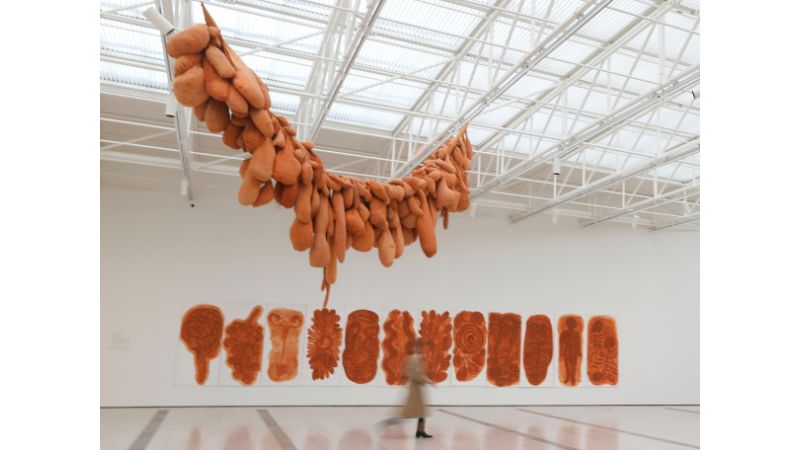
The result is a visceral materiality that shuns idealization. Hair, wax, leather, and other organic substances introduce a physical proximity into the exhibition space that can be both hypnotic and unsettling. The accumulation of elements, the density of surfaces, and the deformation of forms generate bodies that seem to be in a state of permanent transformation. They are neither fully recognizable organisms nor abstractions detached from the living, but rather borderline presences that defy classification. In them, beauty is not necessarily opposed to disquietness, and the aesthetic experience also incorporates vulnerability, decay, and an awareness of finitude.
The choice of these materials also opens up a reflection on time. Unlike supports designed to guarantee the stability and permanence of the work, many of the substances used by Pessoa carry within them the possibility of deterioration. They transform, degrade, and retain the traces of physical processes beyond the artist's absolute control. This condition introduces a temporality that is not limited to the date of production or the history of the artwork. Each piece seems to contain a before and after, a memory that precedes its appearance and a transformation that continues beyond its public presentation.
The exhibition at the Botín Centre is particularly interesting because it connects Pessoa's early research with his more recent developments. This dialogue between periods allows us to observe how certain formal intuitions persist, even as they change in scale, complexity, or configuration. The two new installations conceived for the building and its surroundings further expand the relationship between artwork and space. Architecture ceases to be a neutral container and becomes an active participant in the experience, while the environment is incorporated as a dimension that can alter the perception of the pieces and their resonances.
The proposal also raises a question about the limits of exhibition as an interpretive tool. How can one display a work that seems to resist explanation and finds part of its power in what remains obscure? The answer lies not in deciphering every reference or establishing a definitive meaning, but in creating the conditions for a perception attentive to the relationships between matter, body, and space. The challenge is to prevent the ritual dimension of these works from being reduced to an exotic reading or a generic invocation of the ancestral. Their complexity demands recognizing both the cultural specificity of their references and the formal autonomy with which the artist transforms them.
The exhibition is accompanied by a publication featuring texts by Maria Berbara, PhD in Art History and researcher specializing in art history and visual culture, and by curator and writer Ángel Calvo Ulloa, as well as a contribution by Rodríguez Muñoz. Pessoa also recently led the Botín Foundation's latest art workshop in Santander, an activity that extends his presence at the institution beyond the exhibition space.
You may be
interested
...