Opinion
ETA fifteen years later, the memory that disputes public space
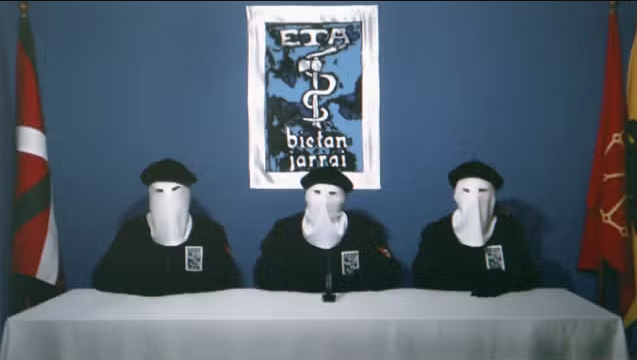
On October 20, 2011, television stations across Spain broadcast news that journalists, politicians, and citizens had been waiting for for over four decades. ETA announced the definitive end of its armed activity. The terrorist organization used a formula that avoided directly naming what it was abandoning: the murders, kidnappings, extortion, and attacks with which it had tried to impose its political project through violence. Fifteen years after that statement, the date remains a point of reference for understanding the recent history of Spain and, especially, that of the Basque Country.
The announcement came amid a profound economic crisis, when the consequences of the recession dominated public attention. However, the statement, read in Basque and Spanish by three masked individuals, marked a historic turning point. After more than half a century, ETA acknowledged the end of its terrorist campaign. Its definitive dissolution would not come until May 2018, when the organization formally announced its demise.
But the end of armed violence did not mean the immediate disappearance of its images, its symbols, or the social fractures it had caused. The memory of terrorism remained present in the streets, in the media, in literature, in film, and in the visual arts. Culture, far from being a mere reflection of political events, had also been a space for ideological dispute, denunciation, and resistance. In this arena, images have played a fundamental role in understanding how the image of ETA was constructed and how its consequences remain in the collective memory.
Walls as a battlefield
Graffiti, murals, and posters linked to ETA and its political milieu have occupied a prominent place in shaping the Basque urban landscape for decades. They were not merely graphic expressions of political demands. In certain contexts, they also functioned as instruments of propaganda, mechanisms for collective identification, and forms of pressure on a society subjected to the threat of terrorism. The symbolic occupation of public space helped to establish who could express themselves, which discourses gained visibility, and who could feel targeted.
The evolution of these images allows us to observe the changes in the communication strategies and political priorities of the organization and the movements within its sphere of influence. During the 1970s and 80s, in the context of the Transition, the streets became stages for political agitation and ideological confrontation. References to socialism, Marxism-Leninism, and internationalism coexisted with demands for Basque independence and solidarity with revolutionary processes in other countries, such as Cuba, Nicaragua, and El Salvador, as well as with references to Ireland and Albania.
In subsequent decades, graphic communication incorporated other issues, ranging from mobilizations against certain infrastructure projects to campaigns related to ETA prisoners and their prison conditions. Among the conflicts that gained greater prominence were the protests against nuclear energy, the Leizaran highway, and the high-speed rail project known as the Basque Y.
However, one of the most disturbing aspects of this visual history was the use of so-called targets. The depictions intended to single out politicians, intellectuals, businesspeople, military personnel, members of the security forces, and others considered enemies by ETA transcended political protest, becoming mechanisms of intimidation. The image thus acquired a coercive function: publicly targeting a person meant exposing them to the hostility of their community and, in the context of terrorism, could precede or accompany a threat against their life.
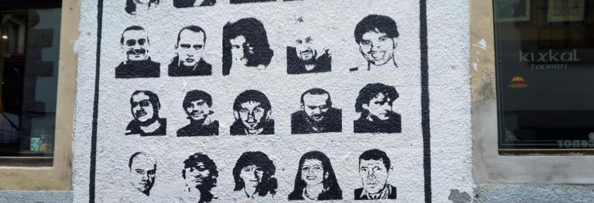
Call for the transfer of Basque terrorist prisoners on a building facade facing a public street.
In his study , Urbanism and Revolution: Graffiti, Murals, and Posters of ETA (1969-2011) , published in 2022, Miguel Ángel Ajuriaguerra analyzes the evolution of these graphic expressions and their adaptation to the social, economic, and political changes of the 1970s, 1980s, 1990s, and 2000s. His research reveals that these manifestations were not static: they modified their content and communicative objectives, although they maintained Basque independence as one of their main political references.
The persistence of certain compositional techniques and forms of intervention in public space also reveals the capacity of visual languages to outlive the contexts that gave rise to them. But this continuity also compels us to ask a question: what happens when an image conceived to mobilize, intimidate, or establish a political identity remains in the collective consciousness after the organization that used it has disappeared? The answer is not solely aesthetic. It has to do with memory, with victims, and with the possibility of critically reinterpreting the signs that have shaped a society.
Art in the face of violence and its silences
The relationship between art and terrorism is not limited to the explicit representation of attacks or the denunciation of their consequences. It also encompasses the ways in which artists have addressed fear, loss, censorship, polarization, and the difficulties in constructing a shared memory. In this sense, exhibitions dedicated to political violence have opened spaces to examine historical images without reducing them to mere illustrative documents of a chronology.
A significant example was 1989. After the Algiers Talks. Delirium and Truce , an exhibition curated by Carles Guerra, then director of the Antoni Tàpies Foundation, and linked to the Peace Treaty project, launched within the framework of San Sebastián 2016 European Capital of Culture. The exhibition brought together around one hundred works by artists such as Jorge Oteiza, Antoni Tàpies, Joan Miró, Néstor Basterretxea, José Gutiérrez Solana, Luis Claramunt, Jeff Koons, Allan Sekula, Ibon Aranberri, Eduardo Nave, Jon Mikel Euba, Iñaki Garmendia, Asier Mendizábal, Asier Pérez González, and Xavier Rivas.
Co-produced by Artium, the Antoni Tàpies Foundation, and San Sebastián 2016, the exhibition offered an approach to the cultural and social consequences of terrorism that avoided reducing the works to mere illustrations of violence. The project examined how the conflict had permeated different spheres of collective life and altered the perception of time, space, and images. The selection also included press photographs by Manel Armengol, Jon Herraez, and Jon Urbe, along with objects that offered insight into the organization's clandestine communication strategies.
Among the exhibited items was a 1976 cassette tape, attributed to an ETA commando unit, whose exterior was marked with a long silence so that, if it fell into police hands, it would appear to be a blank tape. The object encapsulated one of the paradoxes of the history of terrorism: the need to produce messages and, simultaneously, conceal them; to circulate information while still protecting it; to construct a narrative while attempting to erase the traces of its creation.
The exhibition also raised the issue of establishing an unequivocal chronology of violence. In protracted conflicts, images do not always maintain a direct and stable relationship with the events they depict. Time periods overlap, memories transform, and periods of apparent calm coexist with persistent fear. Violence, in this way, not only leaves victims and scarred spaces, but also alters how a community interprets its own past.
The task of art consists, in part, in questioning these images and restoring their complexity. Not to relativize the responsibility of those who perpetrated violence, but to understand the mechanisms by which it was normalized, justified, or incorporated into the collective imagination. Critical distance is especially necessary when political symbols become familiar elements of the landscape and risk losing their threatening dimension.
Agustín Ibarrola, a career of commitment
The figure of Agustín Ibarrola allows us to explore another dimension of this relationship between artistic creation, political commitment, and violence. The Biscayan artist, who died in 2023, developed a career marked by the defense of democratic freedoms, the fight against Francoism, and opposition to ETA. His work was closely linked to the social conflicts of his time, from workers' demands during the dictatorship to the denunciation of terrorism.
In 1955 he moved to Paris and, shortly after, participated in the founding of Equipo 57 along with Ángel and José Duarte and Juan Cuenca. From then on, he developed a socially conscious style of painting linked to the workers' struggles in Bizkaia, featuring images of factories, demonstrations, and episodes of repression. Elongated human figures, often representations of workers, became one of the distinctive features of his artistic language, both in painting and sculpture.
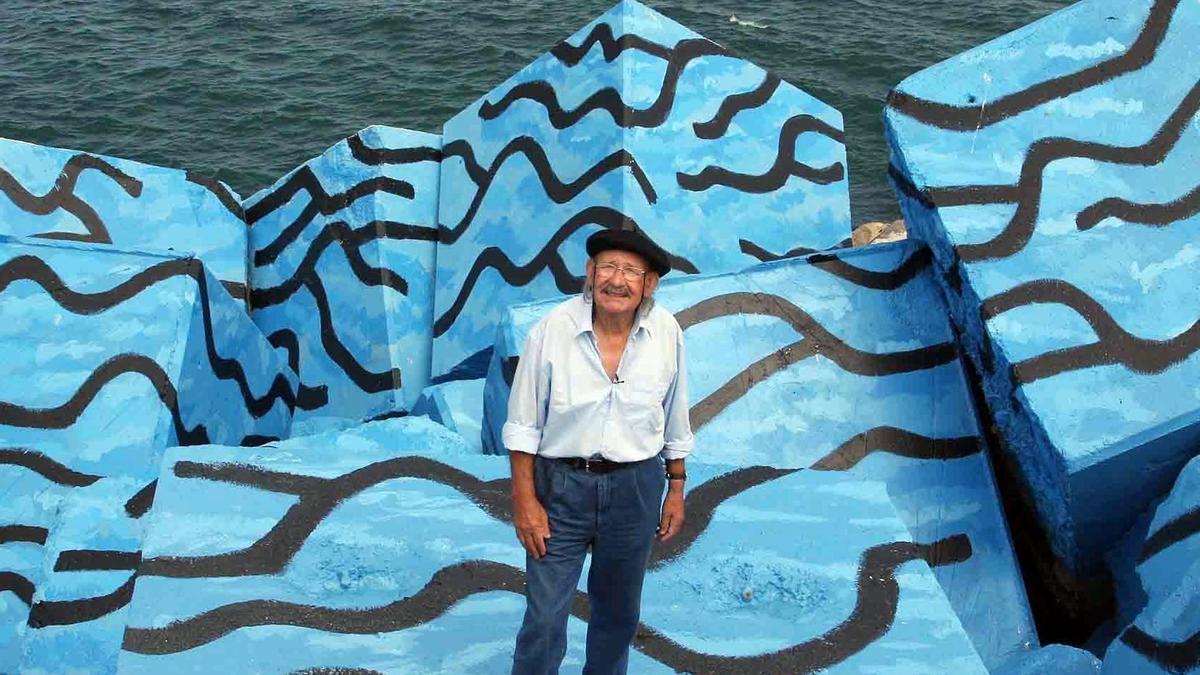
His political commitment had personal consequences. A member of the Communist Party of Spain, he was imprisoned between 1962 and 1965 and again between 1967 and 1973. Not even imprisonment completely halted his creative activity: he continued working and exhibiting abroad. In 1975, a far-right group set fire to the farmhouse he used as his home and studio, an incident that highlighted the vulnerability of those who publicly defended their ideas in a context of political violence.
Ibarrola's opposition to ETA continued this trajectory of commitment, albeit in radically different circumstances. His participation in civic initiatives against terrorism and his involvement with the Ermua Forum expressed a defense of freedom against intimidation. He also designed graphic identities for organizations with which he was involved, including the Workers' Commissions (CCOO) and the Ermua Forum itself.
His son, José Ibarrola, summarized this relationship between creation and public responsibility by recalling that his father was deeply committed to his time, to society, and to art, understood as a human, not divine, activity. This conception allows us to situate his work beyond a purely formal interpretation: for him, art was a way of intervening in the world and of confronting the contradictions of collective experience.
The sculptures he dedicated to the victims of terrorism are a particularly significant expression of that commitment. Faced with a violence that had sought to impose silence and identify enemies, artistic creation could offer a space for recognition and mourning. It did not, in itself, repair the damage nor replace justice, but it helped to make visible those who had suffered the consequences of violence and to remind us that no political cause can justify murder.
Fifteen years later, the responsibility to remember
Fifteen years after the announcement of the definitive end to armed activity, the question is no longer solely about reconstructing ETA's history, but also about examining how it is transmitted, what images remain, and what narratives are incorporated into the public consciousness. The organization's dissolution did not end the need to critically interpret its legacy. The disappearance of armed violence opened a new chapter in which the work of historians, journalists, artists, writers, and cultural professionals acquired a new dimension.
Culture cannot replace historical research or legal accountability, but it can help society understand the ways in which violence permeated daily life. A piece of graffiti, a poster, a press photograph, a cassette tape, or a commemorative sculpture can reveal different aspects of the same story. Each object raises questions about who created it, who it was intended for, what it aimed to achieve, and how it should be interpreted from a present-day perspective.
Memory is not neutral territory either. The selection of images, the preservation of certain documents, and the decision to show or hide certain symbols are all part of a cultural responsibility. Contextualizing does not mean legitimizing; studying propaganda is not the same as reproducing it uncritically; remembering the victims requires preventing their stories from being subordinated to a narrative that presents terrorism as a mere succession of political events.
The challenge lies in keeping this reflection open without diluting responsibilities. Recognizing the historical complexity of the Basque Country does not require establishing equivalencies between those who perpetrated violence and those who suffered it. On the contrary, a democratic memory needs to distinguish between political demands and the use of terror to impose them, between artistic expression and intimidating propaganda, between disagreement and threats.
In this sense, art can contribute to building a collective memory that goes beyond simply commemorating dates, examining the human consequences of violence and the conditions that allowed it to persist. Artworks, archives, and images do not offer definitive answers, but they keep open questions that a democratic society should not abandon.
You may be
interested
...