Questions
Taking for granted the transfer of the medieval murals of Sixena from the MNAC to Aragon, I wonder, as a restorer and artist that I am, what will happen to them, where will they end up. I hope that the paint losses will not be too much, that they will be in irrelevant places, in a background, in an ornamental element and not in the middle of a face. I am curious to know if they will be fixed on a support that will reproduce the shapes of the architecture, or if they will be placed flat, like a painting. I would like to see how they will react to all the manipulations to which they will have to be subjected, to the different environmental changes. But the paintings are more than just remnants of matter that has survived, their purpose is to give meaning to a space, transmit certain messages, awaken emotions, so I also speculate about their role in the new location, whether their relationship with the architecture can be restored and the images can be made more accessible and understandable.
In this writing I reflect on mural painting and its particularities, on the medieval ensembles torn down and placed in museums, on what was in the past and what is now, and in what ways we have mediated between these two points, to project some idea, some truth of something that reaches us disfigured from its journey through time, crossed by all kinds of stories.
Foreign trees
It is easy to find an image of the chapter house of the Royal Monastery of Sixena on the internet, before the fire that damaged the medieval mural paintings. It is a watercolor made by the painter, collector and art lover, Valentín Carderera¹, in 1870. It is an artistic representation, in the romantic style of the time. At the back of the room you can see the door with its tympanum decorated in relief. In the foreground and next to a long bench are two nuns conversing, in front of which is a small table with a lectern and an open book. On the wall you can see a high plinth with an ornamental mural covering, which could be a fabric or a guadamassil. At its top, paintings framed in gold. On the ceiling, the arches are all painted and between them you can see parts of the disappeared Mudejar coffering. The room is bathed in a soft, somewhat zenithal light, from high openings. The watercolor does not have enough detail to recognize the shapes and figures of the paintings, but it gives an idea of the chromaticism and the ornamental richness of the whole. Nor can the appearance of the coffered ceiling be recognized, but a fairly plausible recreation has recently been made that shows the virtuosity of the carving and a rich polychrome with gilding. The room must therefore have been spectacular.
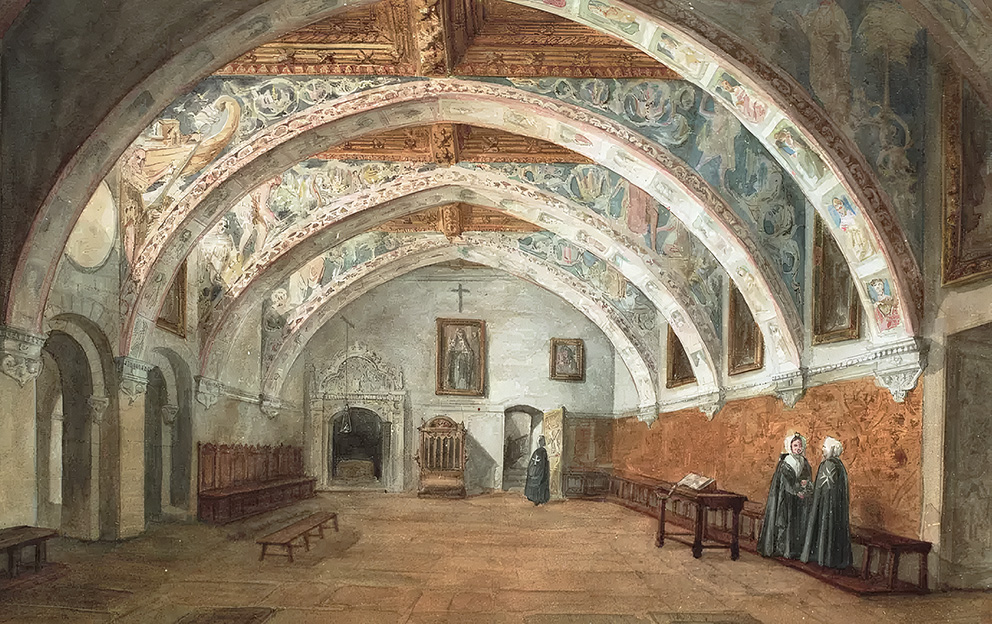
Chapter House of the Royal Monastery of Sixena. Watercolor by Valentín Carderera, 1870.
In July 1936, at the start of the Civil War, a fire turned Carderera's watercolor into an essential historical document, as well as a series of photographs, drawings and reproduction exercises of medieval paintings that were made before that date. The fire was devastating, collapsing the coffered ceilings, irreversibly damaging the medieval mural paintings and compromising the entire monument ( image 3 ). What remained of the frescoes was left exposed until the arrival of the historian Josep Gudiol, months later, who tore them up and took them to Barcelona, where he directed their restoration, carried out by his brother Ramón Gudiol. In this, large gaps or areas of lost painting were reconstructed, based on a photographic report that he himself made, before the fire. Later, the paintings were taken to the Palau Nacional and publicly exhibited in 1961, when the Palau became the Museu Nacional d'Art Català².
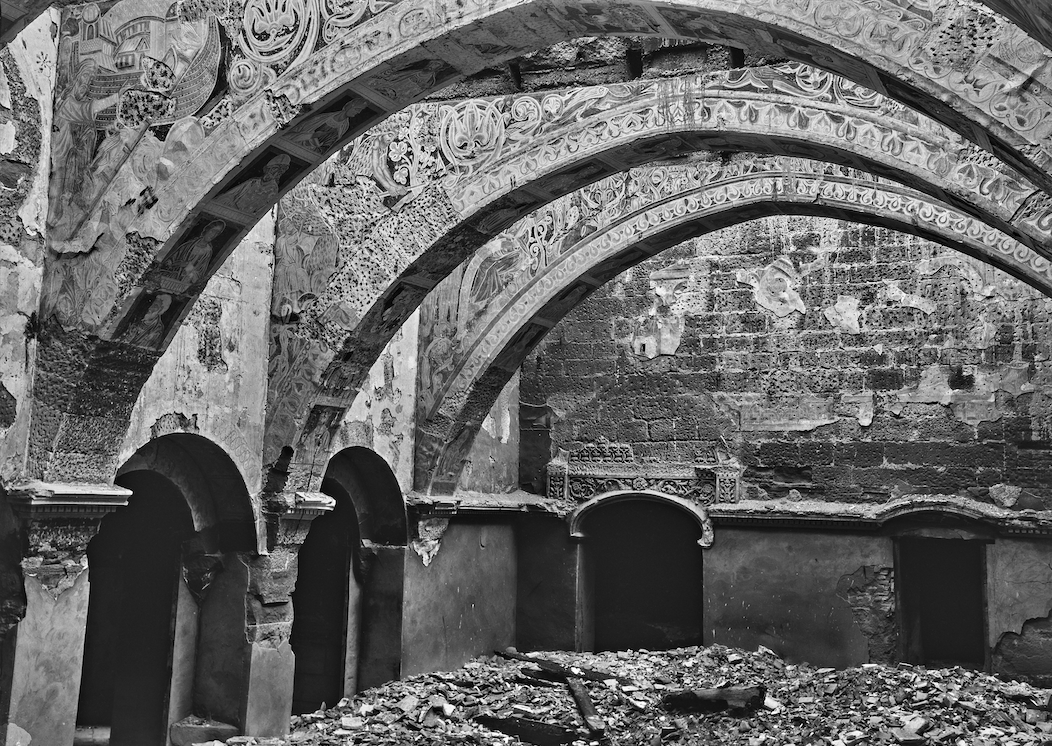
Chapter House of the Royal Monastery of Sixena immediately after the fire, 1936. Photograph by Josep Gudiol. (Photographic archive of the Amatller Institute of Hispanic Art.)
In recent years, and with new technological resources, studies of pigments, tests and reproductions in digital formats have been carried out which have also allowed a lot of information to be collected and are conclusive about the appearance of the mural paintings when the paintings were made³, around the year 1200.
However, for the public approaching the MNAC, its contemplation is a challenge. Between the arches, where the Mudejar coffered ceiling of polychrome wood used to be, there is a large gap. The loss of mural painting is very significant, so that the continuous reading of the narrative is also not possible. The large gaps reconstructed by Ramón Gudiol are made with a clean and defined line drawing for both the figures and the shadows, and monochrome areas for the backgrounds, so that they are differentiated from the originals while, in a first global vision of the whole, they are perceived more or less integrated. The result is that, while it is true that it provides more visual continuity and an improvement in the recognition of the iconography, it also confuses the visitor, who questions the authenticity of what he sees. But what is most disturbing and difficult for the enjoyment of the paintings is the extensive and intense alteration of the colors, due to the high temperatures, flames and smoke during the fire. Thus, what should have been a rich palette of blues and greens, with reds, yellows, whites and blacks, has been reduced to a variety of imprecise hues, shadows, ochres, blacks and greys. The false chromatic perception of the whole is also reinforced by the reconstructions, which, in order to camouflage themselves among the originals, imitate these hues.
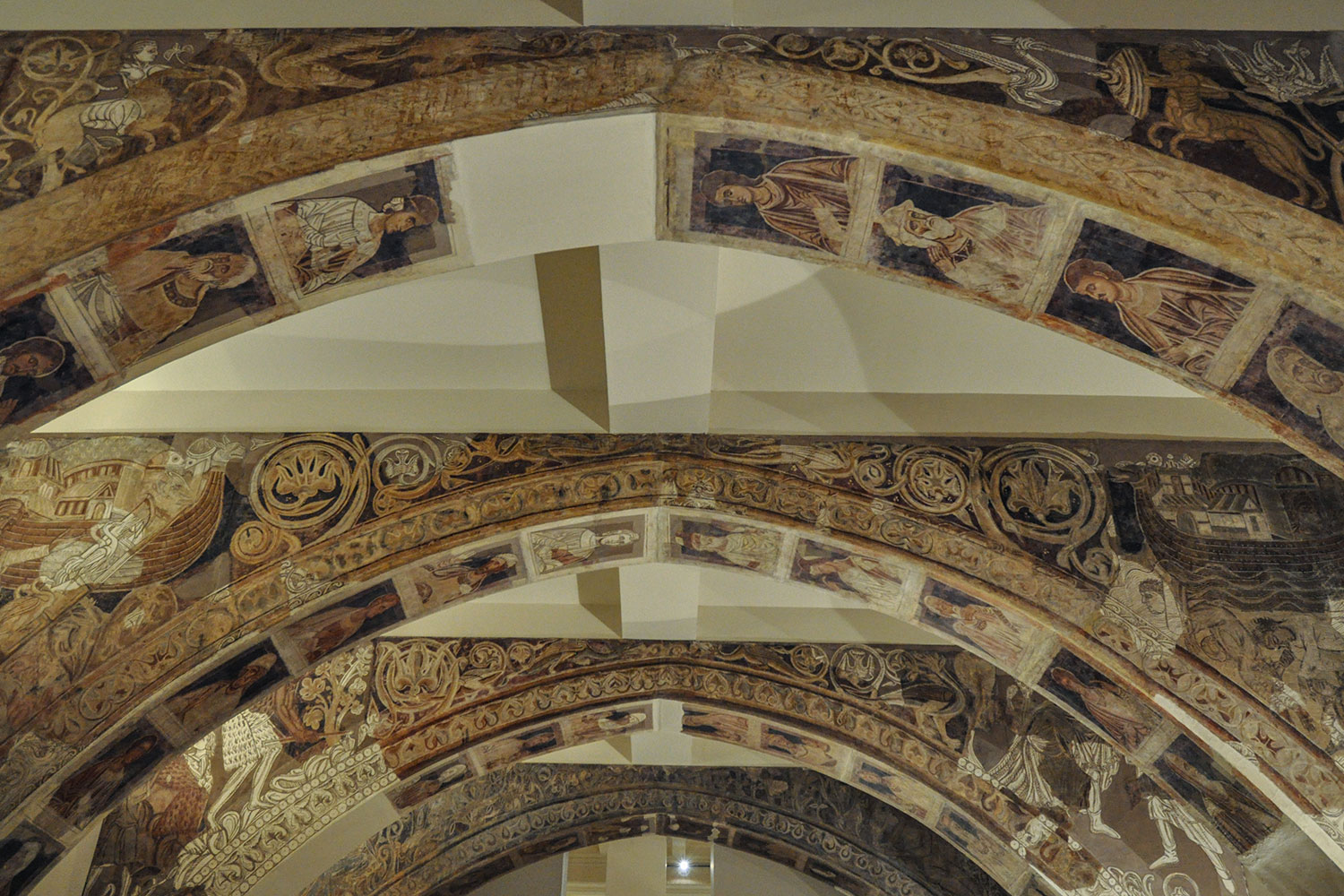
Mural paintings by Sixena exhibited at the National Art Museum of Catalonia (MNAC).
For the visitor who enters the Romanesque rooms, even more obstacles await him. First, the unbridgeable abyss of time. As much as we know about the historical and social context, almost everything remains in the shadows. Just as time, place and surroundings are essential for the perception of a work of characteristics such as Sixena's: light, climate, noises, smells. What was the landscape like a thousand years ago, who inhabited it? What was its relationship with people? All this configures minds, ideas, emotions, actions that we do not know and that we can only imagine from the biased perspective of our own historical condition. The disappearance of the referents of time and space are losses that are difficult to value, because what is not missed is what has never been had. Gaps that are accepted as natural, as if the paintings had been born in the museum.
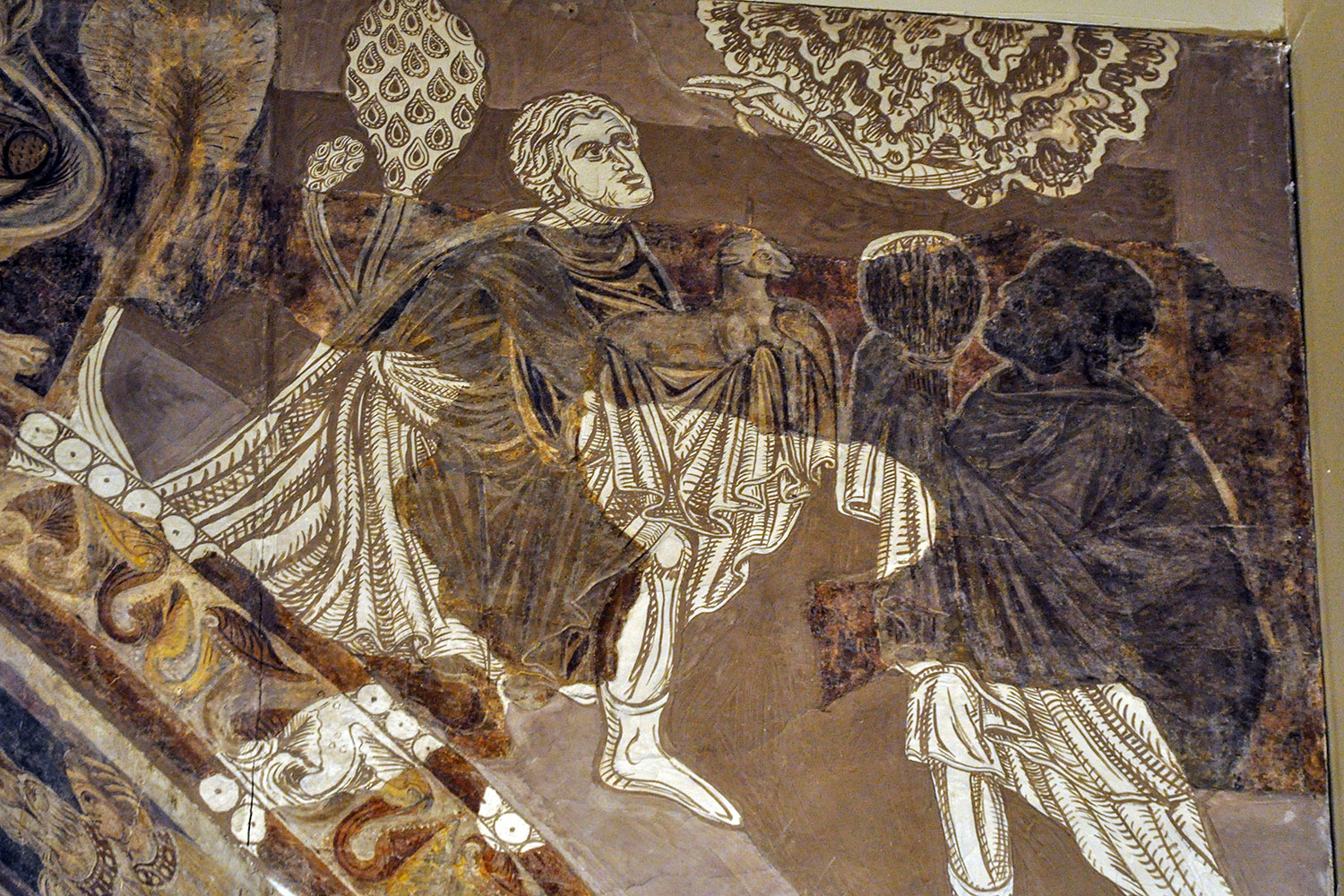
Offering of Cain and Abel. Detail of the reconstructions made by Ramon Gudiol in the late 1940s.
But neither Sixena nor the other murals in the MNAC were born in the museum. They are works that are not where they belong, closely linked to a construction, in a symbiotic relationship of reciprocal subordination. Their support is the walls, columns, arches, ceilings. Their images are virtually projected into the volumes that these elements create. These are images whose two-dimensionality is only an illusion, because the space and the different spaces contained within it are flooded with their shapes, colors, filling them with meaning. In this unit, the mural also requires interaction through physical displacement, to wander and retrace the story posed in the successive scenes delimited by the architecture and decorative pictorial elements, such as borders, zigzags, checkers, inscriptions, etc. For all this, the relationship between painting and architecture is one of life or death. Broken, the spell is broken, the spaces are stripped of colors and symbols. The painting, for its part, will be flat from now on.
The suffering of the painting is not only semantic, but also physical. Its removal is an extremely drastic and irreversible intervention, which always entails damage and loss, and which is only justified in extraordinary cases. After the removal, the painting will still go through many other complex and potentially dangerous manipulations, until its “transplantation” to a new support, in a new location.
Sixena's paintings are an example of these forced transplants to survive a scorched earth, culturally ruined after the Civil War. Barcelona and the MNAC were the place of adoption. They can now be seen fixed on panels in a simplified volumetric reproduction of the monastery's chapter house, which, unfortunately, cannot evoke the original space or environment, but which, nevertheless, have been able to take root there thanks to the care and will of the technicians over all these years, to the different research and studies that historians and restorers have carried out, and to the gazes of visitors. For all this, the paintings have made new connections and one could say that they have rebuilt their lives after the trauma of being uprooted. Paintings are not just pigments and lime, consumer goods, material to study. Paintings have a life of their own, they tell us about things, people and places. Just as trees provide shade in the heat, their presence moves us and their removal leaves a big hole.
In this strange and fascinating forest of foreign trees that are the Romanesque rooms at the MNAC, most of the paintings have had a similar fate to those of Sixena. The loss of the original architecture and environment has been resolved in some cases with a reproduction in the original construction, either on a new support fixed to the walls, or directly on them. The aim is to re-establish the architecture-painting relationships and bring the monument closer to its original physiognomy.
Following in the painter's footsteps
The reproduction of a mural ensemble such as that of Sixena has been conceived in different ways. It has often been chosen to do it as a copy, counting on the solidity of the values of literality, and with the transposition of its elements point by point, as an echo of the museumed remains that return to their original wall. This has been the case of several frescoes in the MNAC, with replicas made using sophisticated photographic processes (Santa Maria d'Esterri d'Àneu 2003, Santa Maria de Mur 2007-2008, Santa Maria de Taüll, 2013). But the reproduction has also been considered as a space for interpretation, seeking to provide new elements for the understanding and enjoyment of the monument. This would be the case of the work carried out in Sant Climent de Taüll (2013), a multifaceted operation, including various conservation and restoration interventions, and a video mapping that is projected onto the apse. The result combines several virtues, that of the exhibition of the restored apse, showing the remains of original plaster and painting, while, in an immersive audiovisual experience, it allows us to learn about the process of construction of the paintings and the vision of the entire set, in a hypothetical reproduction, highlighting iconography, ornamental elements and other details of the painting, in line with contemporary museography.
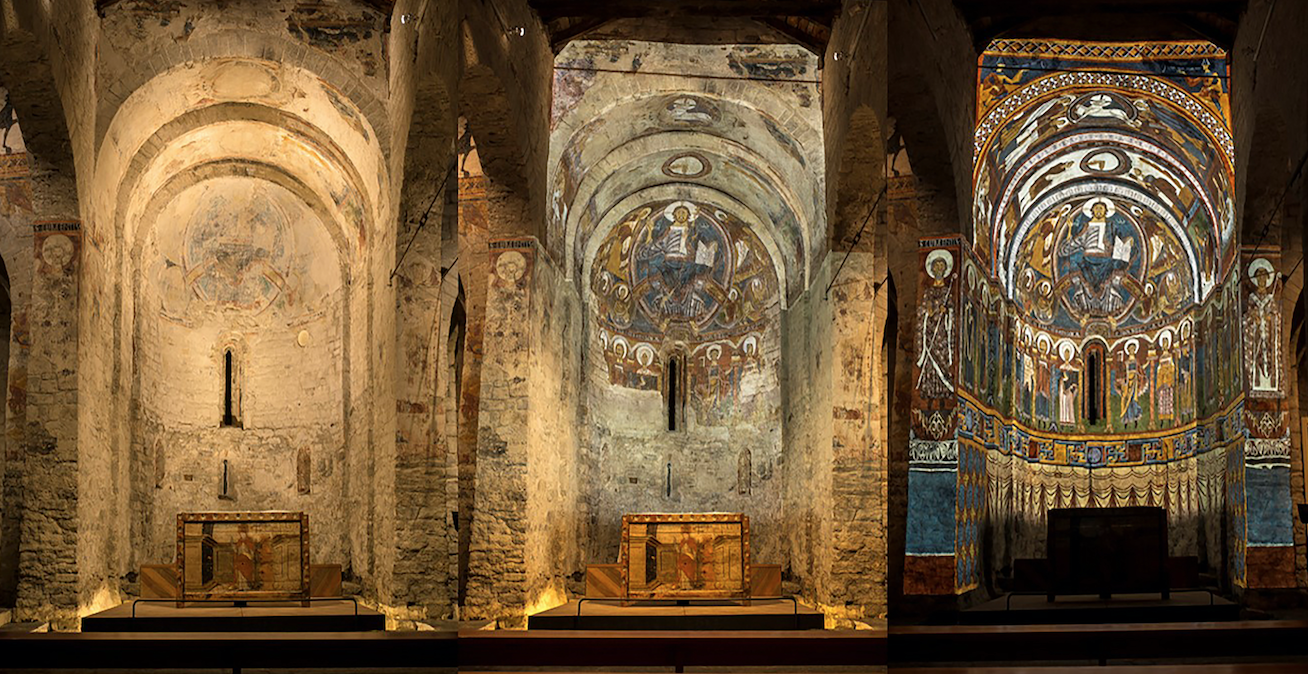
Apse of the church of Sant Climent de Taüll. Restoration and video mapping, 2013. From right to left: 1- apse with the remains of original painting and the preserved plasterwork, 2- projection onto the apse of the paintings torn out and exhibited at the MNAC, 3- projection of a hypothetical restoration of the medieval complex.
Interpretation and reproduction work based on photographic processes, digital technology and artificial intelligence has its precedent in manual reproductions, made with paint and brush. Although these have some important drawbacks, such as their unlikely reversibility, impossible cloning and the high risk of a bad result due to poor practice (painting is a risky practice), they open the door, on the other hand, to a privileged area for exploration and learning. The privilege lies in the fact that the manual reproduction of the painting also requires a certain recreation of the conditions that made it possible. In this simulation, the restorer experiences the monument in all its physical dimension: he occupies it, sets up the scaffolding, registers and measures in detail its entire mural surface to locate remains of painting and other clues to fit the composition and the scenes. Like the medieval painter, the restorer plans and supplies himself with the necessary materials in a remote mountain church, predicts the weather, experiences the climate and the landscape. At work, he prepares the colors, looks for the brushes, does tests, gets dirty and gets tired. On top of the scaffolding he is always alert and oriented. He knows the holes and that dancing wood. He cannot allow himself to fall or let his tools or paint fall. In the fresco technique, time is a countdown. It starts and ends without breaks. The day's work is carefully planned, taking into account the painter's strengths. Fatigue can make him make mistakes, simplify or take unorthodox shortcuts, but also, depending on how, optimize resources or improvise creatively. In mural painting, the body is the measure, and not the hand that paints. His capabilities and limitations are reflected in it. Therefore, when the restorer repaints, following in the painter's footsteps, he ends up encountering similar situations and dilemmas, which help him understand the intertwining of his actions.
The intervention in the church of Sant Joan de Boí, in 1997, is an example of a manual reproduction, conceived in this spirit. The paintings occupied the entire walls, arches and columns, conserving a large number of fragments of different sizes, the most important of which without knowing which walls they came from. The reproduction allowed, combining the interdisciplinary collaboration of historical, photographic and archaeological documentary research with the practical learning in situ of the restorers, to determine the location of all of them, also to recognize the way in which the painters constructed the figures and their particular treatment to modulate the light, to understand the relationships between color and shapes and to formulate new hypotheses about the compositional structures. The experience, methods and knowledge acquired in Sant Joan de Boí were the basis for the video mapping in Taüll, in 2013.
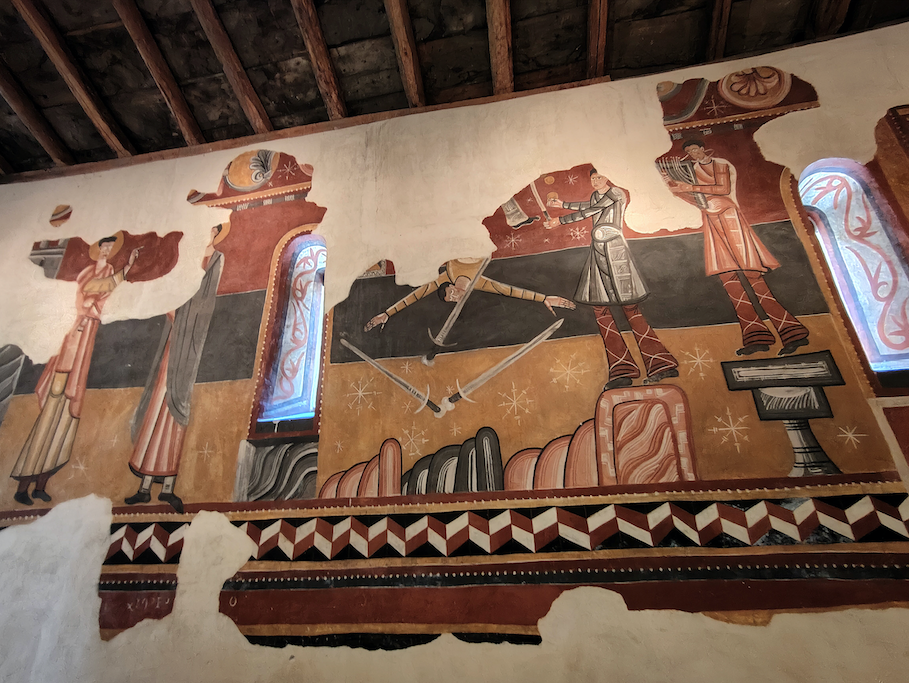
North wall of the church of Sant Joan de Boí. Manual reproduction of the minstrel scene. (Photo: Arcor SCP, 1997.)
For all this, reproduction, whether manual/crafted, or a hybrid museographic operation, is a comprehensive repair. It brings together restorers, historians, artists, architects, archaeologists and politicians who, for a time, focus on this reconciliation. On the one hand, it can restore the painting-architecture-environment relationships without incurring any falsehood, on the other it is an exceptional momentum to deepen the knowledge of the monument and make it understandable, mediating between past and present.
Gods, angels, prophets and all kinds of wonders
Rethinking Sixena. From the romantic interpretation that Valentín Carderero made of the chapter house of the Royal Monastery of Sixena in 1870 to the installation of the murals in the Palau Nacional, conceived by Gudiol in the 1950s, there are all kinds of paths to build a new reality that makes possible the contemporary reading of the monument and allows it to acquire a new existence in the present. Quite a challenge, now having technological means that we did not have not many years ago. But, in this operation, what role will the remains of the original painting have? Will their contribution justify the inevitable losses? We must also think about the large areas reconstructed by Ramón Gudiol. Will they also be moved with the originals and exhibited with them? This intervention has a value that is difficult to calculate. On the one hand, these are reconstructions made under criteria very different from those of today, so extensive that they can represent up to 35% of the total surface area of the set exhibited at the MNAC ⁴ , but essential for the reading of the work and keys to the history of restoration in our country and for the history of the work itself. On the other hand, they are the closest we have to the original, more than any document, written, drawn or photographed, not least because of what they may contain of the poignant memory of Josep Gudiol, who was there himself, shortly after the fire. He himself writes that he cried when he saw the chapter house of the Sixena monastery full of rubble, without roofs, the plastering peeling off, the tombs desecrated. Gudiol played a very important role in saving artistic heritage during the Civil War and immediately afterwards. When he returned from exile, he presented a defense report ⁵ before a court that accused him of theft. It is a very sad text, where he remembers, day by day, what he experienced, describing an endless list of destruction. A story that cannot be omitted, as cannot be omitted the relationship of the paintings with the city of Barcelona.
Like these, other stories also run through the murals of Sixena. Stories of royalty and splendor, of decadence and wars, of the trauma of separation, of reparation and recognition, finally the story of a return and a territorial conflict. Above all, however, above history, peoples and territories, Sixena's paintings tell us about art, painting and painters who one day, oblivious to our debates, to our conflicts, landed in Sixena to represent, with brushes and paint, fantastic plants and animals, gods, angels, prophets and all kinds of wonders.
Notes
1- Valentín Carderera, Sala capitular del monasterio de Sijena, watercolor, 1862, in Manuel García Guatas (ed.), Los álbumes de Pedrola: apuntes y acuarelas de Valentín Carderera en los albumes del palacio de los duques de Villahermosa de Pedrola, Zaragoza, Institución Fernando el Católico, Diputación Provincial de Zaragoza, 2017.
2- Between February and March 1936, Josep Gudiol participated in the photographic documentation of the mural paintings of Sixena. After the fire of the monastery, in July of the same year, he returned there in October and promoted the operation to save the preserved paintings. The removal, carried out with Antoni Robert and Antoni Llopart, began on October 23 and was completed on November 6, 1936. On November 8, the paintings were transferred to the Casa Amatller in Barcelona for their treatment and conservation. The work of transferring, assembling and restoring the paintings of Sixena resumed between 1948 and 1949. The intervention included the reconstruction of the lost parts, carried out by the Gudiol brothers. See Guillem Cañameras Vall, «Josep Gudiol i Ricart (1904-1985). Salvation of artistic heritage beyond Sixena», Bulletin of the Catalan Society of Historical Studies, XXVIII (2017), pp. 441-470.
3- The Sixena paintings have been the subject of several technical studies and digital reconstructions. Rosa M. Gasol Fargas studied the materials and pigments during the 1990s, and in 2009 she produced a first virtual chromatic reconstruction. From 2007 onwards, Juan Naya promoted the Sigena Mágica project, which, since 2016, with Burzon*Comenge/Dreamdigital, has developed the digital reconstruction of the paintings and the chapter house in 3D and virtual reality, based on photographs prior to 1936, the watercolors from 1918, the analysis of materials and other documentary sources.
4- The entire chapter house occupies about 132 m² and approximately 35% corresponds to the reinstatements of the Gudiol brothers. In specific terms, the MNAC estimates that these reconstructions affect approximately 45% of the flat surfaces of the arches and 25% of the soffits.
5- Gudiol i Ricart, Josep Maria. «In his defense: Josep Gudiol's intervention in the rescue of the Artistic Heritage during the Civil War». In: Arturo Ramon and Manuel Barbié (eds.), Three writings by Josep Maria Gudiol i Ricart. Barcelona: Opera Minora, Opera Minora Collection, no. 1, 1987, p. 85-115.


You may be
interested
...