Opinion
Altars and counterculture
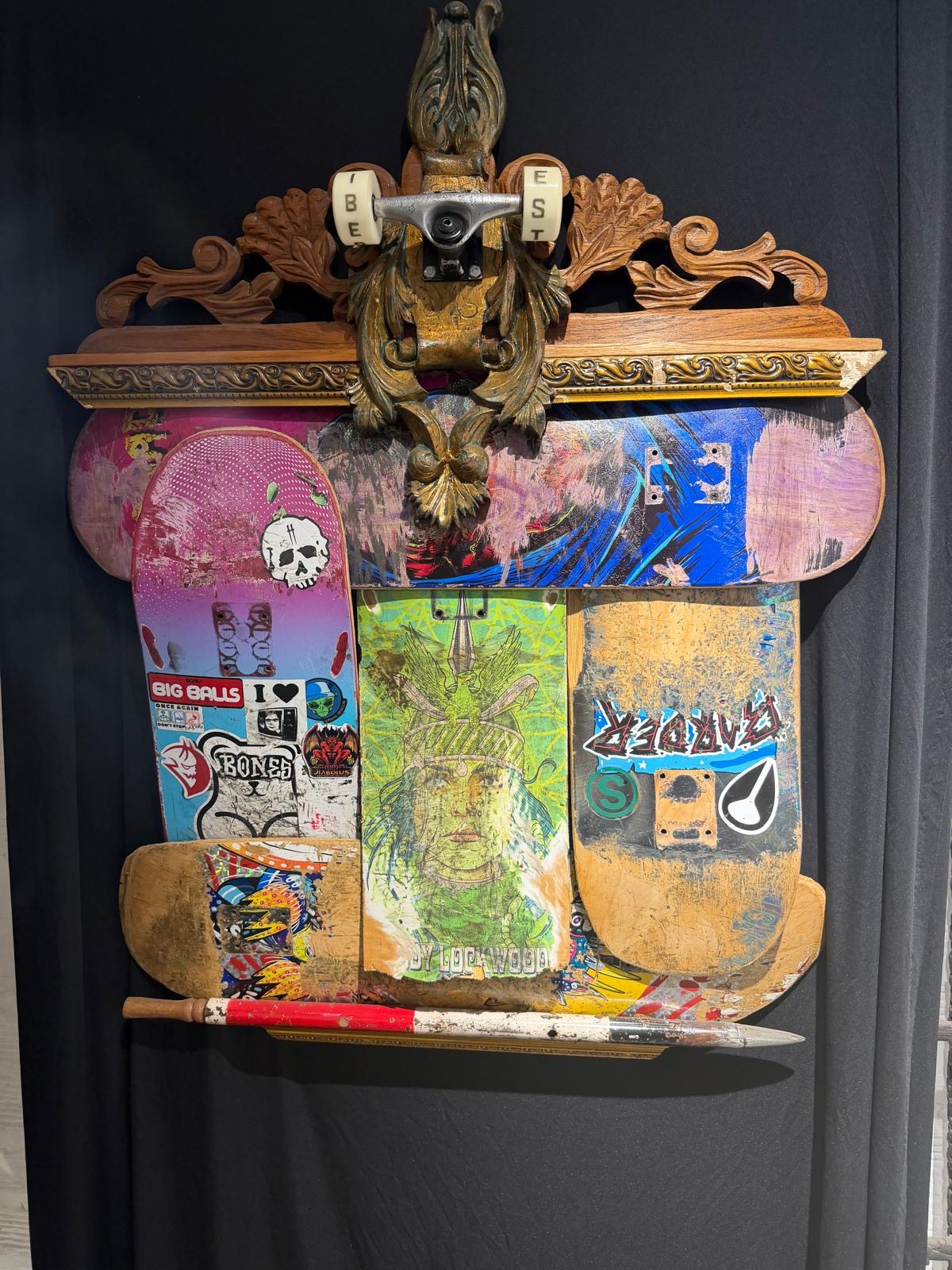
The work of Alejandro Tobón (Medellín, 1978) always brings to our time imagery from the past, recovered and reinterpreted by him, reappropriating the city and its architecture, rescuing antique furniture, and constructing fragments of different eras into a single piece. A prime example is the memorable and viral Las Nieves Pavilion during the Bogotá Biennial, which, in the heart of the capital's historic center (7th Street and Jiménez Avenue, at the corner of the San Francisco Church), juxtaposed a giant, spherical Republican-era building with the iconoclastic gesture of graffiti and urban art tags, which the public then embraced.
These unusual dialogues across time unsettle Tobón. What other connection could we find between skateboards and the religious art of the Latin American Baroque? The first answer might be Tobón's favored material: wood. The constant way he reuses it demands that the object that once served one purpose be transformed to give life to a different one. Dismembered chairs, worn desks, dying windows, faded frames, confessionals with sins already forgiven are now carefully dissected to create new, complex, and unsettling structures that reveal a luxurious past now reduced to relics. The nobility of oak, mahogany, and cedar, which materialized the ostentation of a bygone era, are now mere shadows of what they once were. As in a Baroque vanitas painting, luxury and vanity never manage to postpone death and oblivion. If all this is what the wood that Tobón carves, sculpts and reshapes with the precision of a cabinetmaker tells us, then his work materializes the irony of power.
In Monuments of the Future , Tobón equates the altars of the Quito school during the Latin American Baroque with the appropriation of urban movements and countercultures in 1980s Colombia. In both cases, the lack of access to technique and materials resulted in a unique form of creation. The skateboards of the 1980s in Colombia were merely a makeshift imitation recreated from the few images circulating from the United States, in the same way that the Latin American Baroque created its iconography by attempting to emulate what little was known of European sacred art. The dissemination of styles from centers of power leaves its respective version in the distorted reinterpretations of the colonies, always marked by inventiveness, resourcefulness, and a certain precariousness that generates a hybridization. Its Creole version. For Tobón, these hybridizations are present in every aspect of our lives: they appear in the religious and the sacred, in the street and the public sphere, in the intimate and the private. Hybridizations that expose our incongruities, as symbolically stated in the sculpture that refers to the anatomical structure, meticulously constructed from skateboard fragments.
The skateboard's axles embody the vertebrae, which, connected to one another, form the spine—a symbol of complex social and power structures, as evidenced by each of the inscriptions engraved on them by Tobón. The placement of these texts on the spine is not random: the sacrum is the foundation of the sacred and ancestral; the lumbar region is oppressed by the ominous weight of politics; the thoracic spine, for breathing, is infused with the rebellious spirit of the streets; and the cervical spine is activated by the substance of delirium. In their incongruities and hybridizations, the union of these vertebrae represents the irony of our society in all its complexity.
Each era creates its own imaginaries. Tobón contrasts the ornamentation and design of the past with the contemporary language of graffiti and skateboarding, which in recent years has gone from a subculture to an established and popular style. There is a glimmer of hope that perhaps what was once marginalized will become the monument of the future.

You may be
interested
...