Exhibitions
The Mayoral gallery confronts works of art beyond time
Vicenç Altaió brings together works by Picasso, Miró, Calder, Tàpies, Dalí, Chagall and contemporary artists at Mayoral in an exhibition that dissolves the borders between eras and proposes a journey between origin, love, destruction and death.
The Mayoral gallery in Barcelona has not settled for little when choosing an exhibition for the Barcelona Gallery Weekend 2026 program. Its commitment includes a good fraction of grandiloquence in the best sense of the word and another of risk, fleeing from collective exhibitions made up of gallery funds that too often seem like a purely commercial display of available material, more similar to a fair stand display than an art gallery. But none of this corresponds to what the exhibition Permanent Present offers, curated by the multifaceted writer, curator, cultural manager and trafficker of ideas, Vicenç Altaió, and which can be seen until January 9, occupying the two rooms of the gallery.
The title of the exhibition is a complete declaration of principles. If the present is permanent, this means that time is not linear. Rather than following a path with a beginning and an end in a single direction - that "always moving forward" that the long-lost Arnau Puig always spoke of -, the works of art from all eras remain in a fixed interval, which is precisely ours, that of this very second. The mixture of works from different eras and styles is not so much a dialogue as a more or less peaceful, more or less forceful coexistence. "The works dialogue with each other and the times with the times", says Altaió. Paradoxically, there is an internal narrative in the exhibition, especially if you visit by entering from the historic Mayoral door and exiting through the adjacent one: it goes from birth to death, from the origin of life to the mystical end, from one universe to the other.
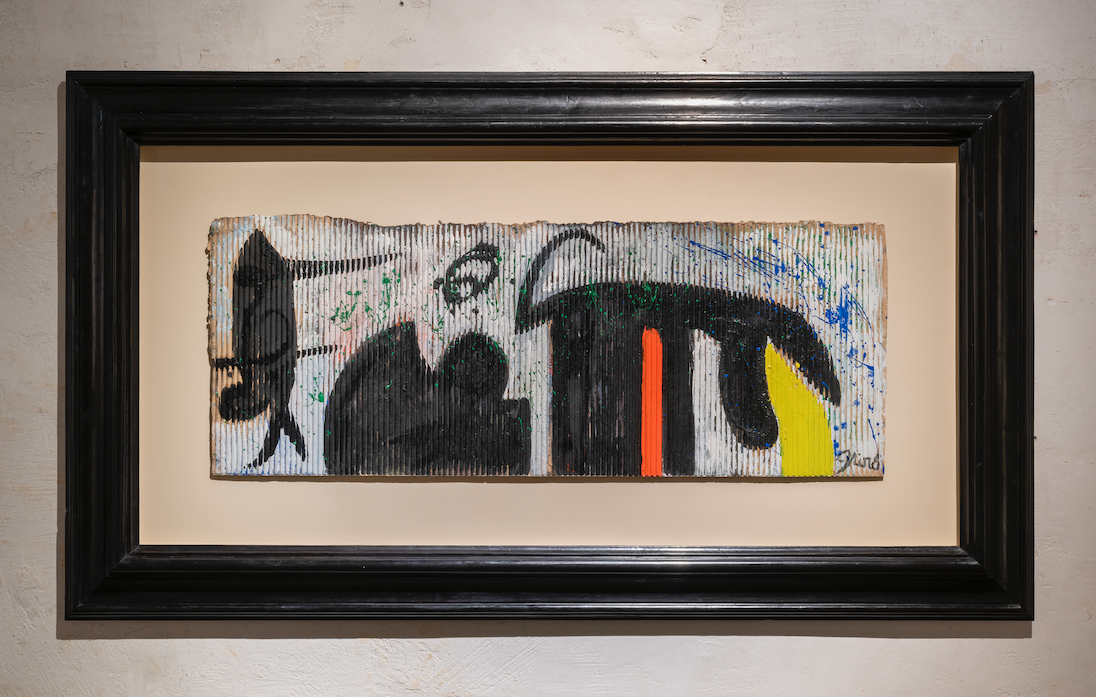
Altaió has chosen, both at one end and the other of the route, to directly confront a work by a young artist with a great name in the history of 20th century art. A work by Marria Pratts (1988), a child of graffiti and children's art - a fetish artist of young art promoted by Mayoral -, crossed by a neon sign, is installed facing the street in what is the conceptual beginning of the exhibition. It dialogues with a work on paper by Alexander Calder, starring circles and organic and cosmic forms, present in this part of the exhibition in other works by Regina Giménez or Mari Chordà. A splendid work by Niki Saint-Phalle is confronted with her master Joan Miró. It is a prelude that alludes to the concept of the origin of the universe, of reproduction and birth.
And on this timeless path, the central corridor of the first room of the gallery hosts works where artists reinterpret the human figure with small drawn portraits of Picasso and Magritte, among others.
The other stage of this vital journey is dedicated to love, couples and sexuality, presided over by a print of a portrait by Picasso of Dora Maar, here less in a suffering attitude but treated more like a Romanesque virgin. A female portrait by Ramon Casas defends the Ben Plantada model of the noucentista ideal. Marià Andreu, in a magnificent oil from 1926, evokes the game of love with a couple playing cards, and Marc Chagall draws the triumph of love. Again different times touch.
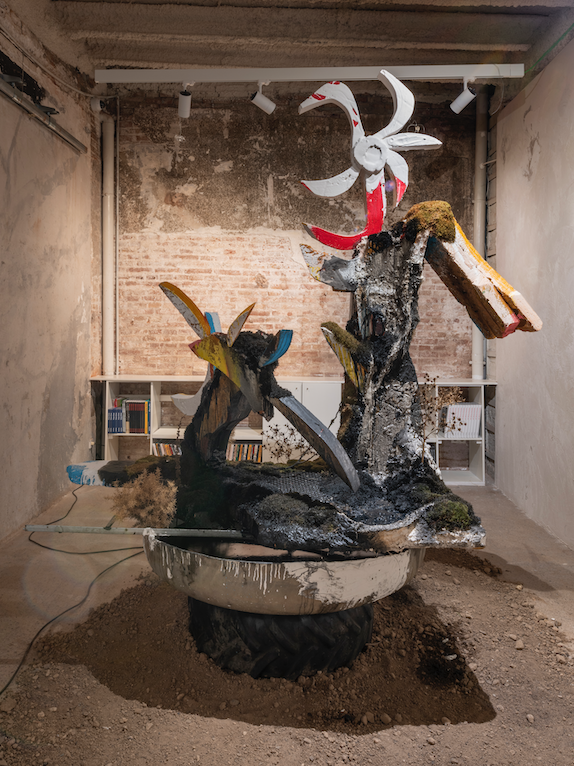
In the other room of the gallery, on the other hand, there is a certain “plastic violence” that begins with the installation Chemical Romance, by the artist from Reus Oriol Enguany (1994), who works near Constantí, surrounded by petrochemicals. Enguany's piece is a sculpture-fountain that sweats a black, slimy material that is obviously a reference to oil and the detritus of wild capitalism. Altaió compares it to Calder's mercury fountain, which can be seen at the Miró Foundation, which in its time was an example of industrial beauty until mercury was identified as a toxic material. In the Mayoral, on the other side of the wall from Enguany's work, a painting by Miquel Barceló is exhibited that exudes organic matter. Dalí's soft clocks, paradigms of this disintegrated time, appear in the work Venus espacial (1977-1984).
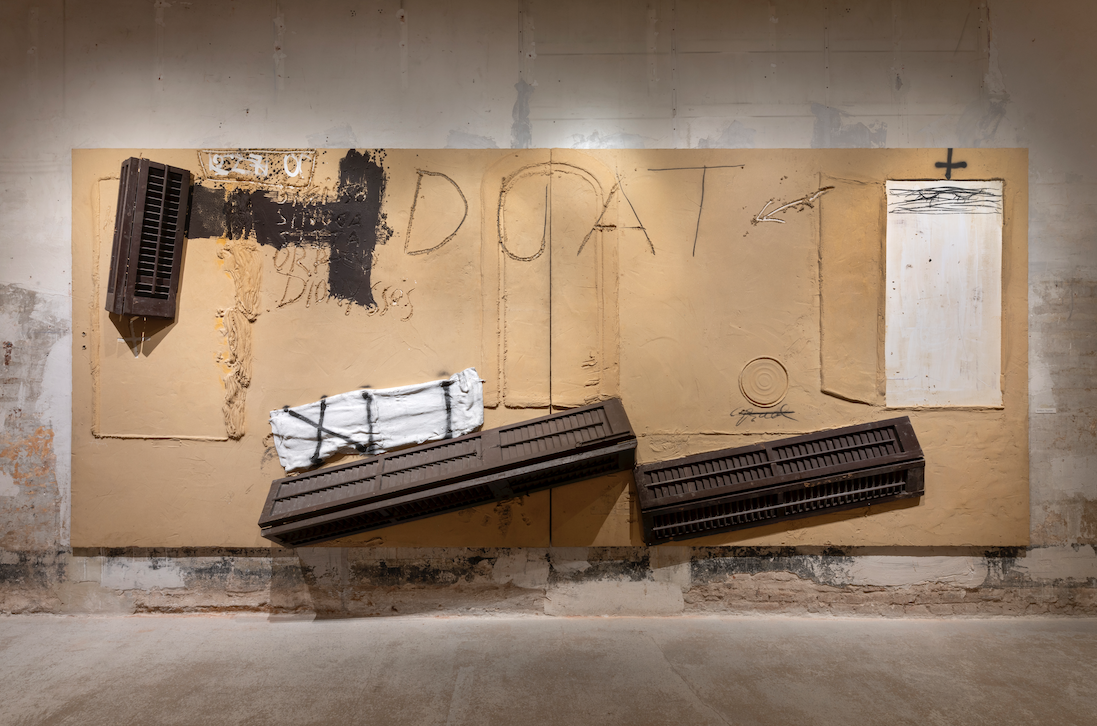
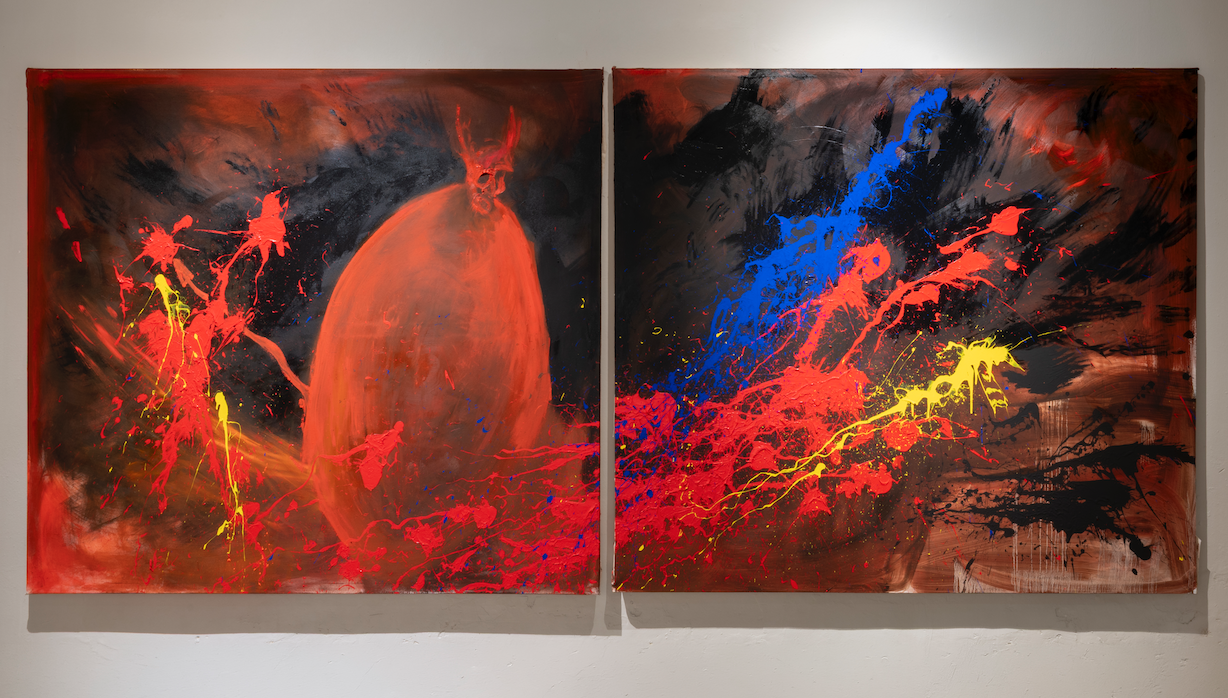
The finale of the exhibition connects with concepts of destruction, death and renewal. Again, it confronts a master with a young artist. Antoni Tàpies' impressive diptych, Duat (1994), measuring 2.5 x 6 m, with mystical connotations, is a compendium of Tapia's iconography -signs, words, objects such as shroud sheets and even window shutters in free fall-, which dialogues with a large diptych by another young artist, José Luis Barquero (1997), inhabited by red flames of correfocs or perhaps, who knows, of hell.
With works by other artists such as Jordi Alcaraz, Ramon Casas, Lichtenstein or Chillida, the exhibition functions like a clock -never better said- as a mere device for aesthetic and philosophical contemplation, beyond added historiographical disquisitions, which is why the assembly has deliberately avoided explanatory texts. Therefore, it is also an invitation to pure amazement, but also to the return, as Altaió remarks, to reading, although paradoxically it is designed practically only from images.
You may be
interested
...