Exhibitions
Joan Claret's linguistic turn at the Marc Domènech Gallery
The Marc Domènech Gallery vindicates Joan Claret's most experimental stage and his role as a precursor of post-war Catalan geometric abstraction.
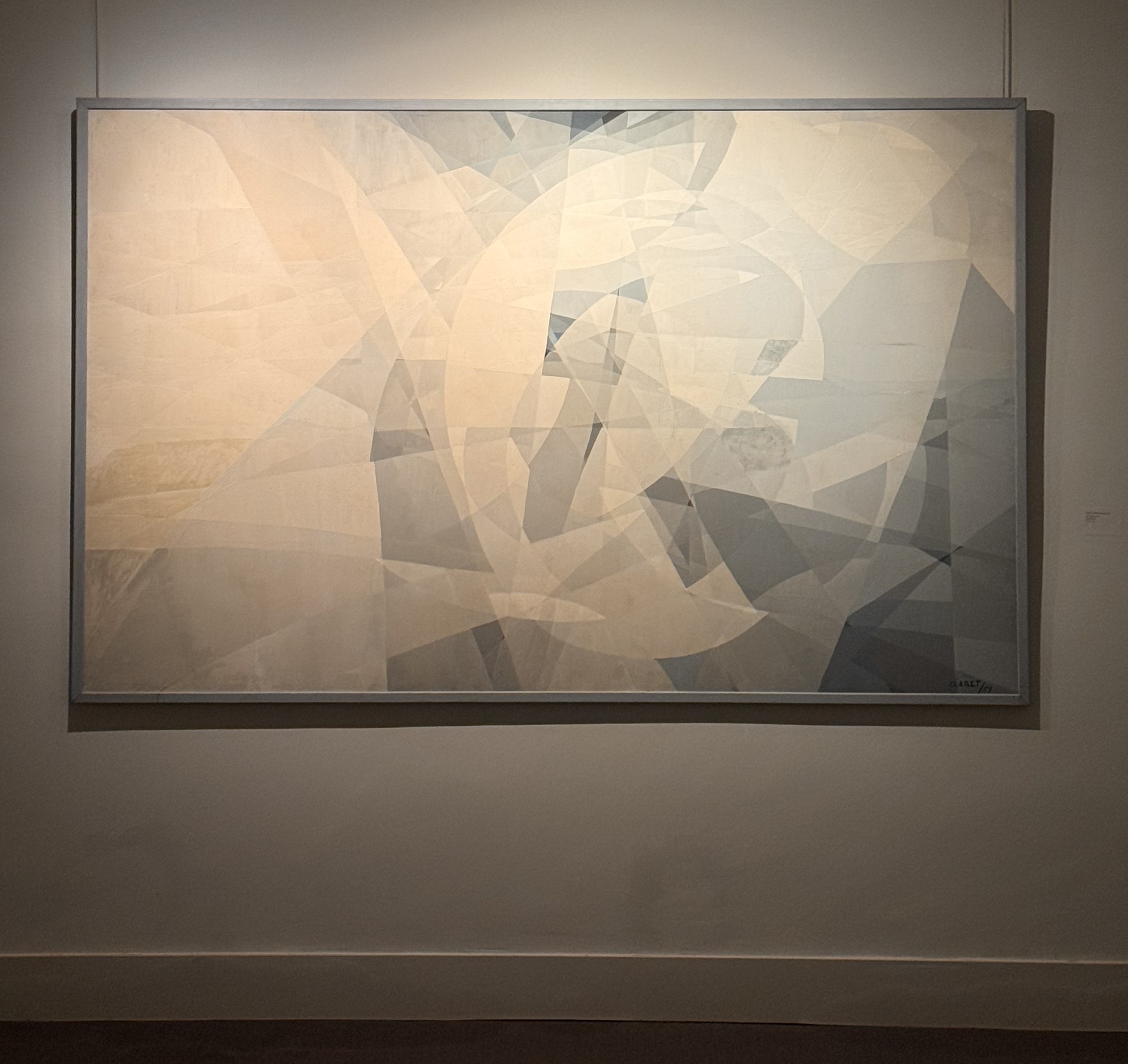
On a sunny Sunday, September 20, 2026, I decided to enjoy the experience of the 12th edition of the Barcelona Weekend Gallery (BWG) at the Galeria Marc Domènech. An art space that, since its foundation on December 12, 2013, has been committed to defending and promoting 20th century art. Taking advantage of the BWG opportunity, the gallery wanted to reclaim the avant-garde legacy of Barcelona artist Joan Claret Corominas (1929-2014) towards geometric abstraction and post-war Catalan concrete art between 1959 and 1965. Despite his rapid oblivion and invisibility from the contemporary Catalan art scene (from the 1980s onwards), Claret was a genuine precursor of the plastic system of Catalan constructivist art of the 1960s and 1970s which, to paraphrase the curator and art critic Albert Mercadé, knew how to make a place for itself in a context dominated by the expressive force and material existentialism of the informalist abstraction of Antoni Tàpies (1923-2012), Modest Cuixart (1925-2007), Romà Vallès (1923-2015) or Juana Francés. (1924-1990).
Arriving at Passatge de Mercader, I mingle with people from here and there who are preparing to experience the most snobbish and gentrifying meals of brunches, which increasingly rival the Catalan breakfast with a fork. I arrive too early. I hesitantly approach a group gathered at the entrance of the passage to ask if they are queuing for the same gallery, but they tell me that they belong to a guided tour of the Arco Gallery Walks . I go to the basement number 12, where a tall and well-built man opens the glass door for me, kindly invites me to enter and hands me the full-color hall sheet. It is Marc Domènech, owner of the gallery, who has curated - together with graphic designer and cultural manager Albert Claret, the artist's son - a cycle of three exhibitions dedicated to the most experimental and transformative years of Joan Claret's artistic career.
The first exhibition, 1959. Joan Claret. Paintings -part of the BWG's Flash program (September 17 and 20, 2026)-, focuses exclusively on the works with which the artist made his linguistic turn towards the premises of post-war Catalan concrete art. The second exhibition, Joan Claret. Paintings.1960-65 (September 23 to October 23, 2026), will allow us to analyze the constant transformations and different evolutionary stages that marked his career during the first half of the sixties. Finally, the third proposal is an online exhibition of drawings materialized between 1963 and 1968, accessible between September 30 and October 26, 2026. As a point of clarification, it should be added that the first two exhibitions have been collected in a catalog with texts by Albert Mercadé.
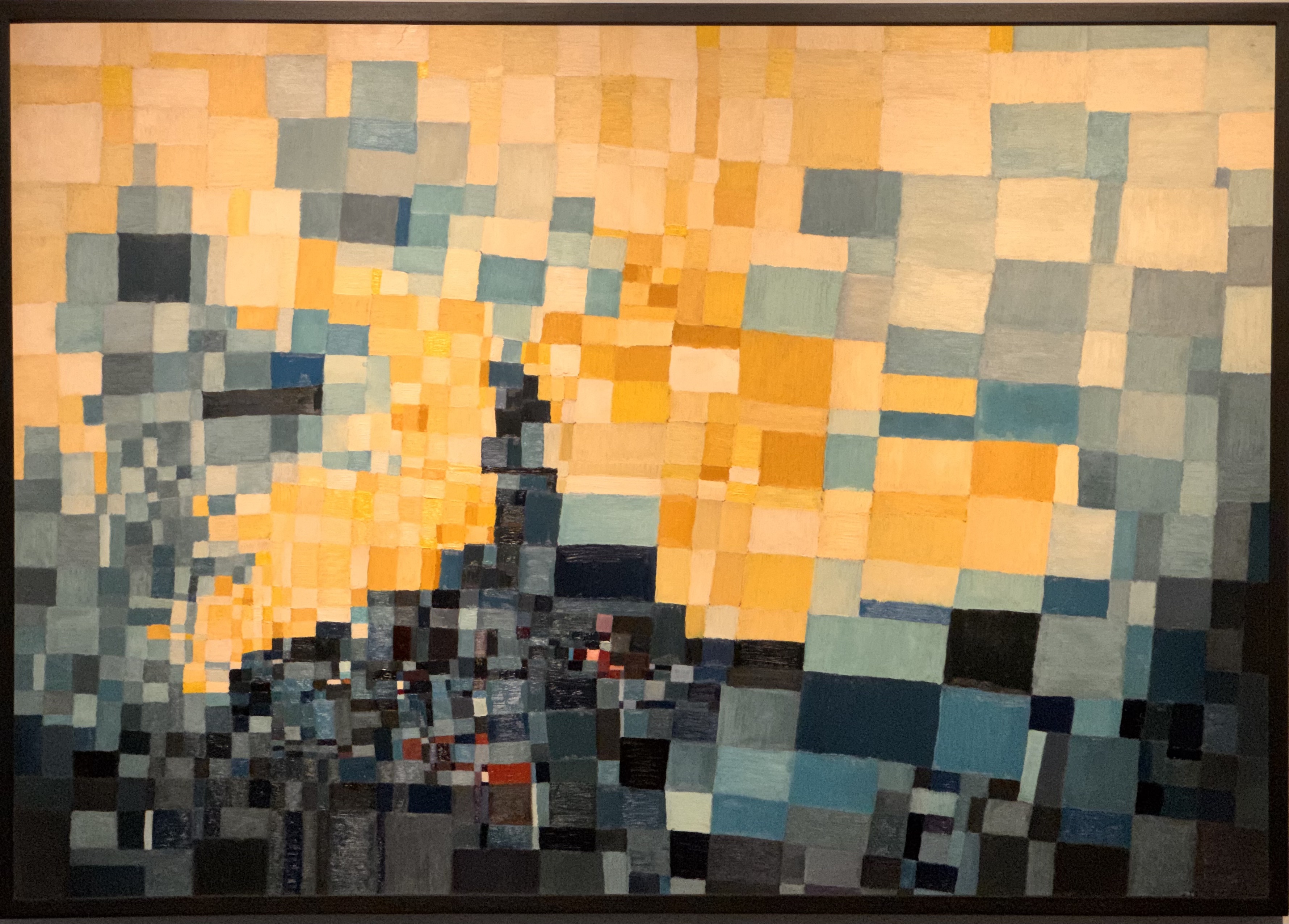
Untitled, 1959.
Going into the first exhibition, it is worth saying that the year 1959 represents a very revealing milestone for Joan Claret. The careful selection of twelve paintings from the artist's collection reveals the abandonment of figurative painting and the assumption of a new constructive and structural system. From then on, a progressive purification of ornamental and gestural stridentness begins, with compositions crossed by almost transparent structures and orthogonal grids predominating. Good examples of this are the oils on wood Sense Títol (1959) and 100 (1959), or the oil on paper 105 (1959). The premeditated arrangement of space and time it is a way of poetically transmitting human feelings and values behind the solid lines, the overlapping planes and the polychrome geometric shapes. From this background, his different polychrome oils on wood should be highlighted, such as the work Sense Títol (1959). Claret is aware that he is generating knowledge and a new metapictorial epistemology that dialogues with the works of contemporary artists, such as the Catalans Enric Planasdurà (1921-1984) or Joan Vilacasas (1920-2007), the Mallorcan Miquel Brunet (1926-2007), and the sector of Valencian constructivist artists of the Parpalló group (active between 1956 and 1961): Andreu Alfaro (1929-2012), Doro Balaguer (1931-2017), Joaquim Michavila (1926-2016) and Eusebi Sempere (1923-1985).
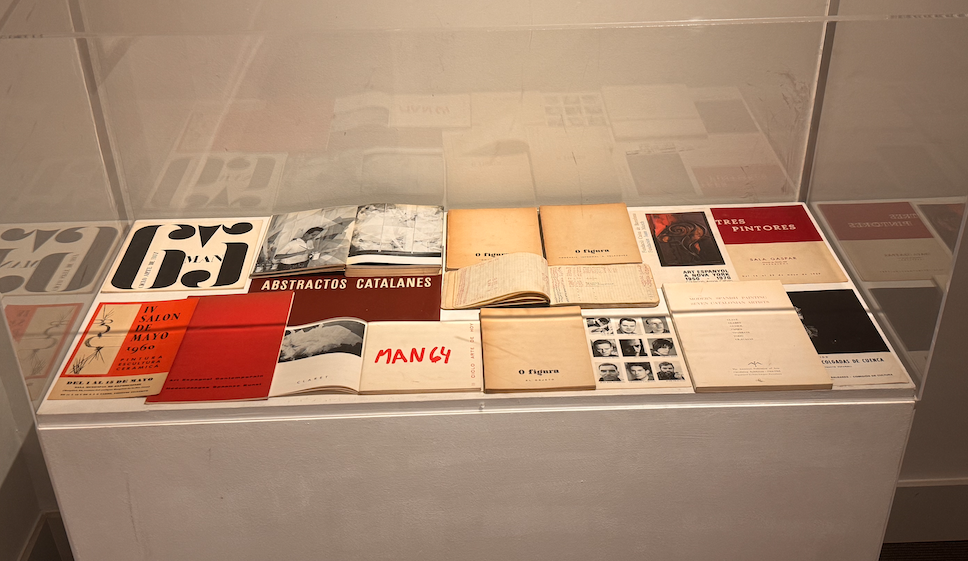
The year 1959 is the moment in which the artist, having returned from Paris (1948-1949), shows himself eager to explore new perspectives, findings and ways of confronting empty compositions - in the Taoist sense of emerging energy - on paper, canvas or wood, as he materialized in the Gaspar Room. That is why this first exhibition aims to vindicate a key figure who, together with other colleagues of the 0 Figura group - such as Joan Hernández Pijuan (1931-2005), Josep Maria Subirachs (1927-2014) or Joan-Josep Tharrats (1918-2001) - laid the foundations of Catalan concrete art and kinetic art, outside the academic tradition and the hegemony of informal art.
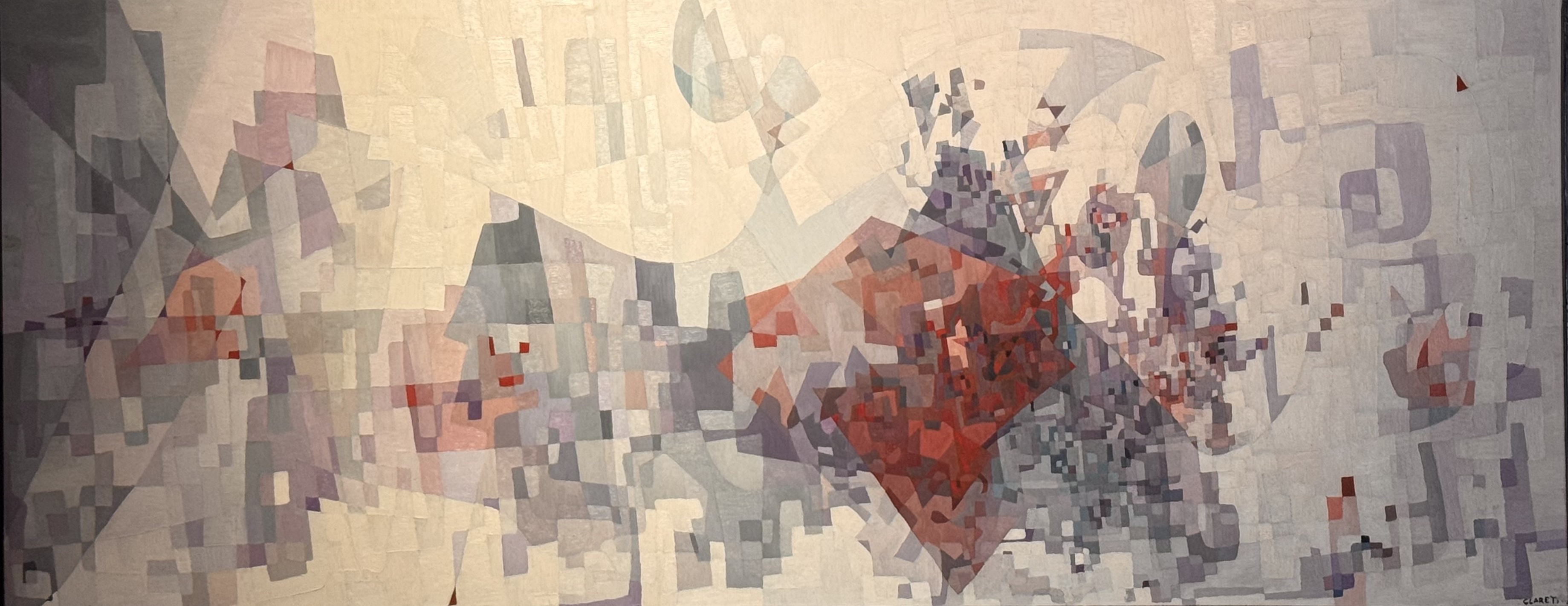
Untitled, 1959.
In terms of the exhibition layout and itinerary, the exhibition has a clear pedagogical interest in making understandable what the Claretian linguistic turn represented as a processual and situated poetic legacy. In this sense, the successful dialogue established with contemporary Catalan artists -Miquel Rué (1929-2008) and Jaume Sans (1914-1987)- and the artists who marked their Parisian stay of fate by Magda Bolumar (1936), Joaquín Torres (1874-1949), García, Henryk Stazewski (1894-1988), Paul Klee (1879-1940), Jesús Rafael Soto (1923-2005), Víctor Vasarely (1906-1997), etc. is noteworthy.
It is worth doing this immersive exercise in the Claretian universe. Even more so, if on the ground floor, you sit down on an old padded seat (inherited from the previous Galeria Tramuntana) with the pretext of framing better and looking for a good angle for the photographs. Suddenly, as if I were in the middle of a play by La Cubana , the entourage of people I had seen at the entrance to the passage bursts in, led by the curator and art critic Pilar Cruz. This group, adorned, travels all over the gallery until they gather around me. At the climax of this situation, Marc Domènech makes a stellar entrance, who with a tone that is both friendly and rigorous, gives a masterful lesson on Claret's trajectory in relation to the artistic environment and the impetus of the galleries.

You may be
interested
...