Exhibitions
June Crespo pushes the limits of matter in Más Graves
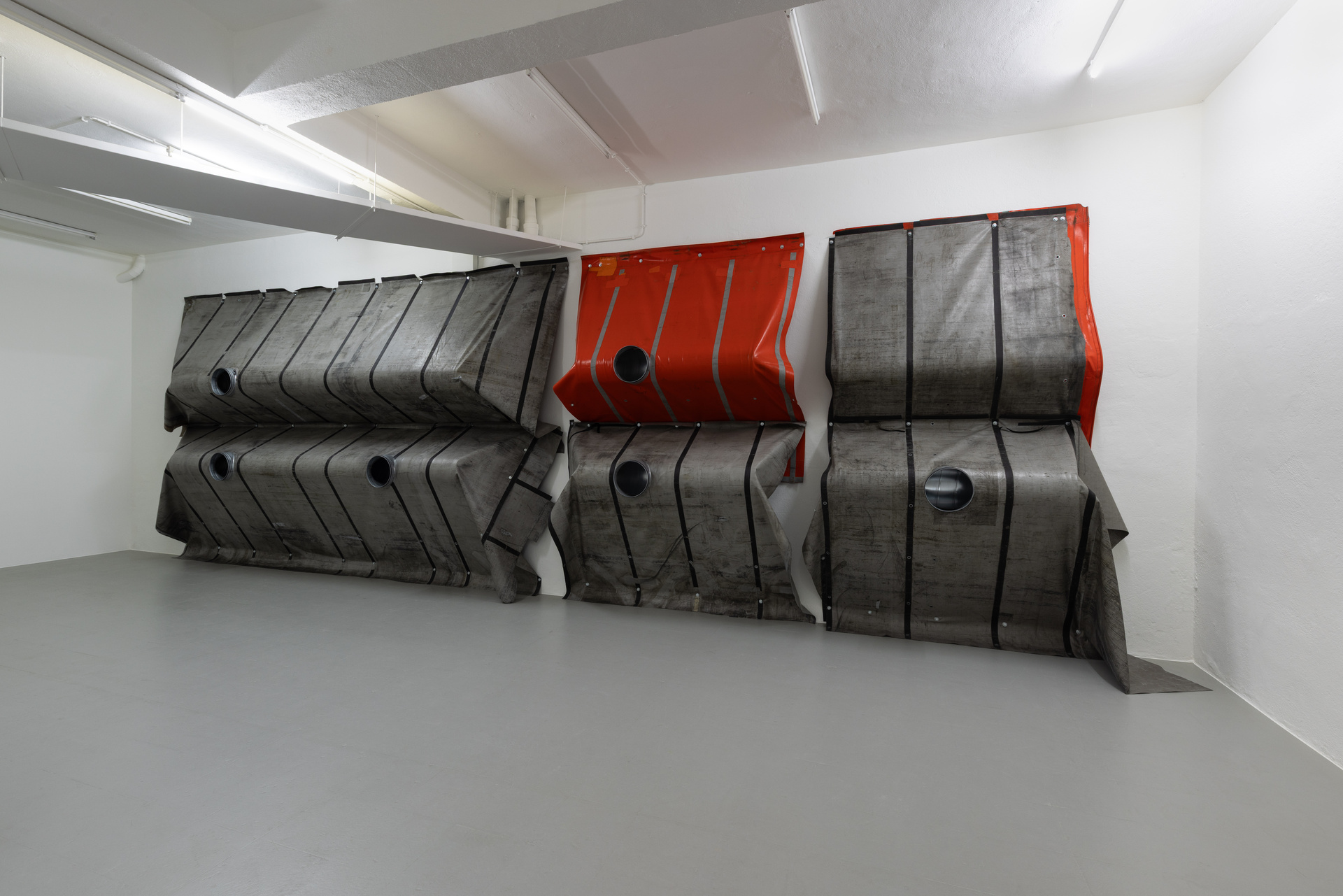
Until September 5, Kunsthalle Lissabon presents MORE GRAVES , a solo exhibition by June Crespo (Pamplona, 1982) conceived specifically for the Lisbon space. The artist, one of the most prominent voices in contemporary Spanish sculpture, presents an intervention in which matter, architecture, and body cease to function as independent elements, instead forming a unified system subject to forces of tension, weight, balance, and vibration.
Crespo's practice typically stems from the relationship between the body and architectural space. Her sculptures explore the limits of scale, density, and the physical presence of materials, creating situations in which what appears static acquires an almost corporeal dimension. Her international career includes solo exhibitions at institutions such as the Fondazione Sandretto Re Rebaudengo in Turin, the Vienna Secession, the Guggenheim Museum Bilbao, Le Crédac in Paris, and the Centro de Arte Dos de Mayo (CA2M) in Madrid.
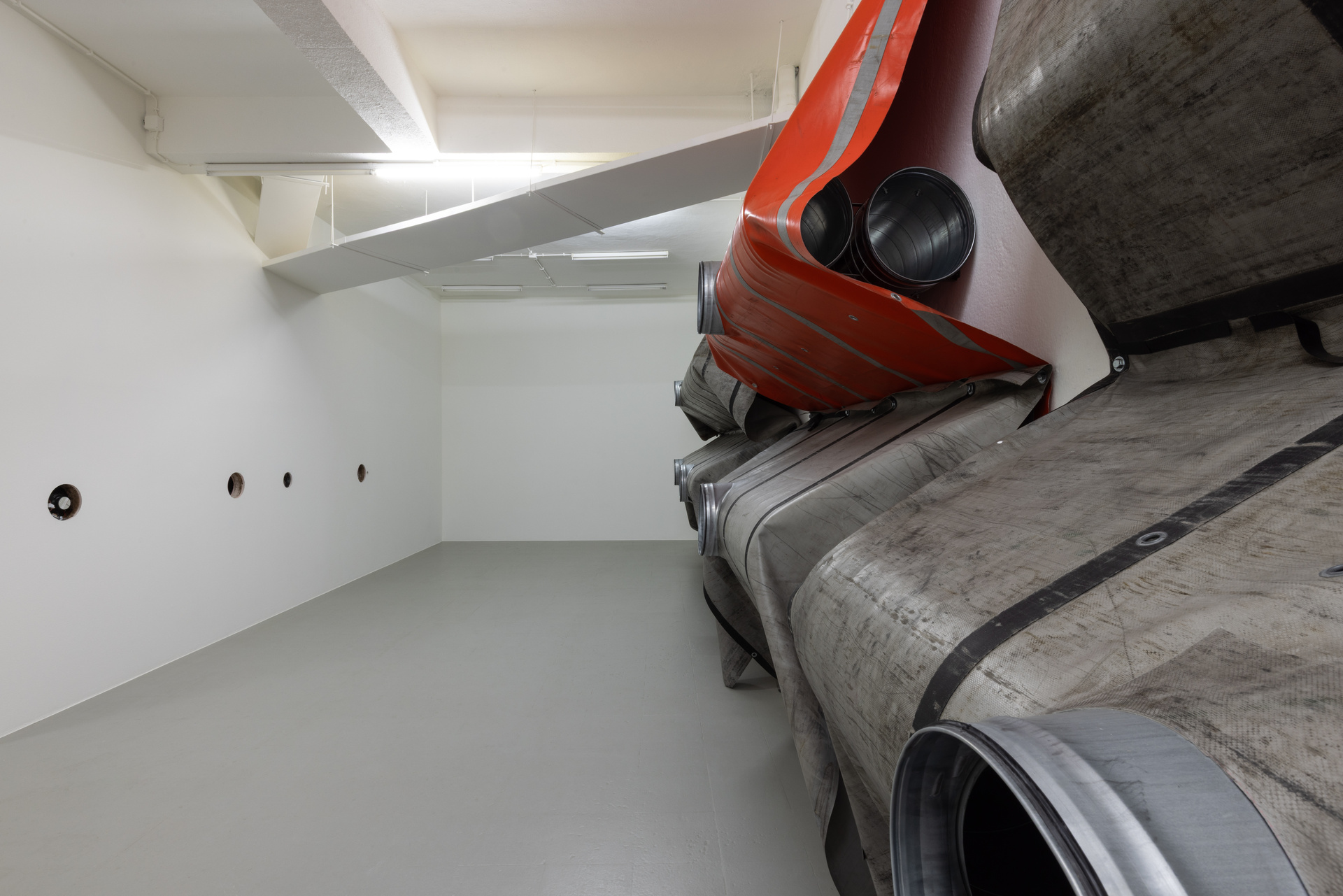
In MORE DEEP , the title itself functions as a conceptual gateway to the exhibition. The expression establishes a play between gravity—weight, density, and the force that keeps bodies anchored in space—and low sounds, those deep, low frequencies capable of penetrating and transforming an environment. Crespo thus unites two seemingly disparate dimensions: heavy matter and invisible vibration. Dense also resonates; that which occupies space can, at the same time, emit a frequency and alter our perception.
The unique architecture of Kunsthalle Lissabon, located underground, becomes the starting point for the intervention. Its walls cease to be a mere backdrop for the artworks and become an active part of the sculpture. They are surfaces of support, containment, and friction that participate directly in the construction process. The intervention is primarily structured around a twelve-meter-long wall, on which Crespo deploys industrial materials such as ventilation ducts and tarpaulins from heavy transport vehicles.
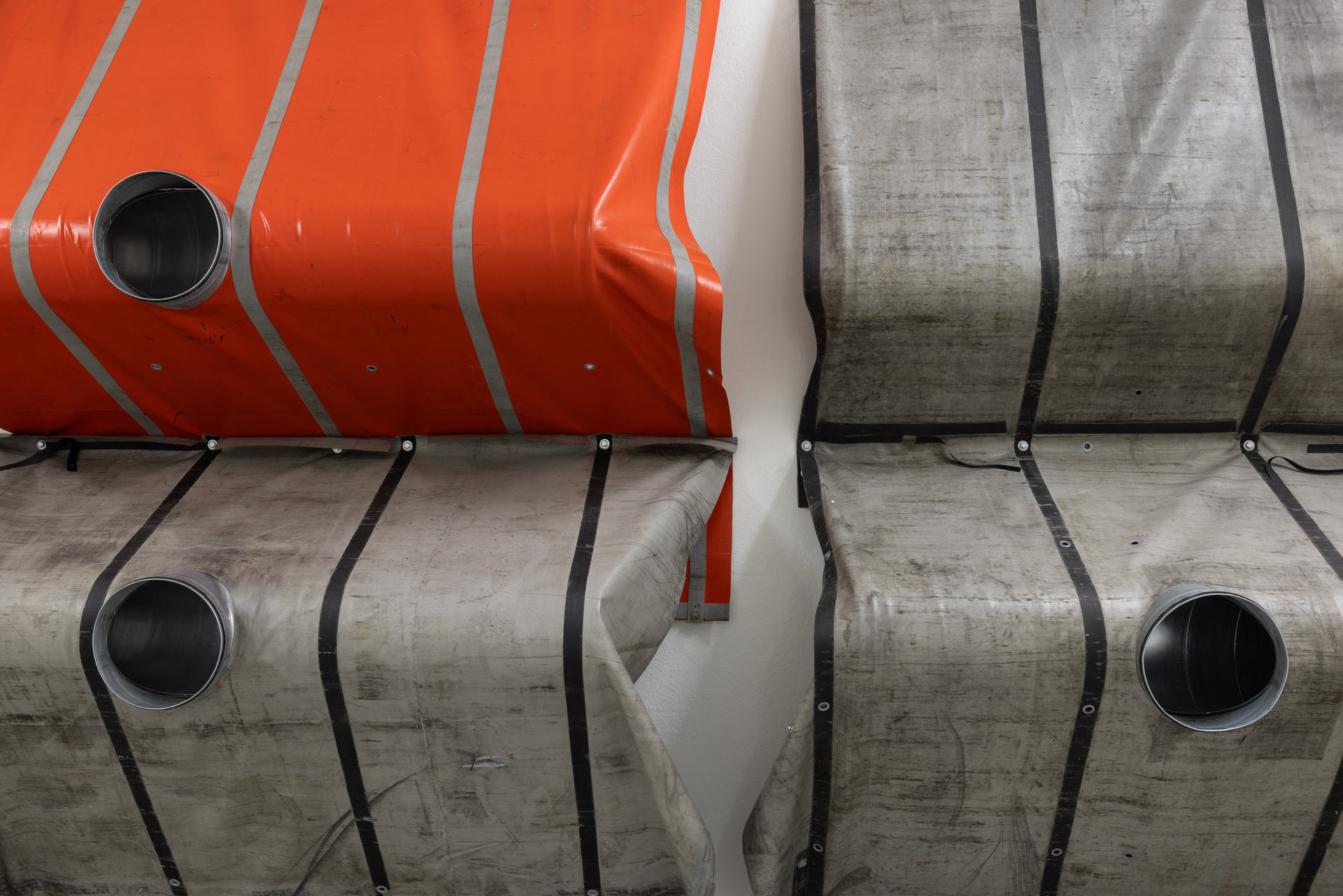
The result emerges from processes of cutting, assembly, and recomposition. The structures seem to oscillate between tension and relaxation, between what is revealed and what remains hidden. The tarpaulins, marked by use and imbued with an intense tactile presence, feature perforations that direct the gaze toward the interior of the ducts. This creates visual pathways between inside and outside, between the visible and the hidden, relating the human scale to the mechanical dimension of the materials and to the building's own construction systems.
The underground architecture thus acquires an almost corporeal quality. The scale, density, and intimate atmosphere of the space act as an additional body that complements the installation. Crespo does not simply occupy the space: he activates it, subjects it to new relationships, and makes visible some of the structures that usually remain hidden.
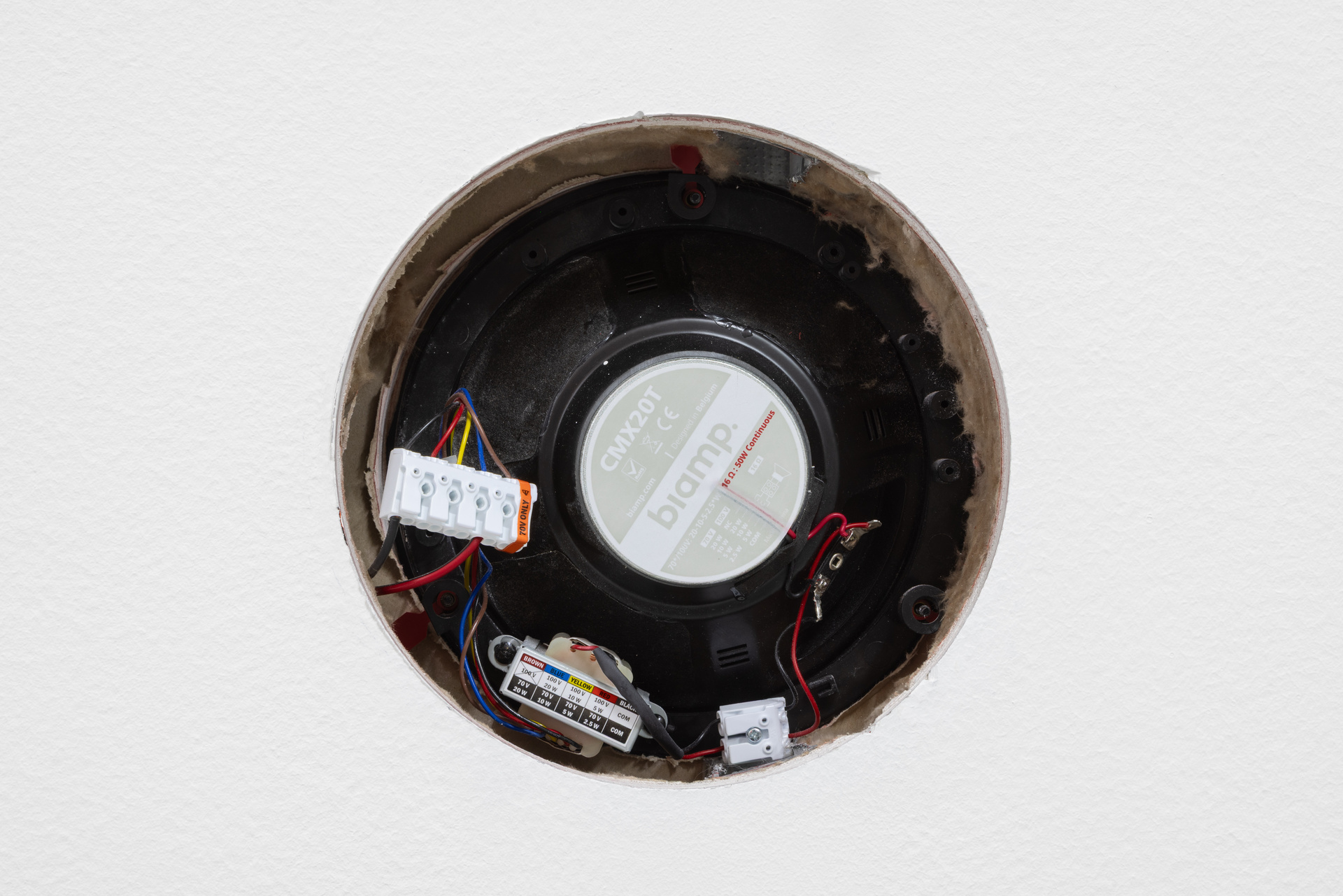
This physical dimension is expanded through sound. hyle , a piece developed by Estanis Comella in collaboration with June Crespo, introduces an intermittent acoustic presence that modifies the perception of the whole. The starting point is a recording made inside a pipe that runs vertically through the building where Crespo's studio is located, from the roof to the basement. The artist uses the particular acoustic quality perceived within this conduit as a reference to construct a new layer of the exhibition.
Emitted from the opposite wall, the sound directly confronts the sculptural intervention. At the same time, perforations in the wall allow it to filter into hidden areas of the space, with the sound source oriented toward the storage area. It is a gesture that seems directed at the building itself, as if the artwork wanted to establish a dialogue with its invisible structures and activate those intermediate spaces that normally remain outside our experience.
Sound thus transforms the sculpture. At times, both dimensions—the material and the acoustic—seem to merge, producing the sensation that the material itself breathes, vibrates, or sings. The installation ceases to be merely something to be contemplated and becomes a bodily experience that requires the visitor to move around, listen, and perceive the space from different positions.


You may be
interested
...