Opinion
An immersion into the expressive universe of the Gran Canarian painter Juan Cabrera Cruz
In a world saturated with digital visual codes—under the umbrella of Barnard's questionable motto "a picture is worth a thousand words"—face-to-face interactions between humans still persist. Proof of this can be seen in a visit to the studio of Gran Canarian painter Juan Cabrera Cruz, a project born from the synergy between Maricarmen Alemán, receptionist and (according to many of the guests) the heart and soul of a hotel in Playa del Inglés (part of the municipality of San Bartolomé de Tirajana, Gran Canaria), and Lilian Campo, an artist and devoted student of Cabrera who frequents his studio on Monday and Tuesday afternoons. It's also worth noting that the connection between Lilian and Maricarmen lies in Lilian's son, who was the former manager of the hotel where Maricarmen works. In short, we can see here how symbolic interactionism (Chicago School, 1920s), based on words and actions, determines frameworks of understanding based on the meanings created by people during social interaction.
Once our connections, which are rather analogical, have been unraveled, it could be said that art constitutes a meeting point and a means of mediation between people from different life backgrounds. In this case, this art physically materializes in the figure of the painter, as an intermediary, and in his studio-home, as a space for symbolic interactions. Juan Cabrera Cruz, born on April 25, 1966, into a humble family and raised in the Las Rehoyas neighborhood of Las Palmas, graduated from the Gran Canaria School of Arts and Crafts (now EASD Gran Canaria) with a specialization in Advertising Illustration (1987) and later completed his training at the prestigious Luján Pérez School. He currently teaches drawing and painting at the Luján Pérez School and in municipal schools in various towns on the island of Gran Canaria. Since 1991, the painter has participated in numerous exhibitions, both solo and group, throughout the Canary Islands, on the Spanish mainland (Madrid), and internationally (London, Hong Kong, New York, Santo Domingo). This career is complemented by his altruistic commitment to charity events and art competitions—where he has donated works as prizes—as well as by lending artwork for the filming of the movie Wild Oats (Andy Tennant, 2016).
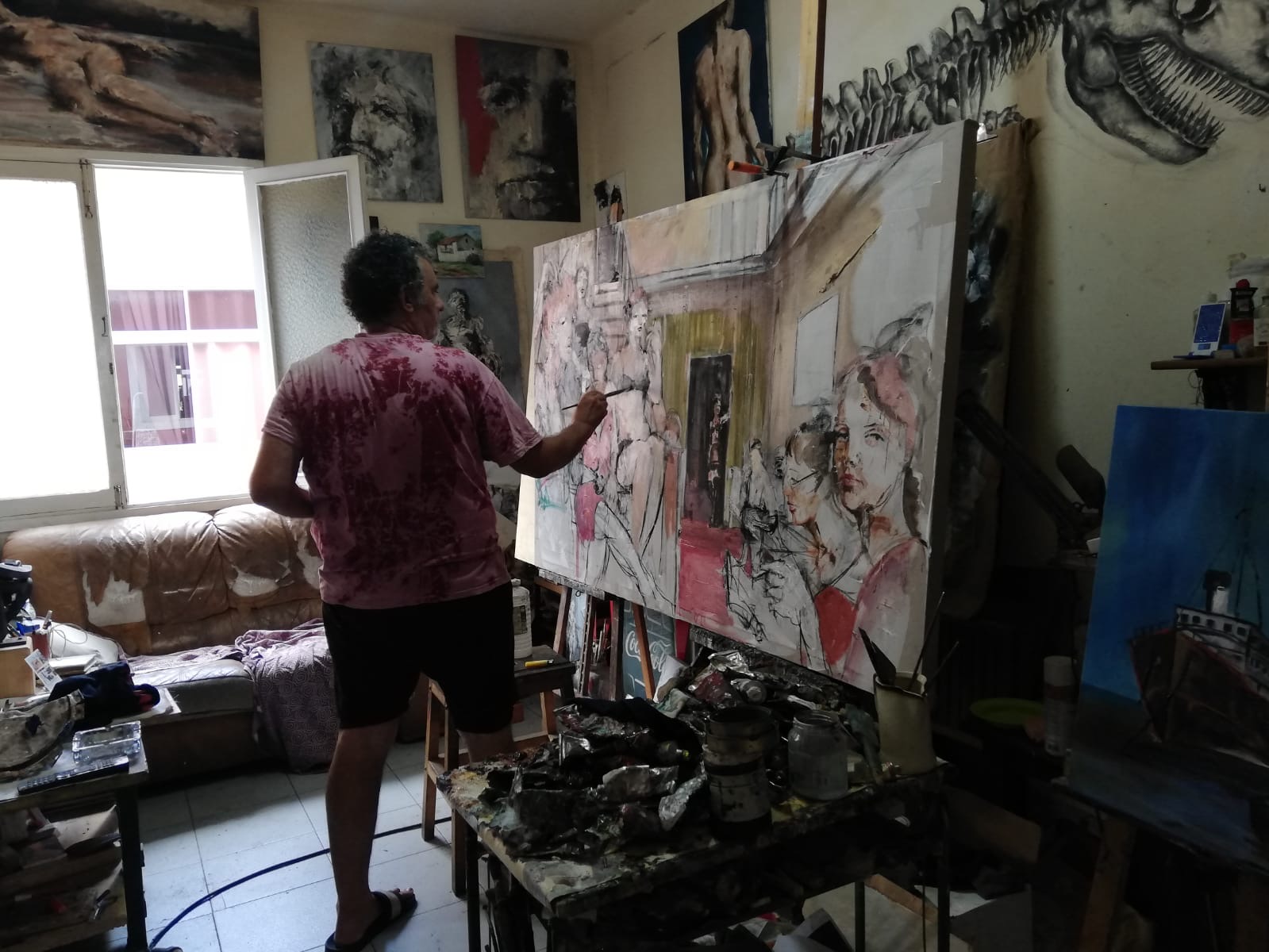
The painter's studio and home, located in the popular Alcaravaneras neighborhood of Las Palmas—directly across from the old Insular Stadium—constitutes the nerve center where his artistic universe has been forged. Different supports (cardboard, canvas, wood, paper, fabrics), artistic registers (sketches, drawings, prints, paintings, illustrated canvases, and sculptures), and techniques (charcoal, oil, engraving) converge here. This studio acts as the temple of a personal art gallery that, in the purest style of the wunderkammer of the 16th and 17th centuries, envelops the visitor in a sea of lines, stains, impasto, brushes, palettes, canvases, cardboard, leaves, and so on. Paintings, drawings, and illustrations are stacked vertically, piled on the floor, leaning against the apartment furniture, or hanging on the wall. A bronze mask and a white canvas displaying a realistic—and somewhat androgynous—image of a Madonna and Child also stand out.
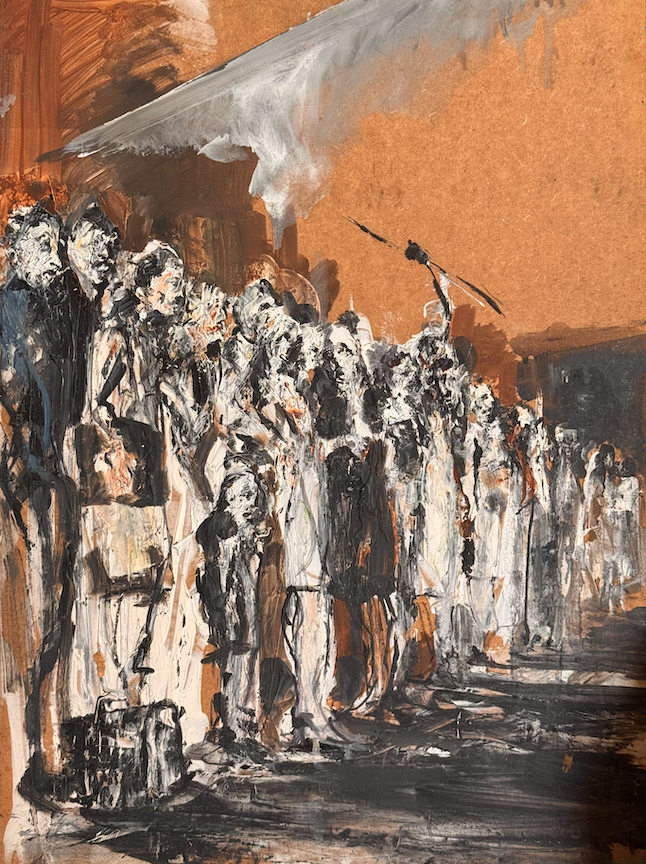
On a conceptual level, Cabrera's recurring themes began in the 1990s with his frontal heads, evolving into autobiographical scenes that explore internal and external tensions, as seen in the pieces *So What?* (2018), *Alone with Myself II* (2019), and * Conflicts II * (2019). From a costumbrista perspective, guided by intuition, chance, and curiosity, works such as *Card Players * and *Bars, What Places* (2019) stand out. Regarding the section dedicated to cultural heritage, his work encompasses passages related to *Don Quixote *, Homer's * Iliad *, with portraits of Hector (2019) and Troy (2018), classical mythological legends with *Charon's Boat I, II, and III* (2019), pre-Hispanic popular culture with *Canarian Wrestling * (2026), and bullfighting scenes with the piece *Extremoduro* (2018). And, faced with life's vicissitudes, the painter was never indifferent to social injustices; rather, drawings and paintings can be seen that denounce the consequences of the cuts of the economic crisis, reflected in his work Cola del paro (2008), or the drama of the migratory crisis that has been taking place in the archipelago since 2006.
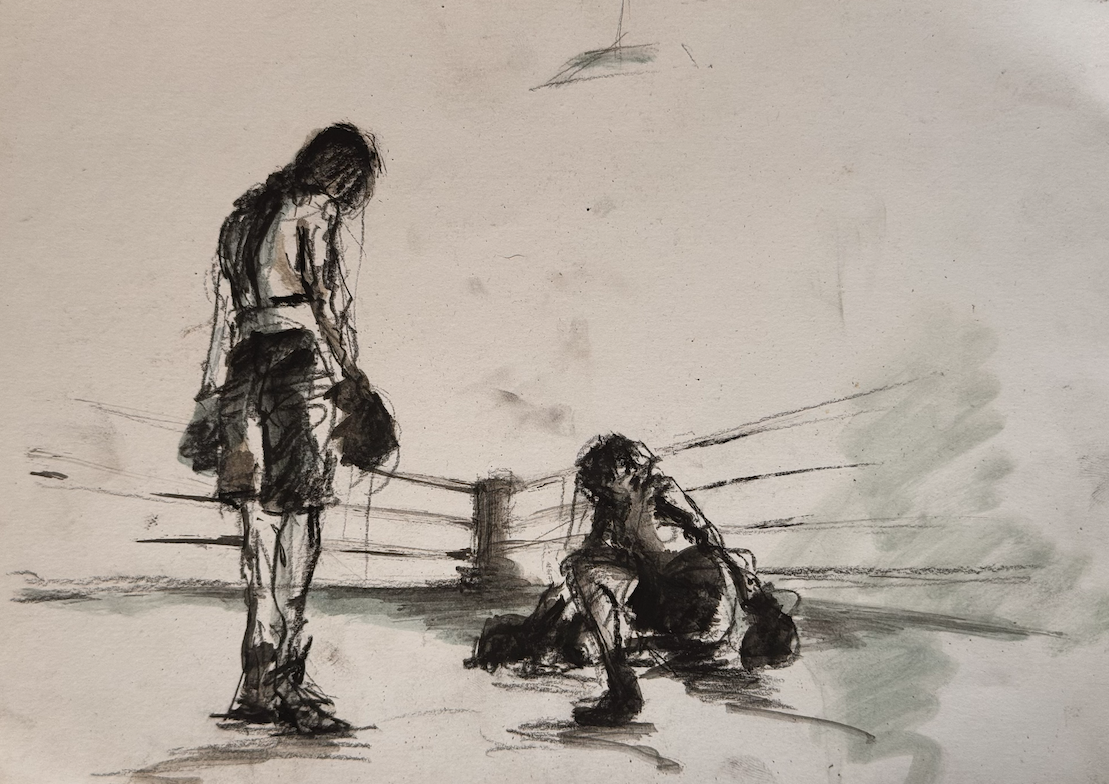
Canarian wrestling, 2026.
The erotic aspect is omnipresent in the sensual conception of female figures in the series Nudes or in the piece Sketches III (both dated 2019). His gaze towards the island's history is settled in the series on the Conquest of the Canary Islands (2026), with pieces such as Warriors II , while his transcendental and religious concerns were materialized in the works Witches' Sabbath or Skull I (2019).
Following the previous paragraph, regarding those scenes linked to meta-artistic approaches, the artist reflects on the techniques applied, the materiality, and the formats of the painting. He also explores the creative process that intertwines the studio with the models, the furniture, and the artist himself, as seen in the painting In the Studio (2019). Among his most recent projects, the Prison series stands out, which he created in 2024 with inmates at the Salto del Negro penitentiary (Tafira Alta, Las Palmas de Gran Canaria).
In terms of style, one could venture to say that it alternates between, on the one hand, a more academic, realistic figuration, learned at the School of Applied Arts of Gran Canaria and notable in his illustrations and allusions to the world of comics. On the other hand, there is an introspective, expressive, and strongly essentialist figuration, possibly deepened during his student years at the Luján Pérez School. This latter style, known as neo-expressionism, is rooted primarily in the Italian Transavantgarde, Central European Neo-expressionism, and the American Bad Painting of the 1970s and 80s, leaving a strong imprint on the students of the Luján Pérez School at that time, where prominent figures in the art world hybridized the indigenist style with the aforementioned European avant-garde. Juan Cabrera, as both a student and teacher at this school, connected with the most groundbreaking artistic principles of great masters such as Manolo and Jane Millares, Plácido Fleitas, Lola Massieu, and Felo Monzón.
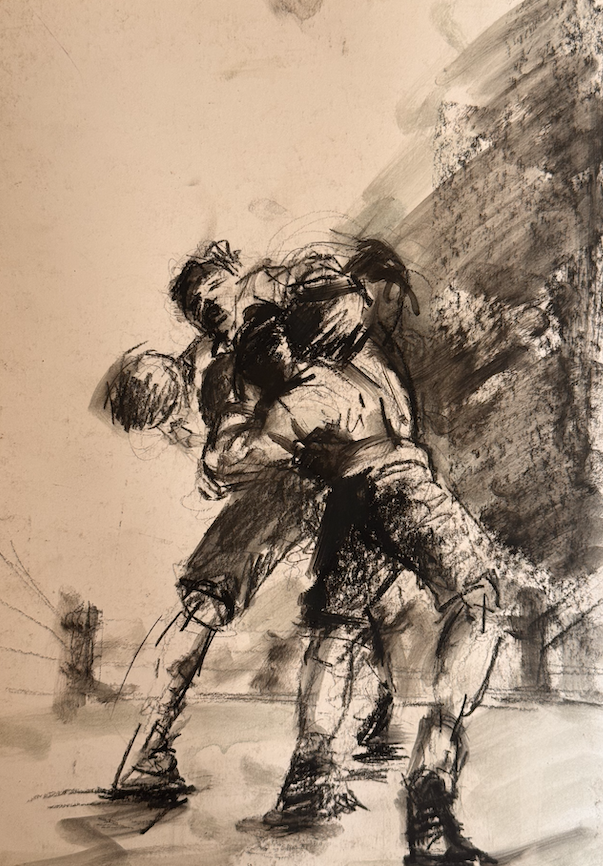
Canarian wrestling, 2026.
While the artist acknowledges that he has not followed the path of indigenist artists in outwardly representing Canarian cultural identity, his specific contribution to the history and cultural traditions of the ancient pre-Hispanic inhabitants is noteworthy. Examples of this include works such as Canarian Wrestling (2023), Hunting Scenes (2023), and Fights Against the Hispanic Conquerors (2023). Generally speaking, Cabrera's linguistic turn focuses on the human figure, which—in a Sartrean vein—interprets perceived reality from an emotional, dramatic, and introspective perspective. His figures are presented as sketched, deformed, torn, or broken through the use of violent brushstrokes, sober stains, and an abrupt use of the palette knife.
In terms of background, Cabrera's different artistic styles and techniques can be traced back to the androgynous musculature of Michelangelo Buonarroti; the Baroque tenebrism of Michelangelo Merisi da Caravaggio or José de Ribera; the encrypted reality of Diego de Velázquez, where the painter made his own interpretation of his dog; passing through the black paintings of Francisco de Goya, until reconnecting with the new figuration and abstraction of Manolo Millares, César Manrique, Antonio Saura or Miquel Barceló.
However, his most direct affiliation lies with the claustrophobic and tragic compositions of Francis Bacon. With the British painter, the artist shares the articulation of suffocating spaces, the use of rough lines and violent brushstrokes, and, above all, an expressionistic figuration with a strong existential charge. In both artists, the anatomy of their figures becomes a veritable battleground. In this sense, the contortion of joints or the deformation of faces act as catalysts to project their psychological tensions and concentrate physical and moral pain.
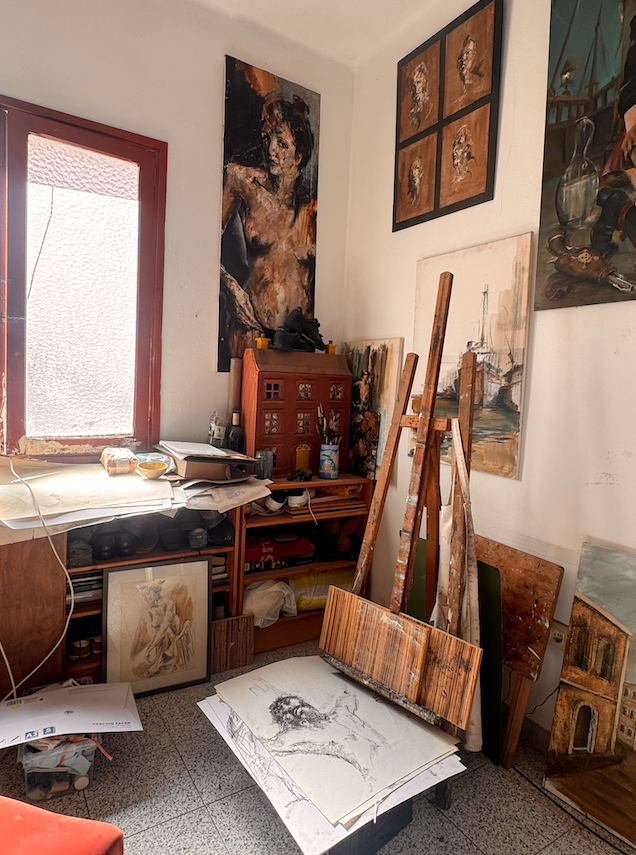
Studio interior, 2026.
Throughout Juan Cabrera's artistic career, the creative impulse is articulated as a unique epistemological system where sketches, illustrations, engravings, painterly strokes, colors, and brushstrokes replace words to articulate a visual language about the human condition and the duality of art and life. It is a coding structured by the direct connection between eye, brain, and hand, characterized by rough foreshortening, performative gestures, and dark, claustrophobic atmospheres, which contrast with landscape interludes or the introduction of brushstrokes of vibrant colors. In his creative work, the same passion capable of bringing life to life from a mere stain or a violent stroke is also capable of destroying it, dissolving into a kind of abstract disfigurement.
Finally, it is worth mentioning that the visits to the workshop/studio/home fostered a dialogical and experimental communication with his works and, consequently, with the artist himself. This experience, which began the moment one crossed the threshold of his studio, connected with the history of analog painting and with the traditional idea of creation as an iterative symbiosis between research, documentation, trial and error, and chance. It is a craft that demands skill, methodological rigor, perseverance, and prolific output. These are the qualities that define Juan Cabrera, a creator with his own style: humanist, ironic, sensitive, and bohemian. His art stands apart from trends and is immune to the impositions of globalizing narratives that stifle free thought. Furthermore, this workshop, conceived as the container of an organic art gallery, takes on meaning as a living archive that safeguards a unique history of Canarian art, embodied in the figure of the artist from Las Palmas, Juan Cabrera Cruz.


You may be
interested
...