
interviews
David Armengol: “The Chapel must continue to be a living x-ray of emerging art”
The Capella as a living laboratory where emerging art, cultural mediation and new curating models redefine the role of institutions in Barcelona.
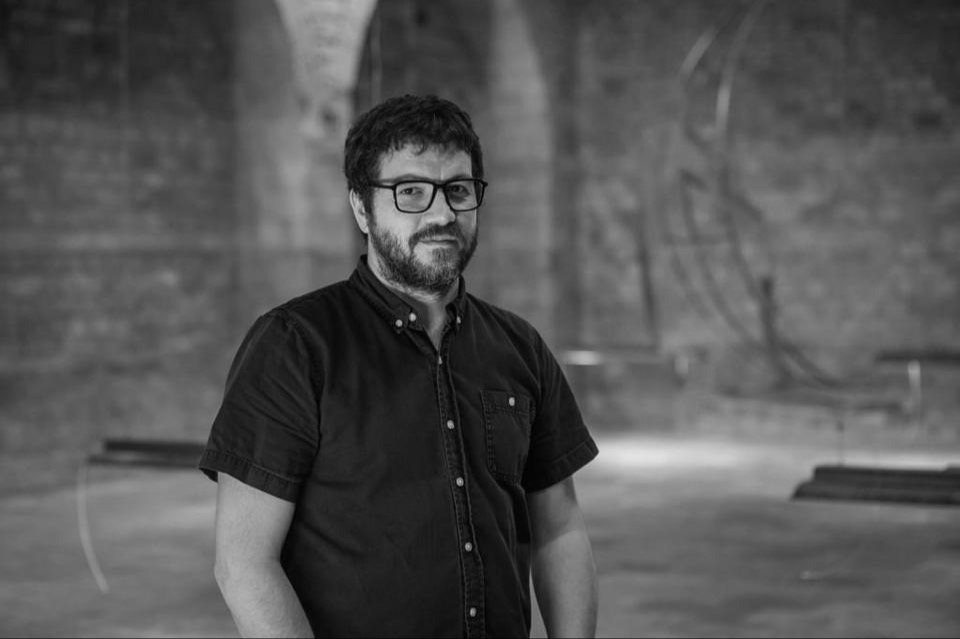
Since 2021, La Capella has consolidated a stage marked by the opening of new programs, international expansion and an increasingly transversal view of what it means to work with emerging art today. In this conversation, its director, David Armengol, reflects on the role of the center within the Barcelona artistic ecosystem, the transformations of emerging art, institutional challenges and the function of contemporary curation, just a few weeks before ending his period at the helm of La Capella.
"Emerging art is not just young art"
He took over the management of La Capella in 2021, a key space within the emerging art scene in Barcelona. How would you define La Capella's role within the city's artistic ecosystem today?
I believe that La Capella has a very clear role within the visual arts ecosystem: it is a center especially linked to emerging art. This also implies accepting this concept of “emergence”, understanding it and defining it. For me, emerging art is not just young art, but the whole set of practices that are not yet consolidated, that are in a moment of expansion and definition.
In this sense, La Capella works precisely from this place: giving space, resources and context to practices that are still being shaped. Within the visual arts ecosystem there are other institutions that operate from another place, more linked to consolidated trajectories —such as the Museum of Contemporary Art of Barcelona—, while we focus on accompanying processes that are still emerging.
Historically, La Capella has played a very important role in this area, and I believe that we continue to maintain it today, especially through Barcelona Producció, which remains one of the center's central axes. But we have also opened other lines of work that try to rethink what it means, today, to be a center dedicated to emerging art.
We do all this from a context deeply rooted in Barcelona, but understanding that the local context is always built in relation to other networks and connections: with spaces and projects in the city, in Catalonia, at the state level and also internationally.
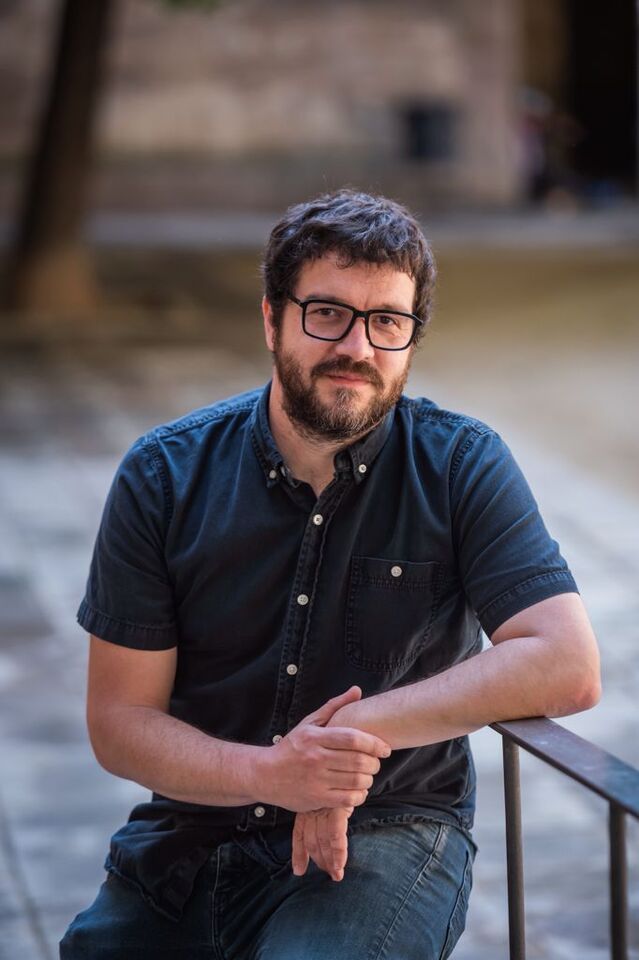
Beyond the label, how would you define emerging art today? And how do you think the profile of artists has evolved in this context?
I would actually like to talk simply about art. But inevitably there are always labels that come with it. In Barcelona, for example, there is a very active circuit dedicated to both young art and emerging art, and there are often those who prefer one term or another. At La Capella we clearly position ourselves in the idea of emerging art because everything we do is unlinked to an age limit.
For me, emerging art occupies a very important part of contemporary visual arts today. In fact, a large part of the art that is made is emerging, because the present is very diverse and consolidation is increasingly difficult. Emerging art is above all a very wide space of possibility: there are artists for whom things work, others who continue to try, some who manage to consolidate themselves and others who do not.
If you want to understand what is happening in the visual arts today, you have to understand what is happening within emerging art, because that is where there is a higher degree of experimentation and where many different practices, languages, and ways of working coexist.
I think that, over the years, emerging art has stopped being perceived as something small or marginal. Even in the media, it arouses a lot of interest, although the focus often continues to be on more consolidated trajectories or institutions. I see this evolution in a positive way, but also with some concern, because emerging art is very broad and at the same time very fragile.
Fragility is also part of its nature. It is a very energetic field, with a very strong need to produce, to say things, to generate new spaces. And I think it ends up functioning almost as an X-ray of contemporary visual arts, with all its uncertainties and tensions.
A permeable institution
During these years at the helm of La Capella, how have you worked on issues such as gender diversity, decolonial practices or the plurality of disciplines within the center's programs?
The most valuable legacy of La Capella is, without a doubt, Barcelona Producció , a program that has existed since 2006 and that continues to be the center's central axis. It is important to remember that it operates through a public call and that it is an external jury that makes the selection decisions. We accompany the processes and the productions.
From here, one of the things we have tried to do is expand the functions of La Capella by opening smaller but very sustained programs over time, which have allowed us to work on other lines in a more stable way.
For example, we launched Concèntric , a collaboration and mediation program closely linked to the context of El Raval. La Capella is located in the middle of the neighborhood, but historically it mainly addressed the artistic context and not so much the neighborhood. With this program we have begun to work with schools, associations and groups in the neighborhood, understanding the diversity and plurality of the Raval and asking ourselves how an art center can connect with it in a real way.
We also created Les Coses de Context , a program of studies and thought within which there has been a school specifically dedicated to the gender perspective. Through these spaces we have been able to address issues linked to feminisms, queer practices, migratory conditions or colonial legacies in a more continuous way.
Internationalization and memory
Looking at the present and also towards the immediate future, what do you think are the main challenges for La Capella today?
The Capella has a permanent challenge: to keep Barcelona Producció alive and to guarantee that the cultural policies that support it remain strong. This is the great objective: to continue taking an x-ray of emerging visual arts in Barcelona.
However, there are currently two particularly important new challenges. The first is the international dimension. This year we have launched a call for international residencies together with De Fabriek and MORPHO, with the support of a European programme. It is a project that we are very excited about because it expands the radius of action of La Capella and opens up new possibilities for artists from the Catalan context.
The other big challenge has to do with publications. Historically, La Capella had developed a very powerful editorial policy. We are now working on a new stage with a physical magazine driven from the center, which we are developing with Nyamnyam and Irzoma. The aim is that it can become a stable tool for thought and documentation.
The present as matter
You recently opened three new exhibitions at La Capella. What can visitors find when they enter the center today?
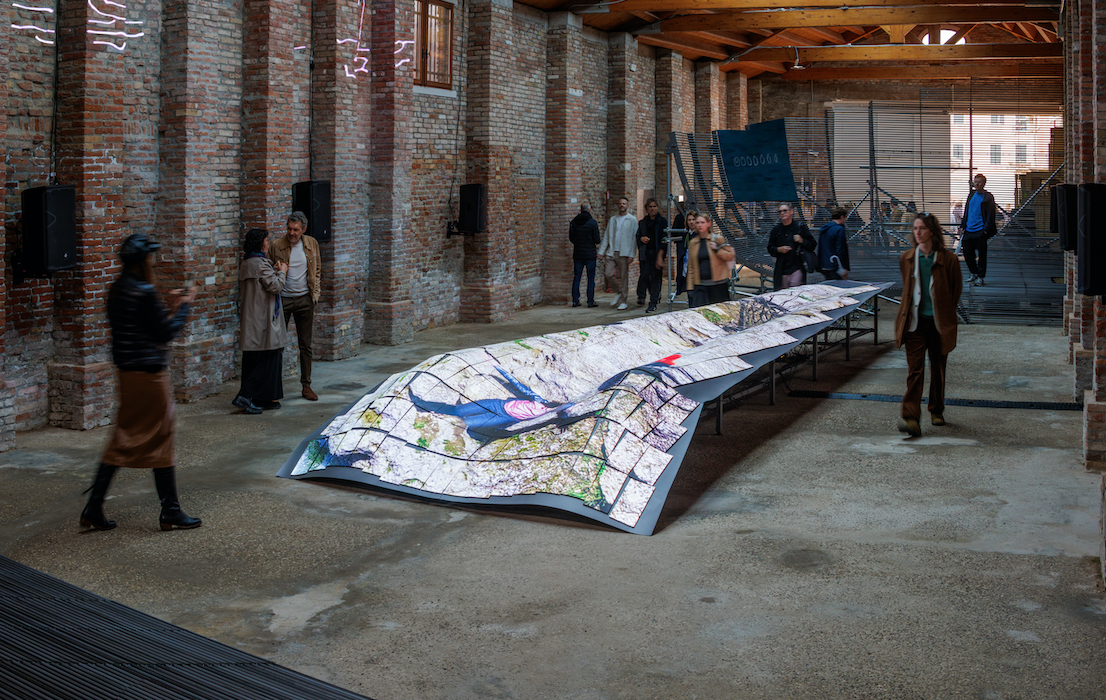
We currently have three exhibitions open. Two are part of Barcelona Producció : Turba , by Sinéad Spelmam, and Perquè m'agrada viver aquí , by Mikel Adán Tolosa .
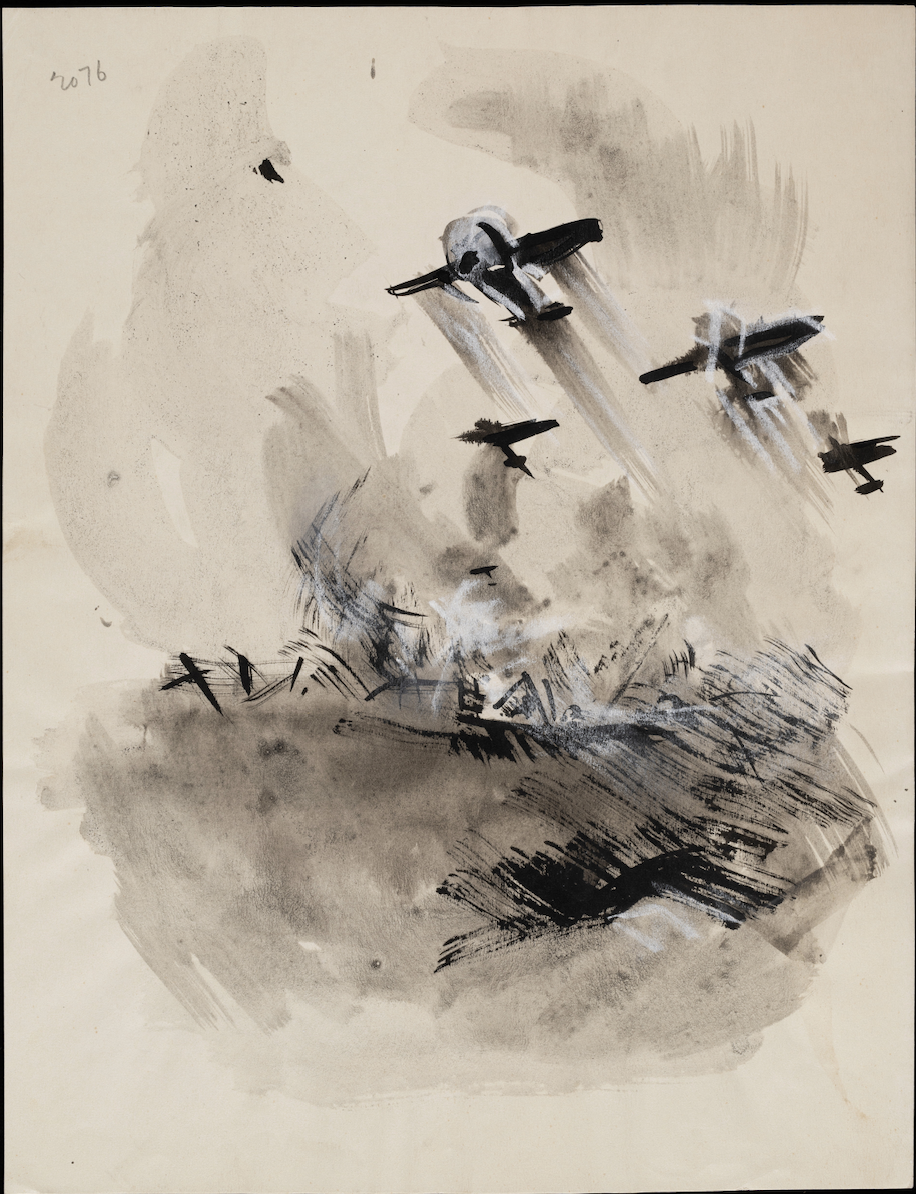
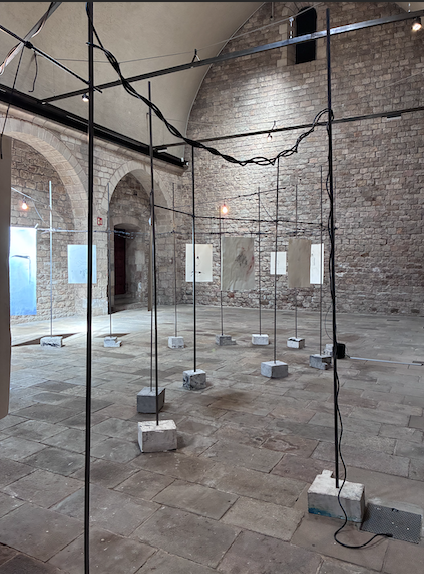
Sinéad Spelman starts from the drawing, but transforms it almost into an architectural and installation experience. In addition, the project incorporates a very important sound dimension, with live performances and a musical narrative that accompanies the drawings.
Mikel, on the other hand, works from the perspective of sculpture and matter. One of the most prominent elements is the use of butter as a sculptural material, which puts into tension the traditional idea of permanence associated with sculpture. The project also incorporates a collaboration with the Cadí cooperative, which has provided discarded butter from its production process.
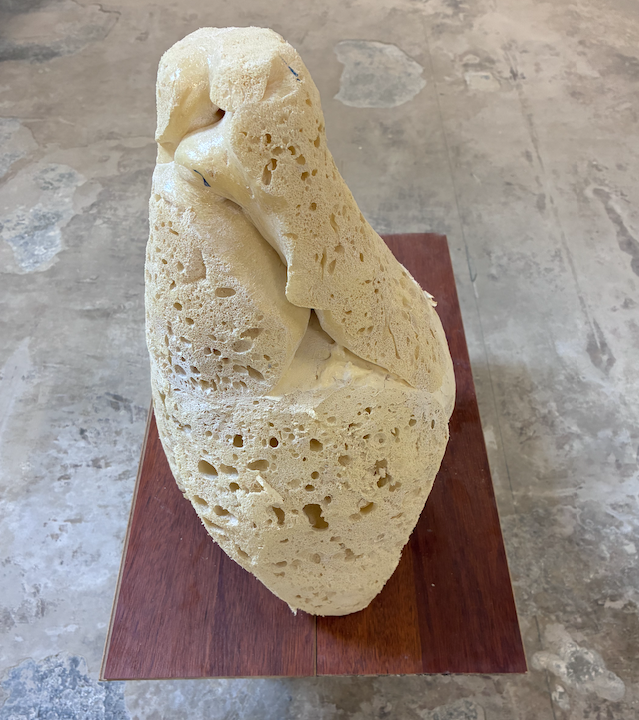
The third exhibition occupies the Vestíbul space and is part of a new program called La Memòria Dispersa . It is Salir a la calle , a proposal by David G. Torres that recovers, twenty years later, an exhibition held in 2005 in Antonio Ortega's workshop. The idea is to recover moments of intensity from the recent history of contemporary art in Barcelona that are often forgotten very quickly. Not from a historiographical will, but as a way of sharing and reactivating memories of the context.
"Curating is caring"
After these years at the helm of La Capella, what personal and professional assessment do you make of this stage?
I have a very positive and also quite emotional assessment. I believe that we have managed to consolidate an agile, receptive and close institution. Obviously, institutions always have an element of slowness and complexity, but we have tried to maintain a very lively capacity to react to what is happening around us.
We are often told that there are many things happening at La Capella, that we are constantly opening lines or experimenting. But this has a lot to do with the very function of the center: working from the present implies assuming flexibility, listening and the capacity for constant adaptation.
You have curated many exhibitions throughout your career. What do you think is the role of the curator within the contemporary artistic context today?
For me, the role of curatorship has a lot to do with the idea of taking care. If I had to define what curating means today, I would say it is accompanying so that something can happen in the best possible conditions.
I understand curating above all as an exercise in accompaniment: understanding well the person or artistic practice you are accompanying and contributing to intensifying their story. I feel closer to this way of working than to the more classic model of “thesis” curating.
I also learned this while directing La Capella. This experience has made me understand curating even more as a structure of accompaniment and care. So, if I had to summarize it, I would say that curating today is precisely that: understanding processes, caring for them and helping to intensify them.
You may be
interested
...