Exhibitions
Aurèlia Muñoz. Us
A major co-production by the MNACRS and the MACBA vindicates, on the centenary of her birth, the sculptural, aerial and ghostly dimension of an artist who anticipated new ways of understanding space and textiles.
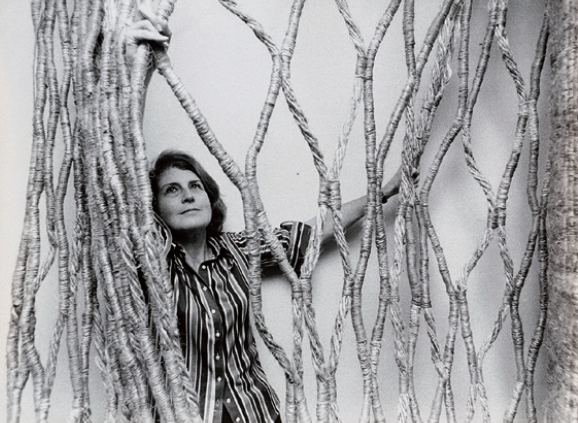
In some cases, over time, we become aware of the relevance of certain creators and we realize that their message was intended for future generations. This is the case of Aurèlia Muñoz (Barcelona, 1926-2011), known especially for her textile creations. This great co-production of the MNACRS and the MACBA, on the centenary of her birth, which brings together more than 150 pieces, is particularly timely because it updates her figure and places her at the center of contemporary debate.
Although the process is much more complex, Muñoz begins her journey working with textiles through two-dimensional pieces, tapestries or, so to speak, painting with plant fibers and traditional techniques. However, her research experiences a major qualitative leap: the work detaches itself from the wall and acquires a three-dimensional dimension —that is, volumetric— that is projected into space. The textile is transformed into volume... This is the great contribution of the Catalan creator.
A process chronologically contemporary with that of Robert Morris, who also in the sixties abandoned the rigid materials of sculpture and became one of the pioneers in working with textiles —specifically, felt— to generate volumes. Morris has little to do with the universe of Aurèlia Muñoz; if this parallel is mentioned it is to claim the absolute originality of the artist, as well as her work of experimentation and search for new expressive possibilities in tune with the most radical positions of international art.
The transition from tapestry to volume is explained —at least technically— by the use of materials such as esparto, sisal or cotton, and by the practice of ligating (making knots) or macramé. This technique created a flexible and air-permeable mesh that allowed any inflection through weights and ropes. In this way, the artist assumed the same work and posed the same problems as a sculptor, but resolved through another materiality.
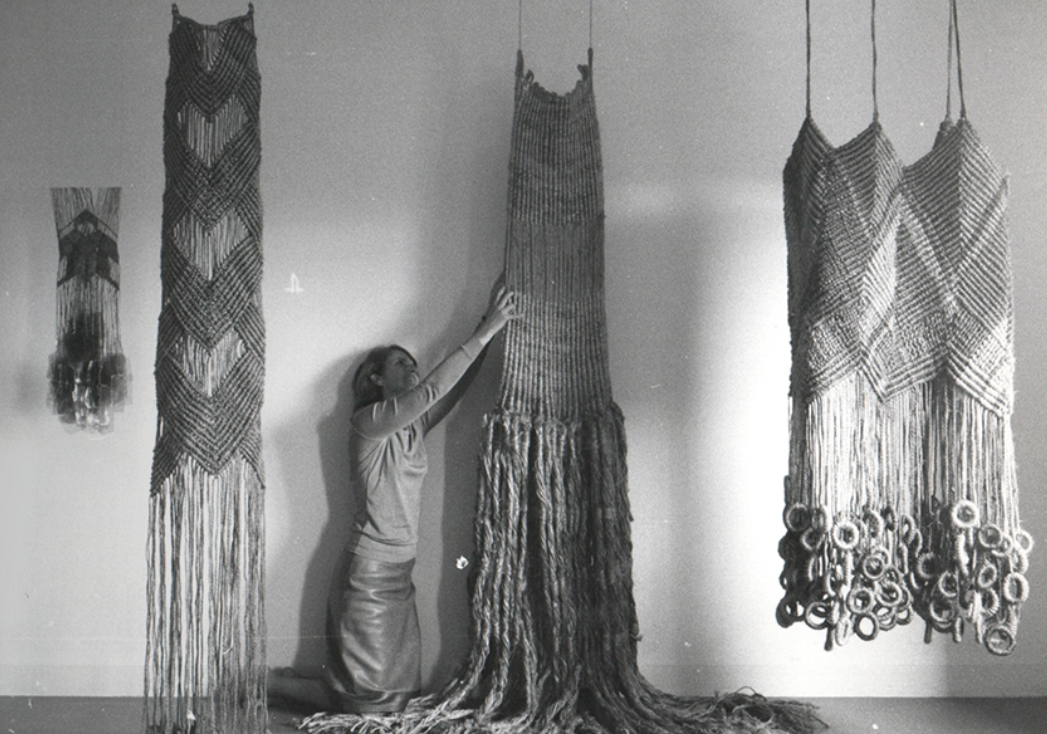
These sculptures —or installations— were originally named Ens, a term that also gives the exhibition its title because, according to the curators, it is implicit in all of Muñoz's production. But what exactly does "Ens" mean? They themselves (Manuel Cirauqui, Rosa Lleó and Sílvia Ventosa Muñoz, the artist's daughter) point out that, upon entering the room, one perceives that there is someone there, even though the space is deserted... Can it be interpreted that they are spirits or ghosts...? Many of these artifacts float suspended in the air; they levitate and vibrate subtly with the air currents as if they had a life of their own. It is an aspect that would be enhanced in later works, such as the spectacular Kite Birds that flew weightlessly over the interior space of the Palacio de Velázquez in 1982.
The volumes of the Ens are empty, immaterial inside and hollow; light and air pass through them: the true body is the void. Furthermore, the materials and technique used are ancestral, carrying the memory of those who have already passed...
Aurèlia Muñoz will expand her research with a multitude of records, the analysis of which goes beyond these lines, but it is very significant that the exhibition concludes with the so-called Winged Books. These pieces culminate and condense her great obsessions: weightlessness and the aerial dimension, the desire to detach oneself from the wall to project oneself into space, and an inquiry into the material —in this case, paper— that orients us towards this ghostly and symbolic dimension to which we alluded previously.
The exhibition has many values, for example, the unpublished models that bring us closer to her way of working, but perhaps the most significant curatorial commitment is to point to the ghostly dimension of Aurèlia Muñoz; this hidden and secret dimension of the artist that has gone unnoticed until now.


You may be
interested
...