
Exhibitions
Steve McQueen explores the power of the bare voice
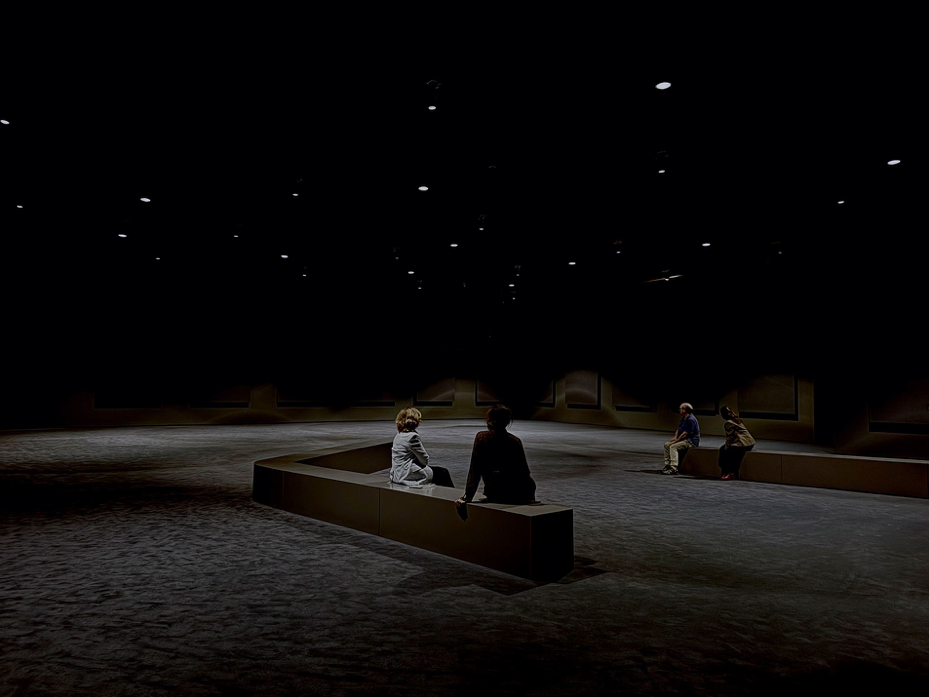
What happens when images disappear and only the voice remains? Steve McQueen poses this question in 66–76–26 , an installation that suspends the viewer's gaze to place listening at the heart of the artistic experience. In a room shrouded in darkness, the British artist and filmmaker brings together Nina Simone's 1966 and David Bowie's 1976 performances of Wild Is the Wind , two recordings separated by a decade that, when brought together in the exhibition space, construct a dialogue as intimate as it is impossible. Curated by Lekha Hileman, the Guggenheim Museum Bilbao's exhibition explores music's capacity to convey desire, vulnerability, and memory beyond images.
Throughout his career, McQueen has explored themes such as violence, history, grief, and the human experience, creating works that force viewers to confront what they might prefer not to see. This time, however, the artist chooses to remove all visual references. There are no projections, objects, or images to guide interpretation. The darkness eliminates distractions and transforms the space into a place of listening, where each voice acquires a physical and emotional presence.
Composed for the 1957 film of the same name, "Wild Is the Wind" found in Simone and Bowie two interpreters capable of taking the song into very different personal territories. Simone's version, recorded during the height of the Civil Rights Movement in the United States and a period marked by health difficulties, is imbued with an intensity that transcends the musical interpretation. Bowie's, recorded in 1976, belongs to a period of profound personal fragility, marked by his addictions and the toll of a life subjected to extreme pressure. In both recordings, the song acquires a dimension that overflows its own lyrics to become an expression of longing, dependence, and emotional need.
McQueen has long been fascinated by the emotional power of these two versions. By placing them at opposite ends of the same room, he creates an encounter that never actually happened: Simone and Bowie seem to respond to each other across time, as if their voices could recognize one another in a shared experience of vulnerability. The ten-year gap ceases to be a mere chronological reference and becomes a space of resonance between two lives and two ways of experiencing music.
The artistic operation is particularly significant because it dispenses with any visual accompaniment. The darkness functions not merely as a scenographic device, but as a condition that alters the audience's relationship with the work. Without images to contemplate or objects to photograph, attention shifts to the nuances of the voice, the breathing, the pauses, and the silences. Listening demands time and presence, transforming the individual experience into a form of participation.
For McQueen, the visitor constitutes a third voice, essential to completing the installation. Their presence introduces a new dimension to the dialogue between Simone and Bowie, ensuring the work is not limited to the original recordings. Each person who enters the room brings their own memories, associations, and sensibilities, so the piece remains open to evolving interpretations.

You may be
interested
...