
Exhibitions
The Earth unfurls its skin from space
CaixaForum Girona presents Orbital Views, an exhibition that transforms images from the European Space Agency's satellites into a visual journey to understand the beauty of the planet and the wounds left by human activity.
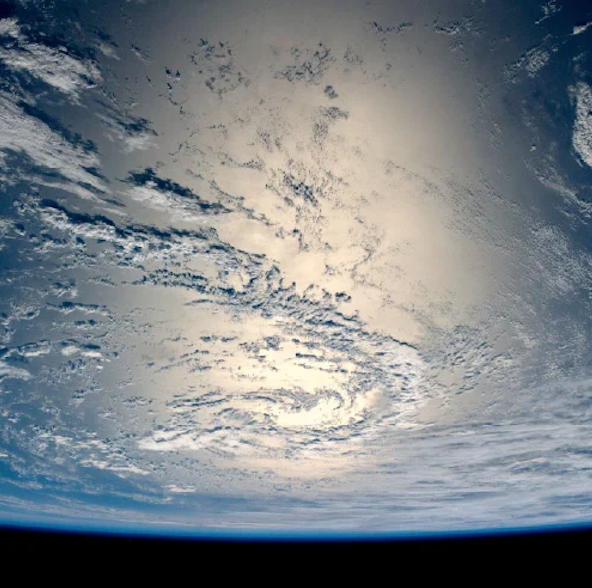
Seen from space, the Earth is revealed as a work in constant transformation. Coasts draw changing borders, forests form large masses of color and the oceans exhibit an immensity that contrasts with the fragility of ecosystems. This perspective, both fascinating and disturbing, articulates Orbital Views. The planet seen from satellite , an exhibition that proposes a visual, scientific and critical approach to our environment based on images obtained by the missions of the European Space Agency (ESA). From October 8, 2026 to February 9, 2027, CaixaForum Girona invites visitors to contemplate the planet from a distance that allows them to discover both its beauty and the transformations caused by human activity.
The photographs taken from Earth orbit constitute the starting point of a journey that goes beyond the aesthetic impact. The satellite images, with their textures, shapes and chromatic contrasts, offer a singular representation of the landscape and, at the same time, become instruments for interpreting phenomena that often escape everyday perception. The interactive installations of the exhibition facilitate this reading and introduce the concept of the anthroposphere, understood as the sphere of human interaction that is incorporated into natural systems and alters their balances.
The exhibition explains how the network of Earth observation satellites, developed by ESA in collaboration with the European Union, works. Using technologies such as radar, multispectral cameras and altimetry, these missions allow for continuous information on the state of the planet. Comparing images from different periods makes visible changes in the territory, atmospheric pollution, the transformation of ecosystems and the evolution of urban areas.
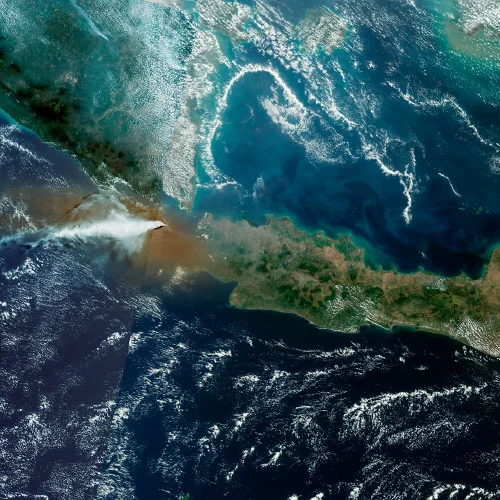
Plume from the eruption of the Anak Krakatau volcano, Indonesia. September 5, 2026. © Copernicus Sentinel-3 (ESA).
The tour is organized around the Earth's large interconnected systems. The atmosphere is shown through the Sentinel-4 and Sentinel-5 missions, which monitor pollutants such as methane and ozone; the hydrosphere and cryosphere, through Sentinel-3 and Sentinel-6, allow us to follow the evolution of the oceans and other water bodies, as well as the effects of climate change on ice. The biosphere focuses on Sentinel-2 and the Biomass mission, dedicated to studying forest biomass and the carbon stored in forests, while Sentinel-1 observes, with radar technology, the transformations of the Earth's surface, from urban changes to certain geological phenomena.
Beyond scientific dissemination, Orbital Views raises an essential question: how can we learn to look at what we are transforming? The orbital distance does not distance the viewer from the planet, but rather provides them with a new perspective to recognize the interdependence between its systems. In this sense, the images become a tool for knowledge and also an invitation to assume responsibilities in the face of the environmental crisis.

You may be
interested
...