Exhibitions
What's missing also matters
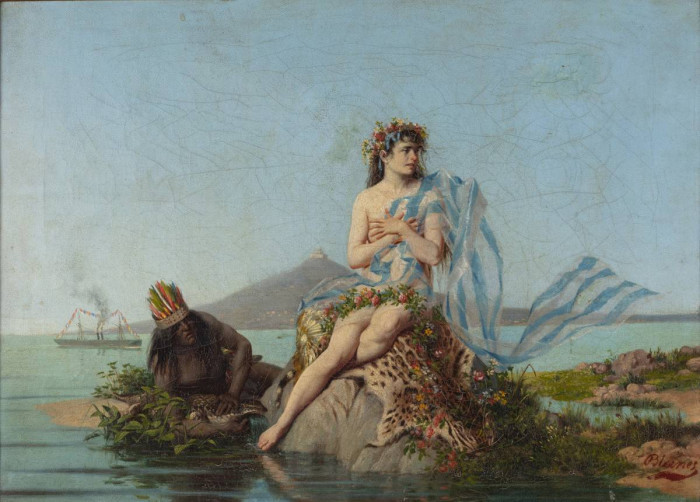
Absences are never silent, however much one might think otherwise. They remain in narratives, in images, in what museums preserve, and also in what their collections could not—or would not—preserve. Based on this idea, the National Museum of Visual Arts presents Erasures, Inventions, and Indigenous Missings in the Collection , an exhibition that revisits its own collection from a contemporary perspective and proposes a return to the ways in which Indigenous populations have been represented, omitted, or displaced from the construction of memory.
The exhibition in Uruguay's capital, open from October 3 to November 15, 2026, is part of the Heritage Day celebrations, dedicated this year to the theme Indigenous Roots: Past, Present, and Future . Curated by María Eugenia Grau, María Eugenia Méndez, Ce Vignolo, and Roxana Fabius, the exhibition does not aim to offer a definitive reconstruction of the past, but rather to open a space for questioning the mechanisms by which a particular idea of nationhood was constructed and the place that Indigenous peoples occupied—or ceased to occupy—within that narrative.
For decades, an imagined historical narrative allowed for the articulation of a coherent vision of the birth and consolidation of the nation-state. In that process, Indigenous memory was subjected to various forms of erasure. The exhibition starts precisely from this fracture to observe how heritage can reproduce certain perspectives and, at the same time, become a territory from which to question them.
The selected works belong to the MNAV collection. Some are part of the collection's best-known narratives; others remain in a much more discreet position. Together they construct a set of images in which the indigenous presence appears intertwined with territorial conflicts, the imposition of models of social organization, and what the exhibition identifies as a process of "civilizational disciplining."
These representations also reveal the tensions that accompanied the transformation of those territories: struggles for land and culture, processes of cultural mixing, and mechanisms of stigmatization. For a long time, Indigenous peoples were described using categories such as barbarians, savages, violent, or threatening. A contemporary perspective allows us to question these representations and ask what is left out when history is told exclusively from the perspective of those who held power.
The problem lies not only in how these populations were represented, but also in who had the power to construct the narrative. Indigenous voices, their own stories, and their material and symbolic forms of production appear as one of the great omissions from that collective memory. Therefore, the exhibition does not simply aim to add new images to an existing narrative, but rather to question the conditions that determined what was preserved, displayed, and transmitted.
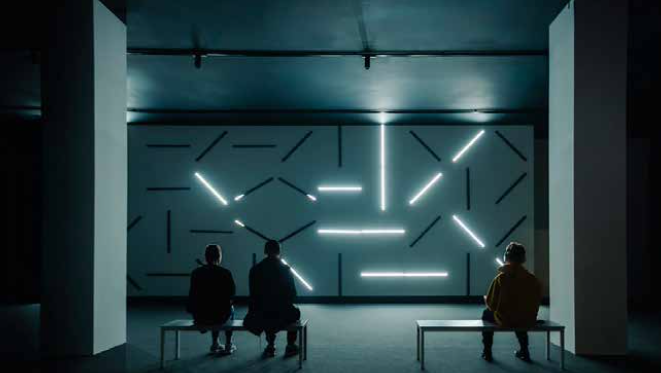
The very arrangement of the exhibition contributes to this reflection. The works occupy approximately half the room and are positioned at a lower height than usual. Emptiness thus acquires both a physical and symbolic dimension: that which is absent also occupies space. Absence ceases to be an abstract concept and becomes a perceptible experience within the museum.
In this empty space unfolds Hilando Oyendaú , a guest performance whose title means 'weaving memory' in the Chaná language. The action recovers ancestral practices inherited from Indigenous grandmothers and seeks to restore them to a corporeal and contemporary presence. In contrast to the static logic of the museum object, the performance introduces gesture, the body, and transmission as forms of knowledge.
The intervention also raises an essential question: Indigenous memory does not belong solely to the past. There are knowledge, practices, and ways of relating to the world that remain alive and can be recovered in the present. Heritage, then, ceases to be understood only as that which is preserved and becomes also that which is activated, transmitted, and put back into circulation.

You may be
interested
...