Exhibitions
A language made of light
Signes, by Playmodes, transforms the MORERA Digital Atrium into an audiovisual organism in constant motion. It will be on view at MORERA until February 28, 2027.
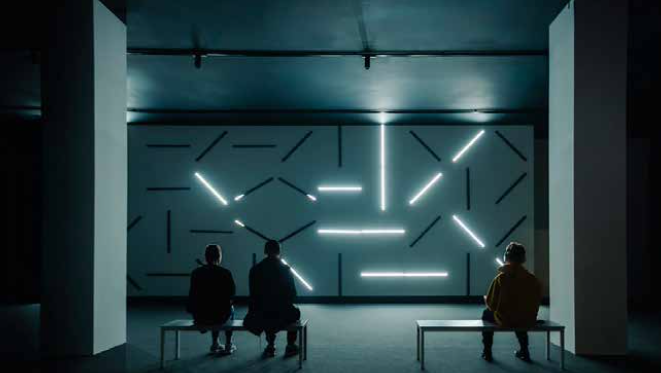
The Digital Atrium of MORERA. Museum of Modern and Contemporary Art of Lleida opens a new space for experimentation with Signes , an audiovisual kinetic sculpture by Playmodes that proposes a different way of understanding the relationship between light, movement, sound and space. Installed on the ground floor of the museum, the work replaces the idea of a fixed composition with a living, changing and unpredictable system, capable of generating an experience that is never exactly repeated.
Created by Playmodes, a contemporary craft and design workshop founded by Santi Vilanova and Eloi Maduell, Signes is situated in a borderland between kinetic art, abstraction, light art and visual music. The piece functions as a generative canvas in which light ceases to be a simple element of illumination to acquire a structural and expressive dimension. The movement of its components constructs forms, rhythms and visual sequences that have, at the same time, a sound correspondence.
The work thus behaves like an autonomous instrument of visual music. A set of geometric and compositional rules determines its possibilities of transformation, but these rules also incorporate a certain degree of indeterminacy. It is precisely in this tension between order and unpredictability that Signes finds his strength: each configuration is born from a pre-established system, but the final result retains an open and unrepeatable dimension.
The visitor witnesses the permanent sculptural process of transformation. The forms appear, move, articulate and disappear, while sound accompanies and amplifies each movement. The visual dimension and acoustics do not function as two independent layers, but as a single audiovisual language in which what is seen and what is heard are part of the same structure.
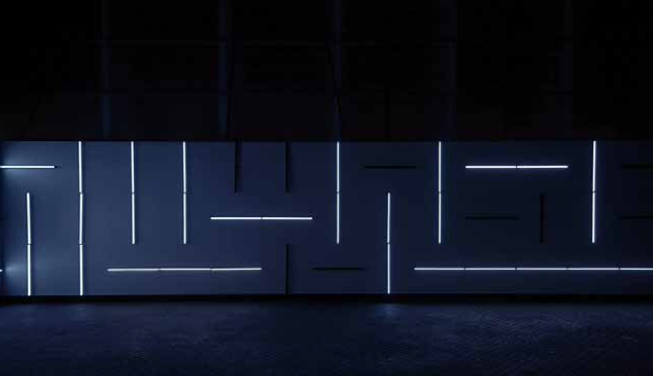
In this sense, Signes explores a central question of contemporary creation linked to digital technologies: what happens when art ceases to be a stable object and becomes a behavior? Playmodes proposes a work that does not limit itself to showing a digitally generated image, but rather constructs the conditions for this image to evolve. The work is not only what appears before the viewer's eyes, but also the system that allows it to appear.
The result is situated halfway between organic behavior and digital automation. There is an apparent freedom in the forms that emerge, but this freedom is sustained by an architecture of rules, algorithms and compositional decisions. In this way, Signes turns time into another artistic material. Each moment is a provisional configuration of an organism that is constantly changing.
The incorporation of the piece into the MORERA Digital Atrium also reinforces the museum's desire to open up to languages that explore the creative possibilities of new technological tools. The ground floor space is thus consolidated as an area intended for practices that question the traditional boundaries between art, technology, sound and design.

You may be
interested
...