
Exhibitions
Organic Wefts: The Precolonial and Contemporary Indigenous Creative Work of Abya Yala
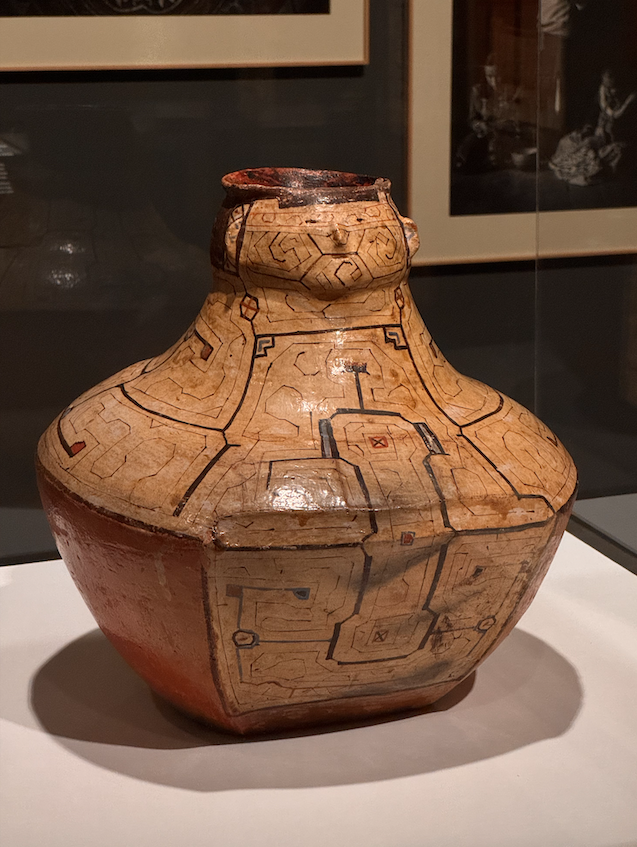
A cultural oasis
Entering the jungle of specialty cafes, ice cream parlors and designer stores in the irregular and narrow streets of Barcelona's Gothic Quarter on the afternoon of September 18th is a real gymkhana to avoid obstacles until you reach Montcada Street, number 14. It should be added that, surprisingly, entering the Palau Nadal -current home of the Ethnological Museum and World Cultures (MUEC)- reminded me for a few moments of the refrain of a pop song that refers to a kind of telluric experience of a certain Iglesias (and it's not that I want to give him free publicity). A true cultural oasis that shares a neighborhood with the long queues of the Fundació Museu Picasso de Barcelona and the more chic experience of the Dutch subsidiary Moco Museum Barcelona. I would like to strongly recommend that readers of Bonart digital come and enjoy the new temporary exhibition at the MUEC, Trames. Traditional works and contemporary American creations , which can be visited until April 24, 2026.
A group exhibition that, curated by curator Estela Ocampo, brings together a selection of pieces from the museum's American collections with the contemporary creation of six indigenous American artists or artists connected to the territory: Sebastiana Calfuqueo (trans woman from the Mapuche community of Santiago de Chile, 1991), David Díaz Gonzales (Shipibo-Konibo people of Nuevo Saposoa, Peru, 1992), Sara Flores (Shipibo-Konibo people of Tambo Mayo, Peru, 1950), Sheroanawe Hakihiiwe (Ianomami people, from Sheroana, Venezuela, 1971), Bernardo Oyarzún (Mapuche from Los Muermos, Chile, 1963) and Guadalupe Miles (Buenos Aires, 1971). Artists aware of their dichotomy between the globalized contemporary art world (fairs, galleries and art institutions) and their essentialist responsibility for the priorities of their communities of origin.
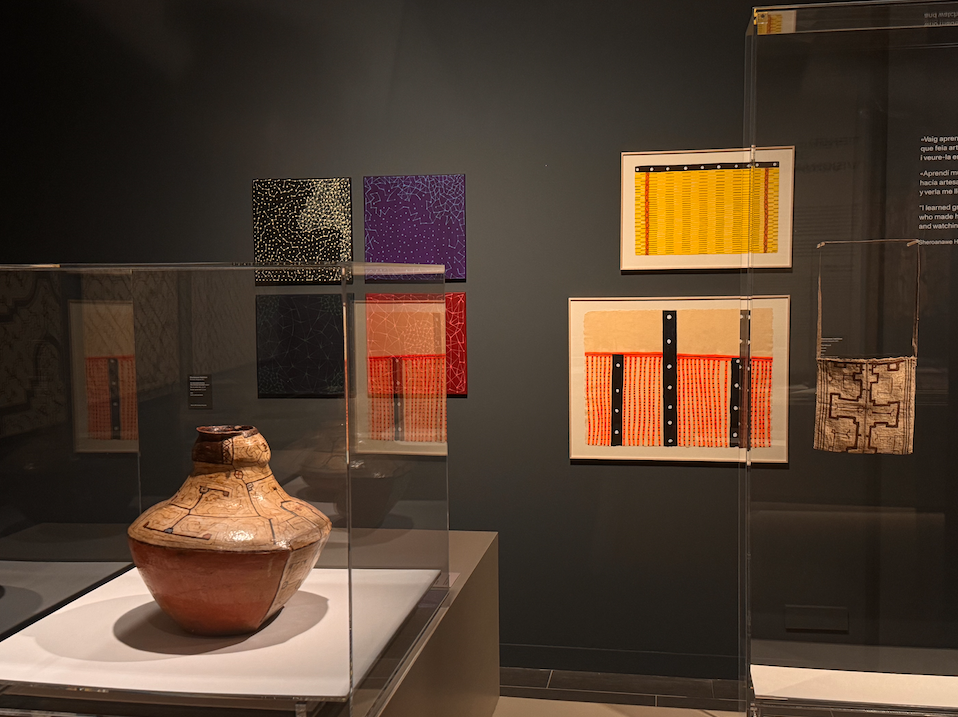
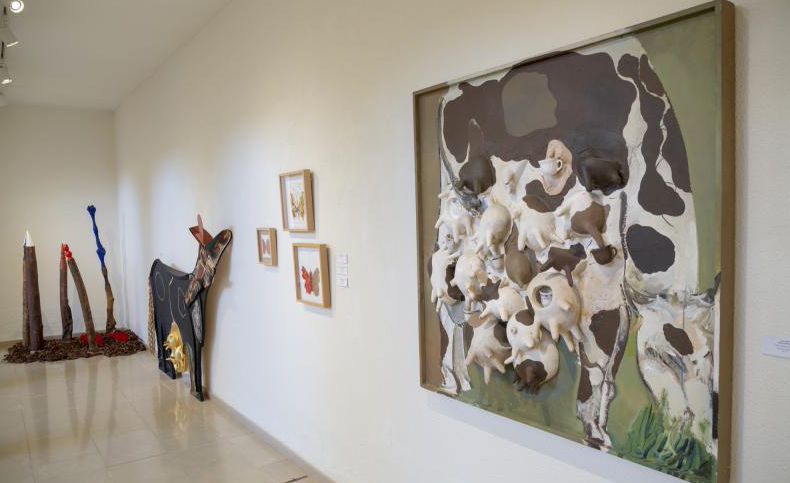
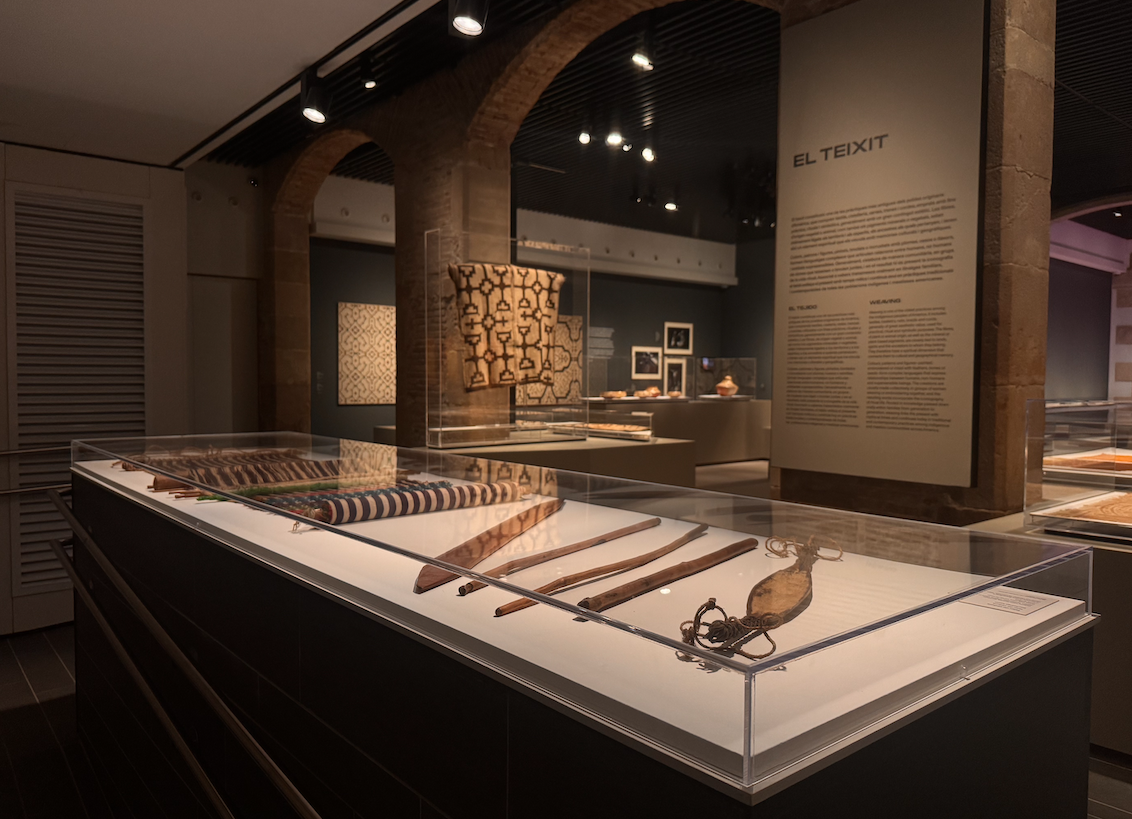
View of the exhibition hall.
Itinerary and connection
Once the various inaugural speeches had been heard, almost every corner of the exhibition space was flooded with a multiplicity of voices, coming from groups of people enjoying the contemplation of the exhibited works, performing social rituals, or holding private discourses with the works or with a limited audience. Amidst this intellectual and, at the same time, prosaic effervescence, the visit acquired different degrees of depth throughout the entire route: from the entrance room furnished with photographs and television monitors, through the large rectangular room that articulates the complicity between the museum's heritage pieces -which cover a large part of the space- and the adjacent contemporary works (installed on the walls), until reaching another, more secluded space, where Mayan funerary bands are exhibited in a display case, and two works by Bernardo Oyarzún.
A successful pedagogical installation with a visual itinerary between the museum's heritage pieces and contemporary works of art - which I was able to record with suitable framing, thanks to the help of Maria Benito, room manager, and Óscar Alvarado, photography teacher at the Llotja Art School. The arrangement of the traditional works in this space follows a path of display cases that house ceramic pieces (anthropomorphic jug and bowls), looms and utensils, vessels, sashes, funerary textiles and pre-colonial and more recent bags from the aboriginal communities of the central coast (Chancay) and southern Peru (Nasca), Guatemalan Maya, Chilean Mapuche, Shipibo-Konibo of the Ucayali River basin (Peru), Yanomami of the Upper Orinoco (Venezuela) and Witxí in northern Argentina.
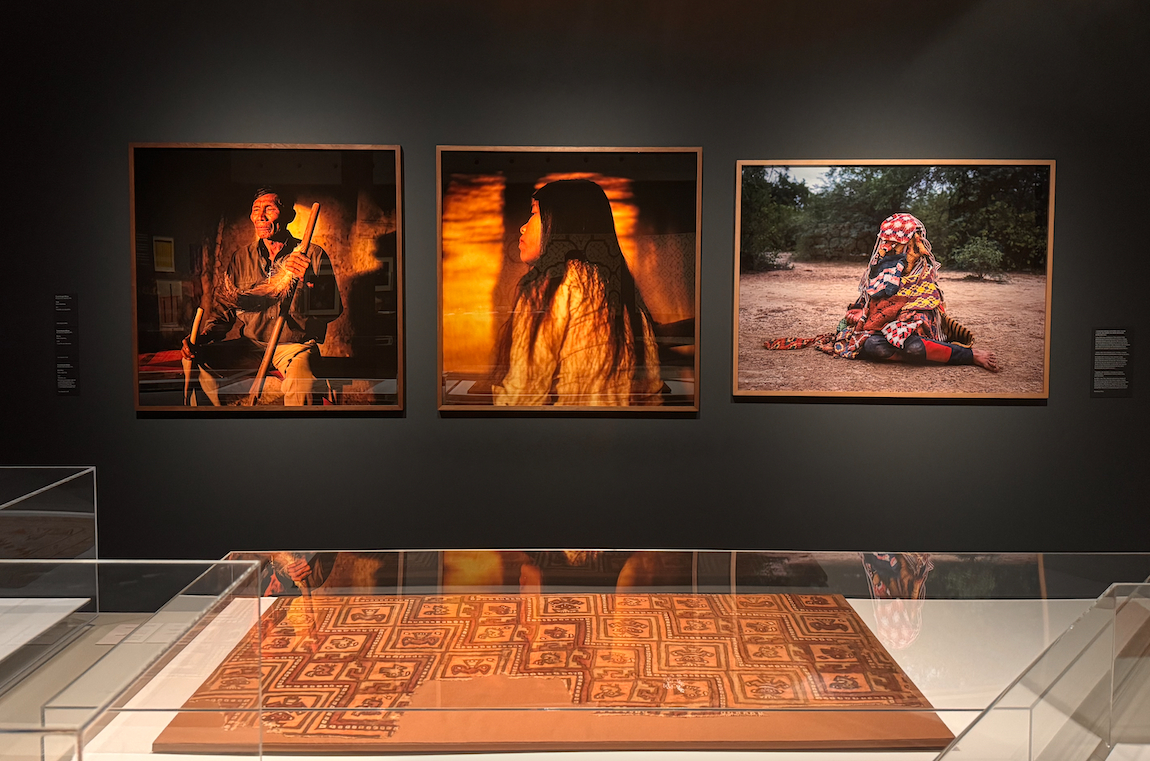
General view of the photographs of Guadalupe Miles.
All these pieces acquire a notable prominence that, far from a subaltern and colonial interpretation, stands out for its inspiring, material and symbolic dimension. In other words, they constitute the starting point and the engine that drives the current inventiveness of many indigenous artists and craftsmen.
Crossover and synergies
Despite being centuries old, these traditional pieces share an ancestral and cultural legacy with all contemporary indigenous artists, as they combine in their poetics artistic practice -from different Western formats and artistic registers-, the dissemination of the works through channels and mechanisms that predominate the rooting of a millenary identity, the culture of care, the appreciation for the territory and the recovery and reinterpretation of traditional creative processes.
In this context, it is worth highlighting the contributions of the Chilean Mapuche artists Bernardo Oyarzún and Sebastiana Calfuqueo, who, through the installation, video and video-performance, allude to personal experiences, cosmovisions, life stories and textile practices, among others. Oyarzún presents his installation entitled Anvers (2023), which projects a red carpet on the floor. For his part, Calfuqueo critically reflects in his video-performances Gran cascada (2022) and Ésser líquid (2020) on the cultural and socio-political dynamics that surround her condition as a trans woman, Mapuche, curator and artist. They are two pieces that, surrounded by a paradisiacal landscape, manifest the performative power of Mother Nature as a healing, integrating and catalytic whole with respect to all her creatures.
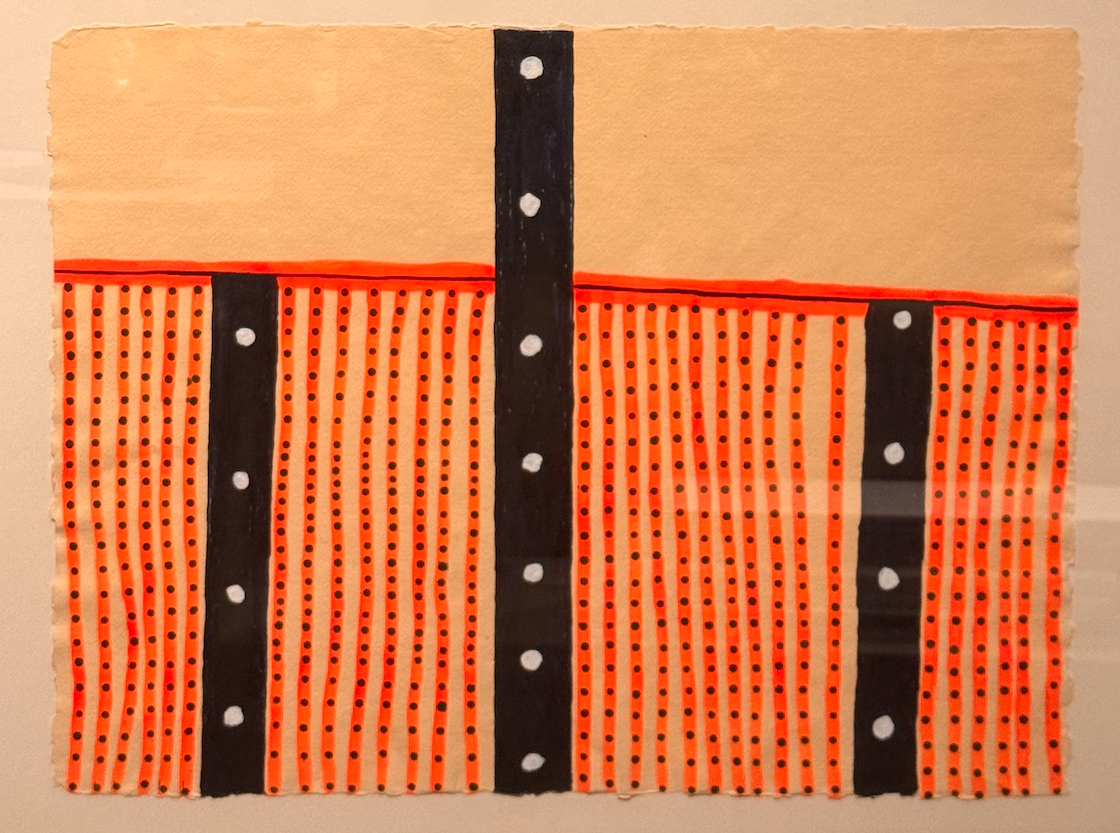
Sheroanawe Hakihiiwe. (2023). shield
As for the works of Sara Flores and Sheroanawe Hakiiwe, they reinterpret forms, patterns and traditional knowledge of the Shipibo-konibo and Ianomami culture that, broadly speaking, trace lines, grids, patterns and figures on different supports. Sara Flores, as a member of the Shipibo-konibo community, recounts in a documentary video -located in the access room- the spiritual relationship of the feminine and ancestral knowledge of the kené with the creation of a complex system of geometric patterns to decorate fabrics and ceramic pieces. These organically articulated and structured patterns are also reproduced in the compositions of vegetable pigments on wild cotton fabric of the artist - Untitled (2023)- exhibited in the main room. On the other hand, Sheroanawe Hakihiiwe transmits this structuring organized in points and reticulations in the works Tela d'aranya trencada 1, 2, 3, 4 (2025), Escut (2023) and Palma pintada amb punts verds (2022). Furthermore, in his animated short film En somnis el shaman está cantar -located in the lobby-, he narrates the revelatory and augurative power of dreams towards the community and oneself, which are interpreted by a shaman.
Guadalupes Miles is an interdisciplinary artist well connected to the indigenous communities of the Chaco. Her artistic and educational projects revolve around the creation of spaces for communication and intercultural collaboration. In this exhibition, the artist has presented a documentary video -located at the entrance- and the photographic recording of the Witxí community in the areas of northwestern Argentina. As a result of this ethnographic work, the artist immortalized with full-color photographs the pieces Karina (2006), Tiluk (2012) and Hillü Wuk (2022). The last piece belongs to the project El rostro del holobiente , carried out between the town of Santa Victoria Este II and the German city of Kassel, which was exhibited at Documenta XV (2022).
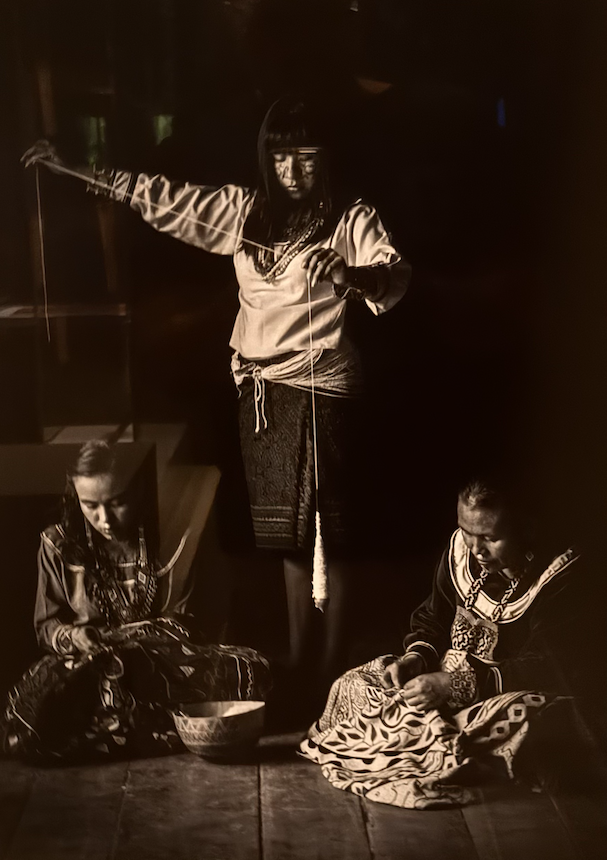
David Díaz. Craftswomen working on embroidery.
Regarding the photographic work of David Díaz Gonzales, it responds to an attempt to generate an archive of living memory on the creative processes of embroidery and designs guided by kené, always executed by women artisans, such as the photograph Artisans work on embroidery and making blankets with kené designs . In his documentary video, the artist defends a photograph as an archive, an object of memory and a means of dissemination towards the claim of the identity and preservation of the culture of the original peoples. From this sense, it is understood that Díaz's emergence of collecting customary conversations, life stories, family meetings... It is not a mere digital capture and reproducibility suspended in time, as if it were an aestheticized phenomenon.
Once my time at the MUEC is up, I realize that, like Lewis Carroll's Alice, I have been absorbed by a kind of black hole within the museum itself. My mind has been transported to another spatiotemporal and multisensory dimension -composed of colors, lights, fabrics, textures, sounds and voices- until Maria Benito warns me that the museum has closed its doors for a while. A harbinger of a second visit.
View of the exhibition hall.

You may be
interested
...