Exhibitions
Carles Congost. 'A finger of ice: three songs' to measure time
Introduction: The twilight turn and temporality in the practice of Carles Congost.
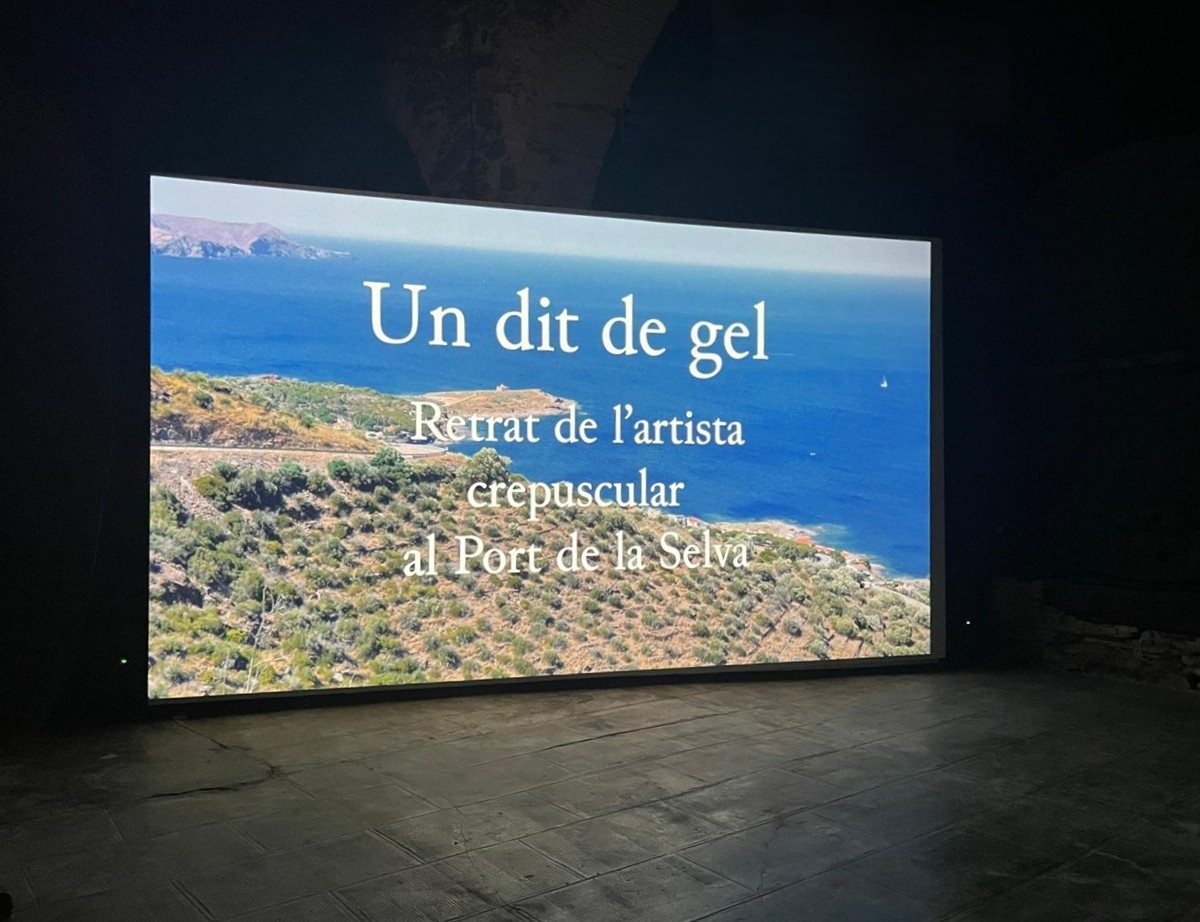
A Un dit de gel. Retrat de l'artista crepuscular al Port de la Selva , Carles Congost aborda la relació entre memòria, temporalitat i trajectòria artística a través d'una ficció que mira el passat des de la posició que l'artista ocupa en el present —una operació d'autoarqueologia crítica que qüestiona els relats lineals de l'evolució artística—. Presentat el 18 de juliol de 2026 en el marc del cicle A+A Vestigis d'estiu d'ARBAR, el film és una coproducció d'ARBAR i el Bòlit, Centre d'Art Contemporani de Girona. L'estiu i el paisatge del Port de la Selva articulen aquesta mirada retrospectiva i situen el territori com a element actiu i polític de la construcció del relat.
Congost develops this reflection through recurring procedures in his practice with a new reflexive density: autofiction, melodrama, music, irony and the deliberate hybridization of cinematic and imaginary languages from media culture. Instead of turning youth into an object of nostalgia or reducing maturity to a simple sign of loss or obsolescence, the film interrogates the way in which experiences are transformed when they are remembered from the present. What has been experienced is not recovered intact: memory selects it, reorganizes it and endows it with new meanings according to the urgencies and mutations of the present. This relationship between memory, time and identity is particularly concrete in the three songs that run through the film —"Port de la Selva", "Les cançons romàntiques" and "Un dit de gel"— and which can be read as three successive operations on what has been experienced: reconstruct, conserve and measure. More than acting as a simple soundtrack, the songs structure the story and advance the reflection from the reconstruction of youth to the consideration of one's own trajectory based on the accumulated time and the position assigned by institutions and the market. This musical articulation has its correlate in the staging. The bodies, objects, photographs and landscape materialize some of the questions that the songs formulate. A photograph fixes a trace of the past; the same landscape allows different times to overlap; the presence of different generations makes the distance between what has been and the position that is now occupied in the field of contemporary art perceptible.
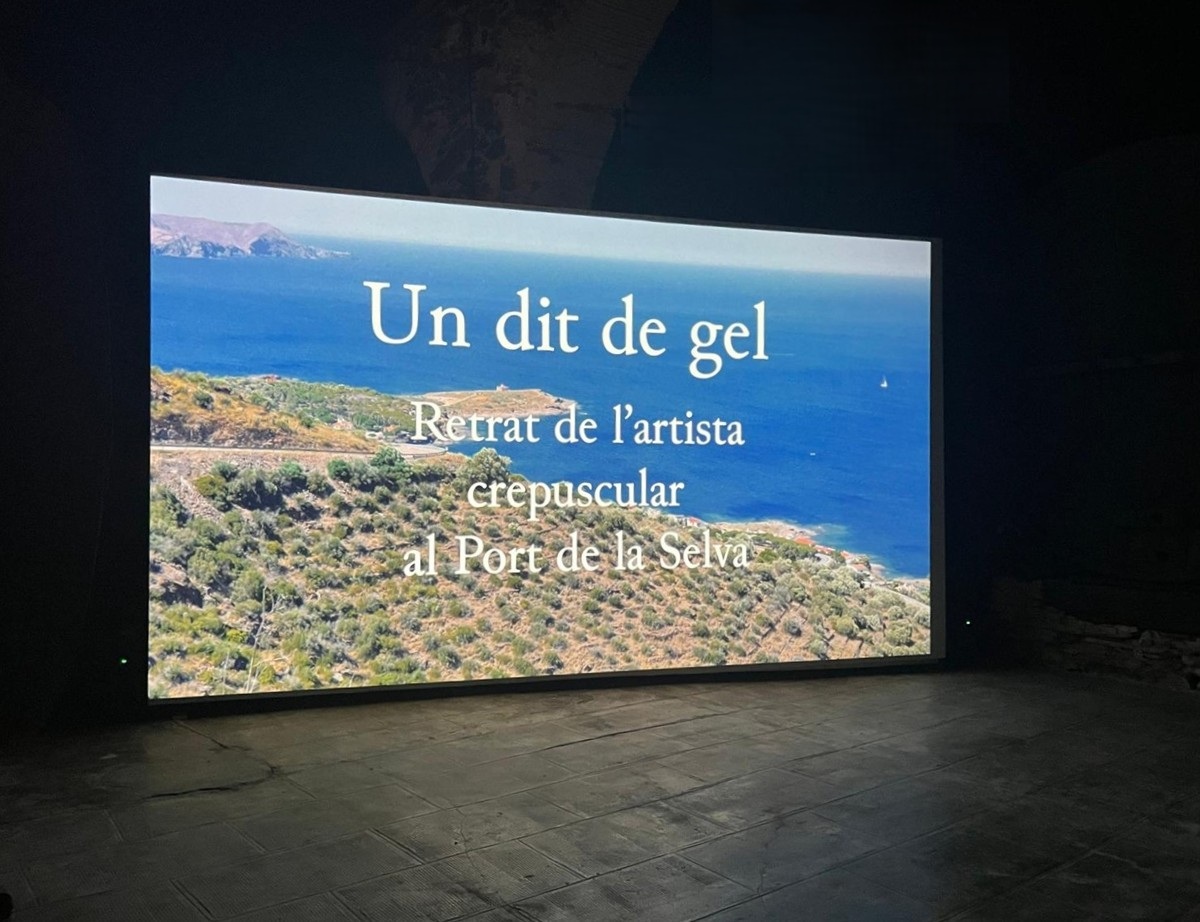
View of the screening of A Finger of Ice. Portrait of the Twilight Artist at Port de la Selva, by Carles Congost, at the ARBAR Center. The maritime landscape of Port de la Selva opens the film and situates the territory as a space where memory and time overlap. © ARBAR.
It is in this articulation between music, image and temporality that the resonances of James Joyce, Éric Rohmer, Thomas Mann and Luchino Visconti acquire meaning. They are not so much previous models as points of contact that allow some of the issues present in the work to be developed: Joyce, the formation of the artist and the emergence of aesthetic consciousness; Rohmer, the open temporality of love and summer experiences; Mann and Visconti, the confrontation between desire, maturity and awareness of time in the face of the vulnerability of the body and of one's own creative authority. All these lines converge on a question that runs through the film: neither the body nor the identity of the artist can escape the passage of time nor the fluctuations of symbolic value.
I. "Port de la Selva": The archaeological reconstruction of youth and the pop mirror
In "Port de la Selva", the memory still retains the form of a story susceptible to reconstruction. Youthful love reappears through a constellation of places, objects, music and situations - La Bolera, la Zodiac, la Vespino, the porró, the lighthouse, the roads of the Empordà - which function as anchor points for memory. They are not simple elements of setting: linked to moments experienced, they allow them to be reactivated from the present as foundational scenes of a subjectivity. The recorded cassettes, with songs by Loquillo, Madonna, The Cure or The Smiths, introduce a generational dimension into this framework. They place the experience in the context of the eighties and connect a shared cultural imaginary with particular experiences. Pop culture thus becomes a sentimental archive in which music, objects, places and images preserve fragments of the experience and contribute to giving narrative form to memory with an irony typical of Congost's critical distance.
Remembering, however, does not only mean recovering what happened. Memory also restores a certain way of living time: the intensity with which the present was experienced and the openness with which the future was imagined. Youth appears, in this sense, as a time in which what is yet to come remains open to different possibilities of self-determination.
The distance from that past is therefore not only biographical. The passage of years modifies the way in which we inhabit the present and project ourselves towards the future. It is this difference that the reconstruction of youth makes perceptible. The film, however, does not present that past as an intact and recoverable reality. It reorganizes the memory from the present. The chosen fragments—places, music, objects, scenes—retrospectively configure a story and convert what was experienced into a possible fabled scene of origin. Memory and autofiction begin to intertwine here: remembering also means deciding which images and which episodes can shape the past and legitimize a trajectory.
It is in this process of retrospective reconstruction that the reference to James Joyce acquires a particular significance. In A Portrait of the Artist as a Young Man , Stephen Dedalus embodies the figure of the artist in training: a still open identity, shaped through discoveries, conflicts and decisions. His movement is fundamentally projective: he looks towards the future while trying to emancipate himself from the family, religious and social structures that aspire to determine him. Experience thus becomes the subject of creation. What is lived is not confined to the biographical sphere, but participates in the process through which Dedalus constructs himself as an artist. Joyce allows us to think of youth as a time oriented towards what is yet to be done.
Congost places the figure of the artist in a different temporal position. A finger of ice. Portrait of the twilight artist in Port de la Selva does not focus on the awakening of a vocation or on the formation of an artistic identity, but on a moment in which an already extensive career allows one to look both forward and backward. If Stephen Dedalus advances towards what he may yet become, the character of Congost returns to the episodes that may have contributed to constituting him and rereads them from the perspective given by the passage of time and the sedimentation of the work done.
Between the figure of Joyce's young artist and that of Congost's twilight artist, a temporal distance opens up that becomes a matter for reflection. "Port de la Selva" does not constitute the transparent story of an origin, but its retrospective reconstruction: a set of places, links, objects and music through which that youth continues to intervene in the present as a critical mirror.
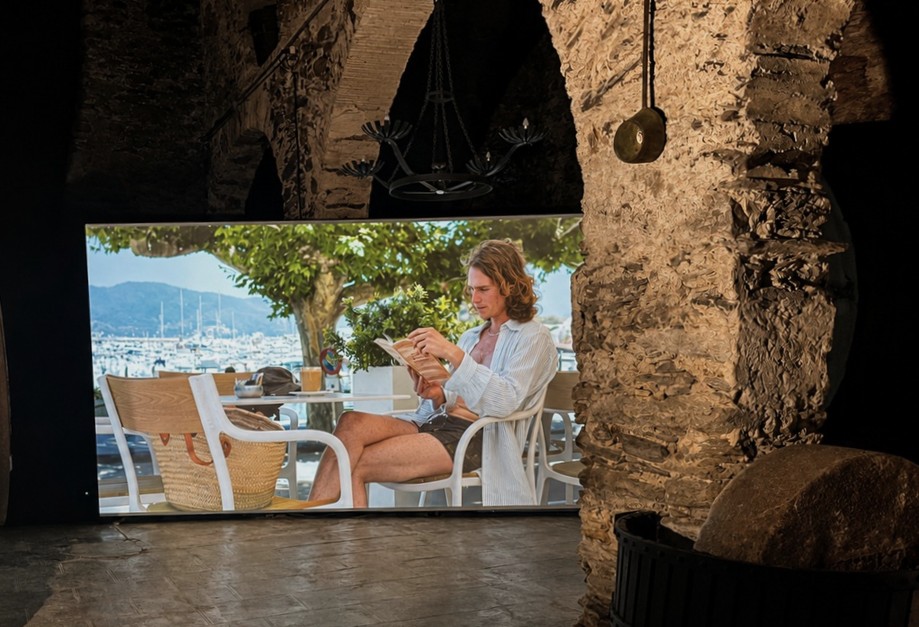
View of the screening of A Finger of Ice. Portrait of the Twilight Artist in Port de la Selva, by Carles Congost. Oriol Valls reads A Portrait of the Artist as a Young Man, by James Joyce, in a café in Port de la Selva. © ARBAR.
II. "Romantic Songs": The Affective Archive and the Persistence of the Vestige
If "Port de la Selva" reconstructs a youthful experience, "Les cançons romàntiques" introduces a different relationship with time: the awareness that certain experiences, despite having disappeared, continue to influence the way we perceive the present. What is missing is not only the loved one, but also a way of being in love and, with it, a certain way of looking at the world. "Tonar a comprendre les cançons romàntiques" expresses the desire to recover that disposition from which gestures, landscapes, music and cultural references acquired a particular, unsuspected meaning.
Love appears as a shared experience that transforms the perception of reality. Kisses, the sea, excursions or a shell bracelet coexist with conversations about colonialism, homophobia, racism or capitalism. Intimacy and thought do not operate as separate spheres, but are intertwined in the same way of living and interpreting the world. When the bond disappears, that shared gaze that had contributed to giving it meaning is also lost. This is where the proximity to Éric Rohmer is particularly suggestive. In many of his summer stories, the characters inhabit a provisional time, far from the usual routines, in which encounters, desires and decisions remain open to different possibilities. The sea, journeys and conversations are not simple scenarios, but constitutive elements of this temporality.
Congost takes up this summer temporality, but displaces it retrospectively. In Un dit de gel , the uncertainty no longer lies primarily in what may yet happen, but in the meaning that what has already happened acquires, over the years. In Rohmer, desire still belongs to the field of possibility; in Congost, it enters that of the interpretation of the affective archive. The question is no longer what will happen, but what persists from that shared time and in what way the present modifies its meaning.
This displacement also modifies the function of photographs, objects, places and songs. What was once part of everyday life later becomes a vestige. A photograph, a shell bracelet or a song cease to be just elements linked to a relationship and begin to act as traces capable of maintaining some form of presence. Photography and music, however, act differently in the face of time. Photography fixes the image of an instant and, in fixing it, makes its absence visible. The song, on the other hand, needs to be heard again: it only fully exists in duration and can temporarily reactivate what it had been linked to. One preserves an imprint; the other unfolds it again in time in a polyphony of echoes.
Conserving does not mean, therefore, keeping what has disappeared intact, but making it possible for its vestiges to continue to acquire meaning. This tension between persistence and transformation is visually concreted when Nadlyn performs “Les cançons romàntiques” from inside a rock. The scene abandons the realistic register and turns the landscape into a figuration of sedimented time. The rock can be read as the material form of this accumulation, while the voice that emerges from it suggests the persistence of what time has not completely erased. The image does not restore the past: it makes visible the coexistence of different temporalities. Maturity then appears not so much as a closure, but as the moment in which this coexistence becomes conscious and productive. Vulnerability, loss or awareness of displacement may surface, but irony prevents the film from turning them into a lament. Congost transforms these tensions into fictional material and keeps open the possibility of continuing to produce from a position that is no longer that of youth.
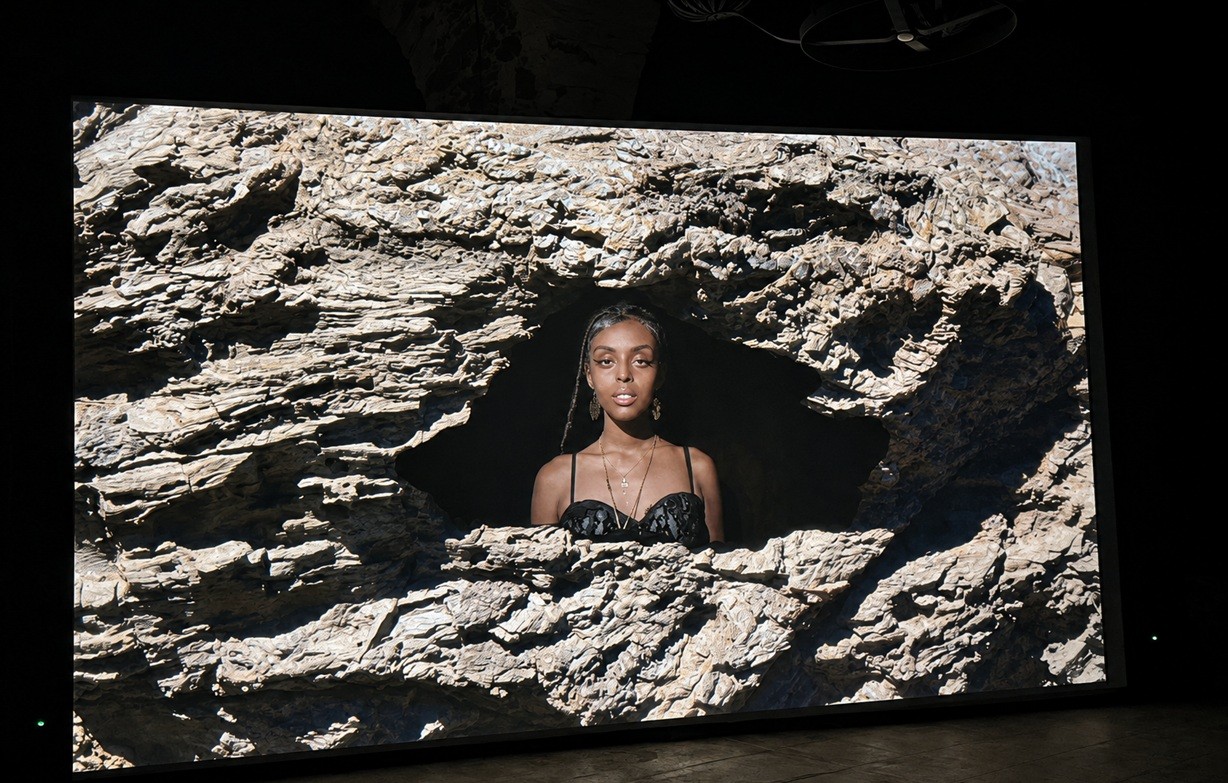
View of the projection of A Finger of Ice. Portrait of the Twilight Artist in Port de la Selva, by Carles Congost. Nadlyn emerges from inside the rock while performing "The Romantic Songs". The landscape becomes a figuration of accumulated time, in which different temporalities can resurface. © ARBAR.
Memory, in this sense, does not necessarily begin after loss. Preserving a photograph, an object or a song implies recognizing the transitory nature of what they are linked to. The vestige is not only what remains when something has disappeared: it can begin to be constituted while it is still part of the present, because what we experience is already susceptible to becoming a memory.
III. "A Finger of Ice": The Ironic Measure of the Art Path and System
With "Un dit de gel" a decisive shift occurs. If the first two songs directed their gaze towards youth and loving memory, the third places the vital and artistic position of the subject in the present at the forefront. Memory no longer serves only to reconstruct or preserve the past: it becomes a scale from which to examine one's own trajectory and question the current standards of evaluation.
It is here that the resonances of Thomas Mann and Luchino Visconti, through Death in Venice , take on a particular significance. The youth embodied by Tadzio is not only an object of fascination or desire, but also a term of comparison that forces Gustav von Aschenbach to confront time. Before him, the distance from his own youth becomes visible and, with it, the fragility of the identity he has built as an artist. Prestige and accumulated work do not exempt him from the vulnerability of the body, desire or awareness of time.
The link with Congost is not plot-related, but temporal: in both cases, a mature artist is confronted with a trajectory that is already thick and with the need to reread itself from the accumulated time. Congost, however, introduces a significant inversion. In one of the scenes of the film, Oriol Valls portrays Judit Martín: it is now the young character who observes and represents the mature character. Youth ceases to be exclusively the image contemplated from the present and also becomes the place from which this present is viewed in a reversal of the hierarchies of the gaze. The generational difference thus adopts a specific cinematic form. The question is no longer only how we look at what we were, but also how we appear before the gaze of those who come later.
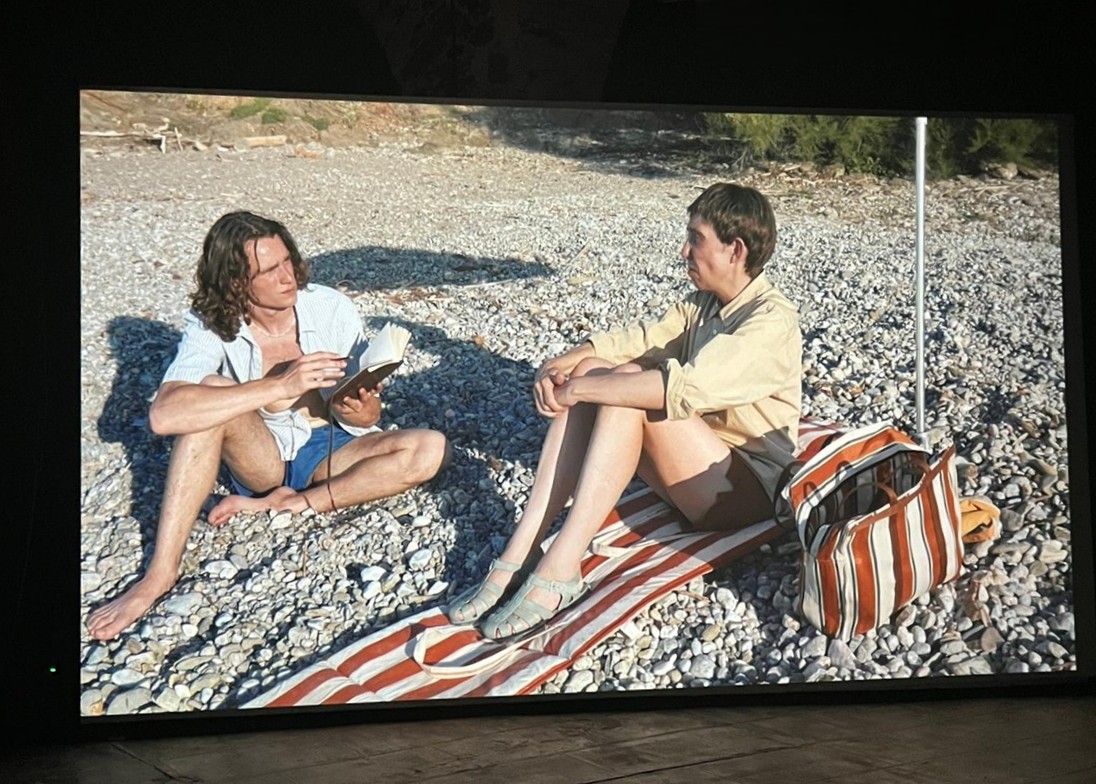
View of the screening of Un dit de gel. Portrait of the twilight artist in Port de la Selva, by Carles Congost. Oriol Valls portrays Judit Martín. The young character's gaze on the mature one turns the generational difference into an operation of representation. © ARBAR.
This inversion expands the relationship between youth and maturity that runs through Un dit de gel and shifts the question of recognition to another dimension: the awareness of one's own historicity. What is at stake is not only the place that the artist occupies in the present, but also what happens when his or her trajectory begins to be perceived both as contemporary practice and as accumulated history. Time thus ceases to constitute a simple biographical background to become an active dimension of artistic identity.
In this sense, Visconti's mediation is particularly significant. By turning Thomas Mann's writer Aschenbach into a composer, Visconti displaces part of the character's inner conflict into musical language. In A Finger of Ice , the song also plays a structural role: it does not accompany or illustrate the images, but rather concentrates and articulates some of the film's fundamental tensions. It is through song that the awareness of time, generational displacement and the transformation of one's own position can take shape without becoming an explicit statement. Here a decisive difference appears with respect to Mann and Visconti. Where his works tend towards tragic gravity, Congost introduces pop culture, autofiction, comedy and an ironic distance from the melodrama itself. Irony does not neutralize the conflict, but rather sharpens it, because it allows vulnerability and loss of centrality to be addressed without reducing them to a story of decadence or victimhood. The ironic gesture avoids complacency and turns fragility into a position from which to continue thinking and producing.
It is from this perspective that the "twilight" condition acquires its full density. It does not designate a finished artist or a career that is extinguished. Twilight is a temporal position from which the present also begins to be perceived as history. The light still persists, but it has changed enough for what seemed stable to be revealed as transitory. The artist continues to produce, desire and project himself towards the future, but he can no longer do so from a present without memory: his own career inevitably forms part of the place from which he creates. Thus, the accumulated history is not relegated to what has been left behind, but becomes an active matter of critical recycling. The experience, works, imaginaries and languages that have shaped a career can be revised, displaced and reactivated. Historicity therefore does not appear as that which closes a career, but as an active condition from which to continue working.
The Mediterranean light also participates in this displacement. The sun, the sea and the summer, initially associated with youth, desire and openness, end up making visible the distance between different moments of the same existence. Twilight concentrates this transformation because it simultaneously contains permanence and mutation: it is still light, but it is no longer the same light. In this way, the landscape ceases to be just a repository of memories and becomes a sensitive form of time.
It is in this context that the title A Finger of Ice acquires a particular force. A “finger” is a minimal and approximate bodily unit. Applied to ice, it allows us to ironically measure what, in reality, cannot be quantified: distance, cooling, loss or accumulated time. The strength of the image lies in this disproportion. Faced with potentially solemn questions—finitude, displacement, loss of centrality—, Congost responds with an almost domestic measure. The smallness of the unit does not reduce the problem: it makes it more precise by disarming it. The same operation reappears in the demand for “a hair of gratitude.” A finger and a hair: two minimal bodily measures with which the film addresses issues that exceed any measure. If the “finger of ice” registers a variation in temperature, the “hair of gratitude” introduces the desire for a trajectory to continue to have interlocutors and to be recognized beyond ephemeral circuits. It is not just about demanding institutional recognition, but also about questioning what happens when the frameworks that regulate its visibility and reception are transformed.
This is where the loving memory of the first songs and the artistic trajectory of the third converge. In both cases, the same question is raised: how does something that is already part of a story continue to act in the present? In "Les cançons romàntiques", photographs, objects and music keep the relationship with a past experience open. In Un dit de gel , this question is transferred to the art system and acquires a structural dimension. The problem does not lie in the contemporaneity of the work, but in the constant transformation of institutional frameworks, circuits of legitimation and, above all, the logics of the art market, which redistribute visibility, attention and symbolic value. What is modified is not necessarily the capacity of the work to question the present, but the position that these structures assign to trajectories at each moment.
In this sense, the figure of Aschenbach becomes especially significant. In Visconti's version, Aschenbach's music is not presented as an exhausted form; what is destabilized is the position from which the character thinks of himself as an artist. Congost transfers this tension to the contemporary art system: the work persists, but the structures that condition its circulation, reception and legitimacy change. In this way, Un dit de gel displaces the reflection on the passage of time from the strictly biographical sphere towards the forms of valuation that the art institution and the market project on trajectories and their political economy.
The contemporaneity of the work is not, therefore, the problem; what is disputed is its position within a mutable field. A work can remain fully active while the place it occupies in dominant narratives, in institutional circuits or in the economy of attention varies. Time does not invalidate the work: the conditions from which it is viewed, situated and recognized change.
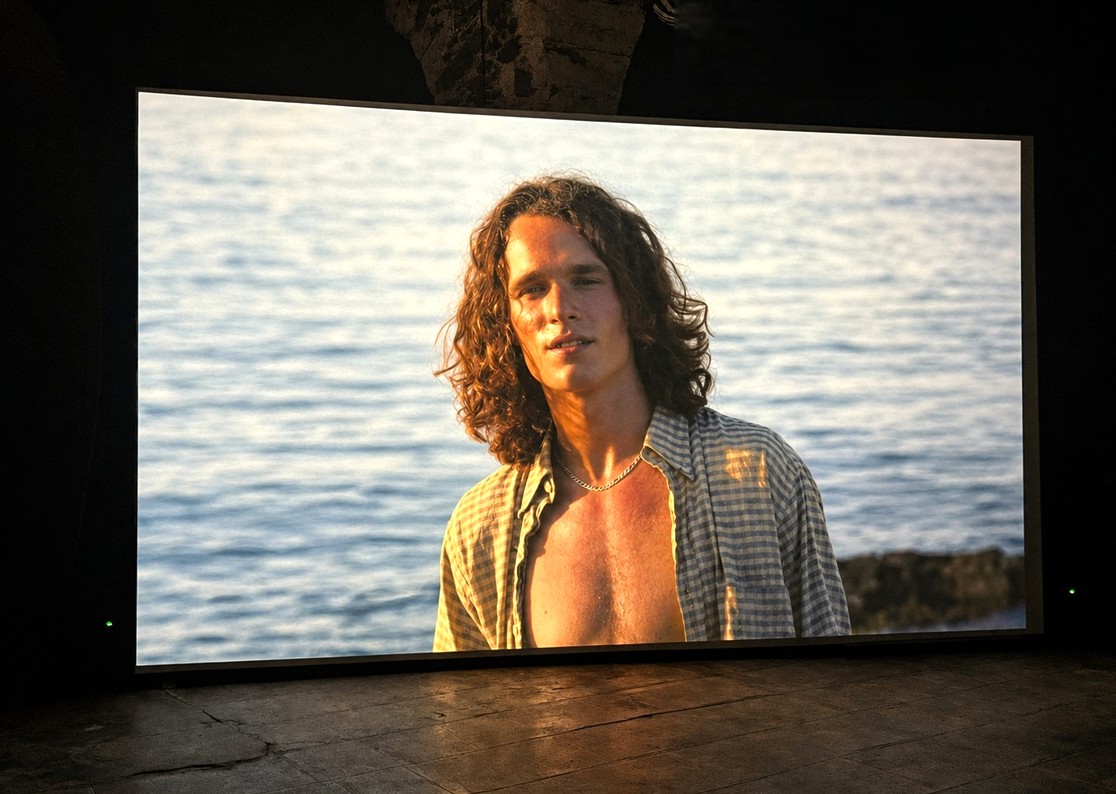
View of the screening of Un dit de gel. Portrait of the twilight artist at Port de la Selva, by Carles Congost. Oriol Valls, performer in the film, also performs the song "Un dit de gel". © ARBAR.
Critical epilogue: The twilight artist as a political and contemporary position
The three songs configure three temporal operations of the same portrait. "Port de la Selva" reconstructs a youth still oriented towards what was to come; "Les cançons romàntiques" shows how experience, when it disappears, is transformed into a vestige; "Un dit de gel" introduces a third operation: looking at the present from the thickness of one's own history. The journey does not describe, however, a transition from plenitude to decadence. The heat of summer and the cold of ice do not represent two incompatible times, but two intensities that coexist. Youth and maturity are not canceled out: the first persists as memory, fiction and a temporal measure from which the second can be thought.
Photography, music and cinema make this coexistence possible without trying to suspend time. Photography fixes a trace; music reinscribes it in duration; cinema reorganizes bodies, places, objects and memories in a new temporality. They do not restore the past: they reactivate it and transform its meaning from the present. This operation is also central to autofiction. Between biography, memory and cinematic construction, Congost prevents the trajectory from being read as a stable or definitive story. Remembering implies selecting, displacing, dramatizing and fable-making; history itself thus becomes a matter susceptible to being reinterpreted from each present.
From this perspective, the "twilight artist" does not designate a figure located at the end of a journey, but a temporal and critical position from which one's own historicity becomes visible. Accumulated time ceases to be just a biographical experience and becomes a condition from which to look at one's own trajectory and, at the same time, the structures that determine its reception. Historicity is not equivalent to obsolescence: a work accumulates time without ceasing to be contemporary.
This is where the political dimension of film gains strength. What is transformed is not necessarily the work itself, but the structures that administer its visibility, legitimacy and symbolic value: the art institution and, especially, the logics of the market. The centre and the margin are not natural or permanent positions, but effects of power relations, economic interests, circuits of legitimation and economies of attention. The question is no longer whether a work remains valid, but what structures determine the conditions under which it is seen, situated and recognised in each present.
In this sense, twilight does not express a loss of strength in the artist or the work. It points to the distance that can open up between the continuity of a practice and the mutability of the structures that order its position within the system of art. It is in this friction that A Finger of Ice locates one of its most incisive tensions: the practice can continue to be active while the devices that distribute attention and value are reconfigured.
A finger of ice does not resolve the distance between what has been and what is, nor the tension between the continuity of practice and the place that the art institution and the market assign to it. It turns it into its productive principle. Continuing to work thus becomes a way of acting within this tension: not to claim a guaranteed position or to submit to the changing hierarchies of the present, but to affirm the capacity of artistic practice to continue producing meaning from its own historicity.
The "twilight artist" thus ceases to be read as a melancholic figure and is defined as a critical position from which it becomes visible that time not only transforms the artist and the work, but also the structures that condition the gaze, the assessment and the inscription in history. Twilight is therefore not the end of a trajectory, but the place from which it can continue to produce meaning and intervene critically in the present.
Work sheet
A finger of ice. Portrait of the twilight artist at Port de la Selva , 2026
Project and direction: Carles Congost
Interpretation: Judit Martín and Oriol Valls
Voices: Nadlyn and Oriol Valls
Music: Andrés Papas Pérez / The Congosound
Songs: "Port de la Selva", "The Romantic Songs" and "A Finger of Ice"
Co-production: ARBAR / Bòlit, Girona Contemporary Art Center


You may be
interested
...