
Exhibitions
The Call of Cthulhu. Crossing the Threshold of Art
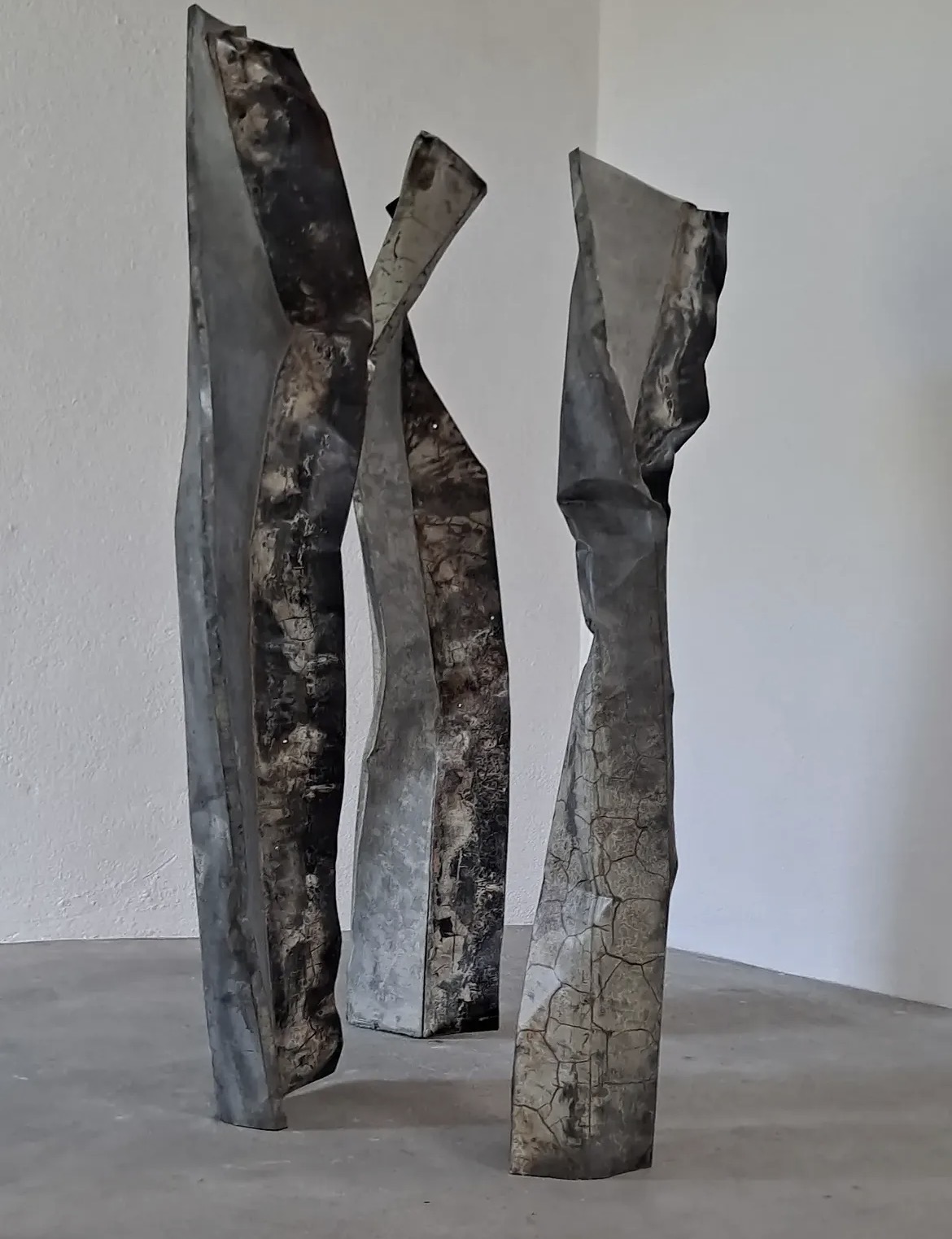
The Horizon Gallery in Colera opens the summer season with Crossing the Threshold , a proposal by Àlex Nogueras, curator, gallerist and collector, well known in Barcelona since he founded the Nogueras Blanchard gallery in 2004, which recently merged with the historic Joan Prats to form Prats Nogueras Blanchard, with offices in Barcelona and Madrid. He is also a member of the board of trustees of the Tàpies Museum and Hangar.
I highlight Àlex Nogueras' professional resume because it is worth having conceived a thesis exhibition as important and complex as this one and doing it in collaboration with a very prestigious gallery in Alt Empordà, but far from conventional exhibition circuits. A remarkable challenge.
The curator raises the idea that there are numerous issues that concern us and overwhelm us. I think that many of them are the reason for the current proposals of the gallery circuit, such as gender situations, "racialization", social exclusion, control of technological oligarchies, the limits of authorship, how collective meanings are generated, etc. I understand that the thesis is that all these issues can frighten us and generate instability; then the need appears to find the solution by generating art. As happened to Lovecraft in his time, overwhelmed by the fear of living with the threat of the other race and the enigma of the unspeakable, he created the monstrosity of Cthulhu.
This chronicle deals with this, with how the exhibition helps us determine the causes of art, its origin and how the artist gives shape to fear, to unease, through his works.
Living on the border
Crossing the Threshold is the title and it already tells us that we are starting with a challenge, an expedition into the heart of the darkness of art. Crossing the threshold is synonymous with discovery, transformation and change. Passing through the narrow door of initiation, going to another dimension. Art, thus understood, is an experience of transcendence and with this step we must cross a border limit that separates us from the truth.
For this reason, the chosen location could not be more ideal to do it, since the Horizon Gallery is located next to the old border with France. This circumstance is not trivial. I am one of those who thinks that the territory marks, and that geography determines the circumstances of art. In Malcolm Lowry's famous novel (Under the Volcano), Under the Volcano, he confirms this, since living with the presence of Popocatépetl is a fact that will be decisive for the plot of the narrative. Living on the border has the same strength as the place. Not for nothing, a few kilometers from the gallery, is the town of Cerbère (Cervera), which popular non-scientific etymology says alludes to the monstrous three-headed dog that guarded the door to the Underworld in order to prevent the dead from escaping and the living from entering. Since it is an obvious place of passage where exile and pain have been experienced, it seems well-placed. Other well-reasoned versions must have more weight, but in matters of art, Mythos performs better than Logos. We will stick with the former and see why.
Given the determinism of the territory on the work of art and also due to this geographical and cultural border condition, some exhibitions, texts or the sculptural work itself by Ralph Bernabei, creator of the gallery together with Silvy Wittevrongel, have orbited around the idea of line and limit throughout the gallery's more than thirty-five years of history.
The Call of Cthulhu
To address the issue, there are numerous philosophical references that would dialogue in a particularly fruitful way on the threshold, the limit or the border and that any postmodern curator would have chosen, such as Martin Heidegger and un-concealment and the work of art, Maurice Merleau-Ponty, the visible and the invisible, Edmond Jabès, the desert and absence, Emmanuel Levinas and otherness or Hans Blumenberg and the work on myth, or Eugenio Trias himself with the Philosophy of the Limit, etc.
But Àlex Nogueras, beyond appealing to any of these overly abstract ideas, proposes something much more radical: he has chosen as a reference a book by Lovecraft, nothing more and nothing less than a narrative of cosmic terror that marked an entire era and perhaps himself. "The Call of Cthulhu", from 1928, can be seen in a copy in the same room. It poses the challenges and consequences of crossing the threshold and going, like the anthropologist FW Thurston, in search of R'lyeh, a gigantic city submerged at the bottom of the Pacific Ocean where Cthulhu, a primordial god of unknown origin, a force of cosmic nature that escapes human understanding, is found. The book acts as a kind of tuning fork so that we can sharpen our gaze before entering the exhibition and gradually uncovering what is hidden from us.
Dark mathematics
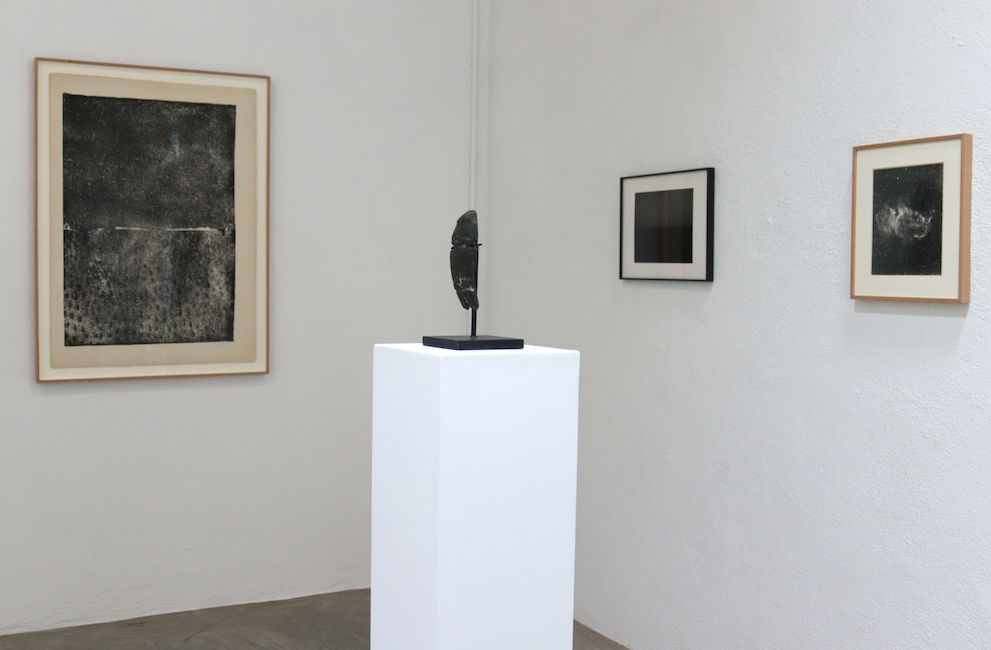
With this question on the horizon, Àlex Nogueras has chosen the works for this exhibition, which forms a real personal "cabinet" of disturbing images around this idea. They are not images that literally illustrate the book. They are works, not too large, adapted to the dimensions of the gallery, but enough to reinforce its objective. Works by very different artists and cultures: Acharya Vyakul, André Martus, Antoni Tàpies, Enrique Brinkmann, Francisco de Goya, Hiroshi Sugimoto, Joan Claret, Joan Miró, Sebastian Münster, Vasiliy Fessenkov & Dmitry Rozhkovsky, Yoon-Hee and an anonymous work from the Mezcala culture of Mexico.
One of the most immediate ways to approach terror is to turn reason into an instrument to explore what lies beyond itself. Fear, delirium, the turmoil of the imagination are of Romantic origin. That is why, when approaching the exhibition and writing this chronicle, it is especially useful for me to focus on the Romantic or, better yet, neo-postromantic perspective. Antoni Marí, theorist and critic, of whom I was a friend and of whom I consider myself a disciple, was one of the main drivers of the recovery of Romantic criticism. In his latest work, «Matemática tiniebla» (2011), he reflects on several authors; among them he discusses Edgar Allan Poe, a precedent revered by Lovecraft himself. His theory is precisely that Poe —and the same could be said of Lovecraft and, by extension, of all works of art—does not simply write horror stories, they are not an unbridled delirium, but they obey a logical and rigorous order, which contain a certain stillness, a tense calm. This thought is very effective in understanding the expressive nature of art. There is always an order, a "cosmos", but there is also enthusiasm, delirium and chaos, the revelation of an unfathomable abyss. It is the chaos that dwells in concreteness. Fear is not eliminated through reasoned, learned concepts or complex theoretical explanations, but by making itself visible, generating images and symbols.
Works on the threshold
Each of the works on display responds to an invisible thread of meaning and participates in the same symbolic operation: converting what is unnamable, what frightens and overwhelms us, into an image. Poe, Lovecraft and the works on display here themselves orbit around mystery, the ominous and inexplicable, cosmic horror.
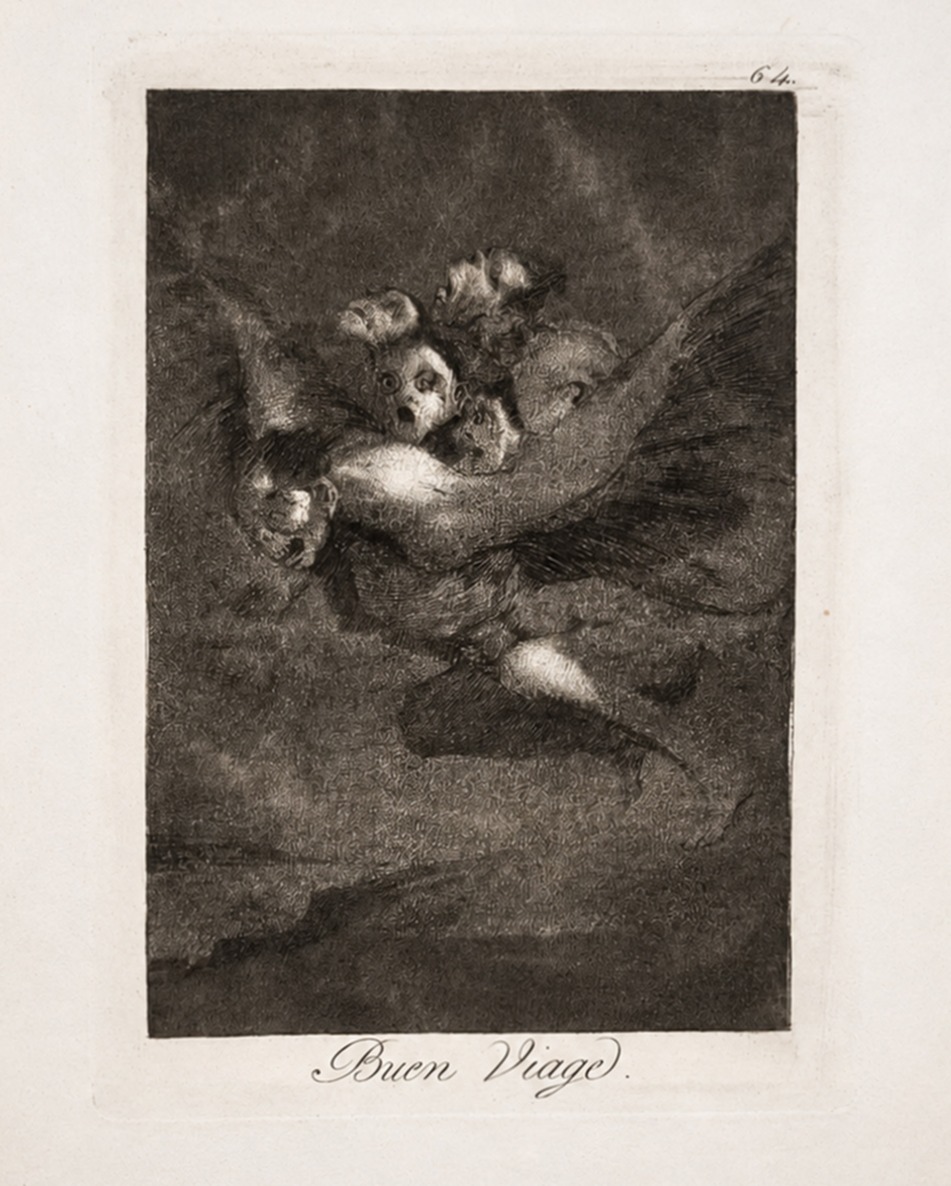
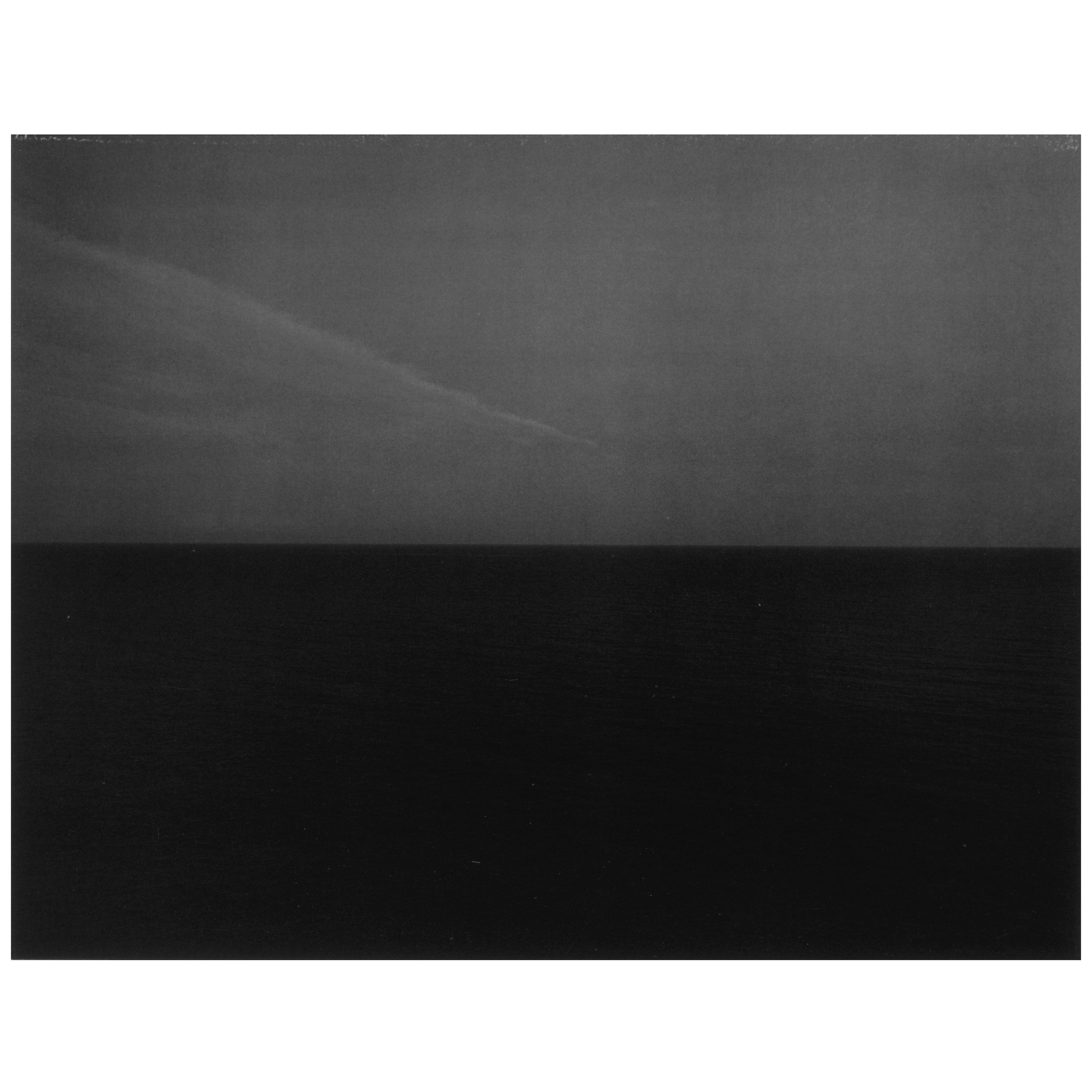
This is the plot of the exhibition which, without going into detail about the book, is a mirror of the atmosphere of cosmic terror created by Lovecraft. The etching "Buen viaje", from Los Caprichos, by Goya, where we see figures entering the darkness, towards a place without name or form. The darkness becomes the symbol of that which escapes any explanation, like the immobile horizon of Hiroshi Sugimoto. The matter of Antoni Tàpies or the fantastic maps of Sebastian Münster share this same intuition: the visible always points towards an invisible that cannot be fully represented. The astronomical photographs of outer space by Fessenkov and Rozhkovsky reinforce this alien idea of the supposed origin of Cthulhu. Paradoxically, the more precise the scientific gaze, the more evident the immensity of what remains outside our knowledge becomes. Science does not eliminate mystery either. The geometric constructions of Joan Claret tell us about exact mathematics, about an invisible architecture and city where mystery can also be present; the Great Black Figure of Joan Miró, heir to the monsters of the Barcelona series, or the conceptualism of Robert Filliou show that mystery is not born only from chaos, but also from irony and symbol. Brinkmann accumulates graphite and ink until he turns the surface into a memory of time and gesture. In all of them, the meaning is never fully given: it only appears as an insinuation. Art does not solve the mystery: it keeps it open.
From here arises the need for art: to create works that allow us to subdue this feeling of anguish and restlessness. Like Cthulhu, it is a shadow that always accompanies us, because we will never know its cause. The artist transforms the threat, that which is incapable of understanding, that which frightens and overwhelms, into a work of art.
On the other side
Once we reach the threshold, do we have to cross it, or not? Here another plane of experience opens up that is fundamental to understanding what needs to be done with art, and with the artist. There are two attitudes: on the one hand, we have seen how some artists made their fears explicit, so to speak, and, in the words of the curator, some need to turn it into an enemy and others allow it to be inhabited.
Now we see those who have firmly decided to inhabit it. They are those who intend to cross the threshold, they have the ability to invoke the unnameable and do not fear it; they want to know where Cthulhu dwells. These artists and their works confront the true enigma.
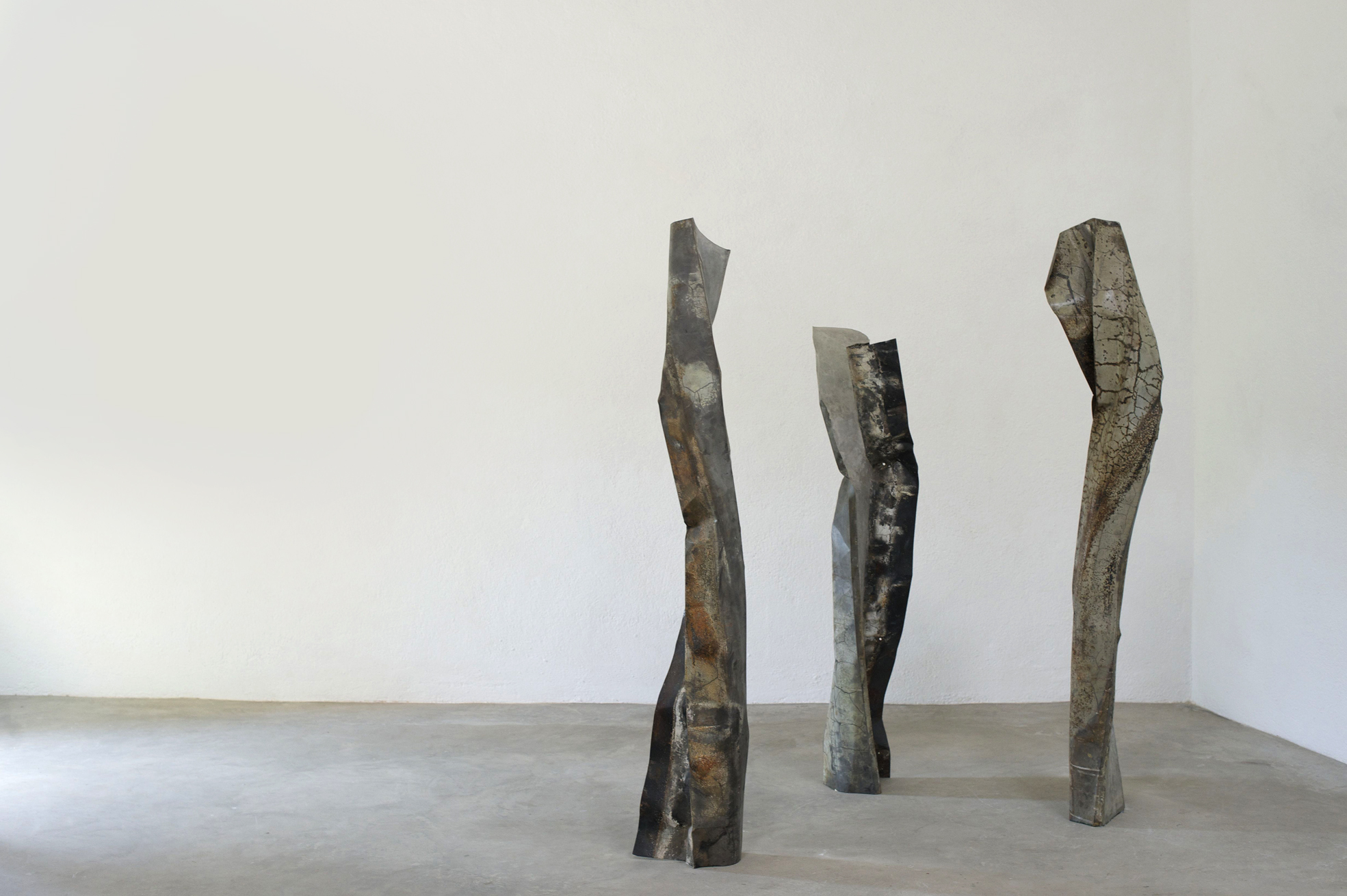
This is what the spirals of Acharya Vyakul or Yoon-Hee, the ritual figures of the Mezcala culture, want. The border ceases to be a geographical line to become a spiritual exercise. The witness is three totems by André Martus. They all bring us the recognition of the transition, and the threshold places us on another plane of consciousness.
Above all, two works that make the journey to the other side achieve this; they do so with very sharp tools. One is the stone sculpture for funerary use that accompanied the deceased on their journey to the afterlife, belonging to the Mezcala culture (Guerrero region, Mexico, developed between 500 BC and 500 AD). This work —of art?— responds to a ritual need for accompaniment and protection.
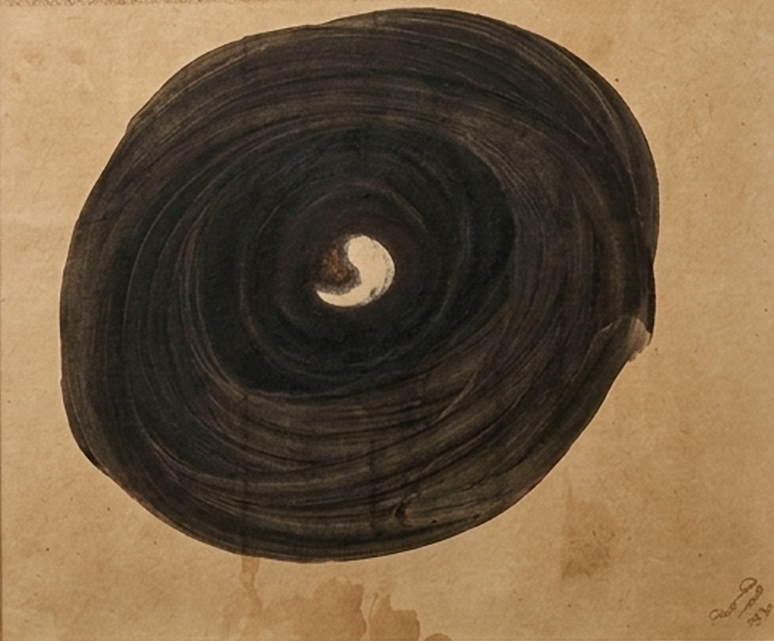
The other is Acharya Vyakul, from Rajasthan, with his tantric paintings. In the work, the vortex that appears is a dark spiral with a white dot in the center, one of the most persistent symbolic forms of humanity. A new portal of spiral-shaped movement that relates her, only from a formal point of view, to the Korean artist Yoon-Hee, who also reaches this same form of vortex. This generates two directions, two movements, whether ascending, vertical or downward, in the form of a funnel that unites heaven and earth. For them, the threshold no longer appears as an external border, but the spiral movement is inward, it is an internal experience.
Acharya Vyakul shows us a path, he is the light of the East and, as is typical, he dedicated his life to searching, from an existential point of view, for the way to "awaken" to the true nature of being.
The curator writes: "Far from illustrating fear, his tantric paintings function as devices to traverse it, as ways to investigate and question the automatisms of thought."
There is meditation and method here because, for decades, Vyakul painted in secret and solitude. Each painting is a ritual act, a work not intended for any outside gaze. As meditative devices, they do not seek to explain mystery, but to modify the consciousness of themselves and the observer.
This exhibition is a contribution to the cause of art, it makes us wonder who among us—artists, gallerists and critics—dare to cross the threshold that leads us to this inner path. Probably, only from this secret attitude can works be created that are capable of helping us reach the heart of darkness where Cthulhu dwells, I mean where ART dwells.

You may be
interested
...