News
Tess Jaray, geometry as memory
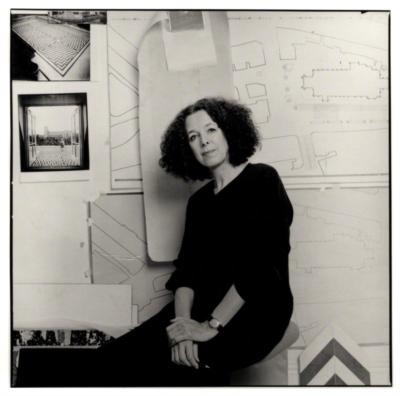
The story of Tess Jaray (Vienna, 1937–2025) is that of an artist who transformed geometric precision into a profoundly human language. A painter, printmaker, and teacher, she was one of the most singular figures of British abstraction in the second half of the 20th century, developing a body of work in which color, rhythm, and architecture engaged with memory, space, and perception. Her death at the age of 88 brings to a close a career spanning more than six decades, marked by experimentation and extraordinary artistic coherence.
Born in Vienna into a Jewish family connected to the world of culture, her childhood was inevitably marked by the rise of Nazism. After the annexation of Austria by Nazi Germany in 1938, Jaray fled with her parents to the United Kingdom, where the family settled in Worcestershire. That experience of exile was always intertwined with the memory of family members who did not manage to escape: some were deported to the Theresienstadt and Auschwitz concentration camps, while her uncle Richard Jaray was murdered in the Łódź ghetto. Although her painting never explicitly addressed these events, the idea of memory and place silently permeated all her work.
His artistic training began at St Martin's School of Art and continued at the prestigious Slade School of Fine Art in London, where he graduated in 1960. That same year, he received a scholarship to travel to Italy, a pivotal experience that sparked a lasting fascination with classical architecture and urban planning. From then on, buildings, pavements, staircases, and urban layouts became constant references in his paintings, which never sought to represent reality but rather to capture its essential structures.
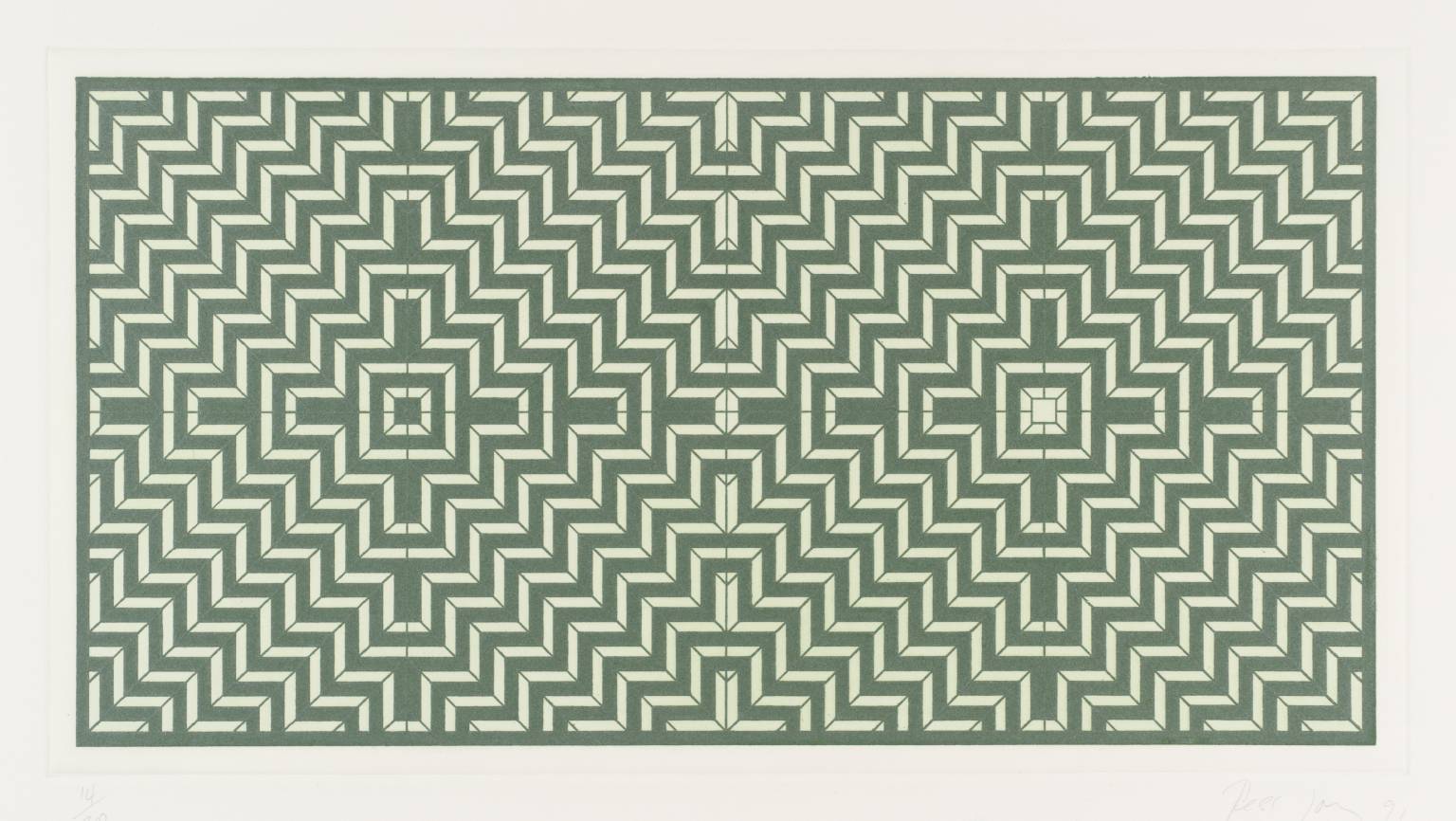
In the early 1960s, she developed the language that would define her career: geometric abstraction compositions constructed with crisp lines and perfectly delineated surfaces. Far removed from expressionist gestures, Jaray conceived each work based on numerous preparatory drawings and meticulous planning. The use of masking tape eliminated any trace of the brush, reinforcing the visual clarity of compositions that evoked facades, architectural pathways, or spatial sequences without ever literally depicting them.
Over time, his formal research incorporated new materials and technologies. In series created from the 2000s onwards, such as Thorn , he replaced the canvas with metal supports painted with acrylic, which he then altered using laser cutting, further exploring the relationship between surface, light, and geometry.
Architecture ceased to be merely a source of inspiration and became a field of work. From the 1980s onward, she received numerous public art commissions that integrated her abstract language into everyday spaces. Among the most notable are the paving of London's Victoria Station, the brick plaza of Wakefield Cathedral, and the stone floor of St. Mary's Church in Nottingham. These interventions solidified her recognition beyond the realm of painting and earned her, in 1995, an honorary fellowship from the Royal Institute of British Architects, an exceptional distinction for a visual artist.
His influence extended to the field of education as well. Between 1968 and 1999, he directed the postgraduate program at the Slade School of Fine Art, where he trained several generations of British artists, including Martin Creed, winner of the Turner Prize. More than transmitting a style, he championed a rigorous approach to the creative process, based on observation, discipline, and constant research.
Institutional recognition came naturally to an already established career. In 2010 she was elected a member of the Royal Academy of Arts and, seven years later, received the title of Honorary Professor from Norwich University of the Arts, in recognition of her contribution to both artistic creation and education.
Tess Jaray's work occupies a unique place within contemporary abstraction. Far removed from gestural excesses or formal spectacle, she constructed a silent universe where geometry became a sensory experience and architecture a form of thought. Her paintings, prints, and public interventions continue to remind us that even the most precise lines can contain emotion, memory, and time.

You may be
interested
...