Exhibitions
Argillà Argentona 2026 claims to be a great international reference in ceramics
The festival presents the poster by David Callau, premieres the "guest city" project and reinforces a program that looks to the future without renouncing its roots.
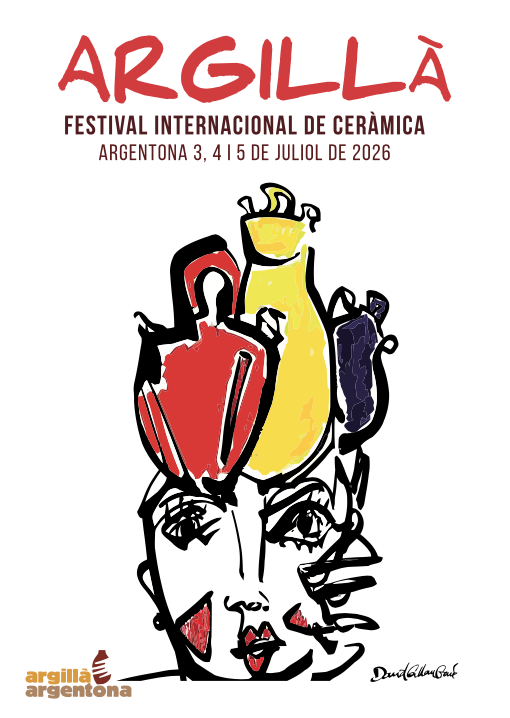
Argillà Argentona continues to consolidate its international projection. The official presentation of the 2026 edition has served to unveil the festival's new poster, the work of artist David Callau, and to advance a program that reinforces its vocation to become one of the great European events dedicated to artistic and artisanal ceramics.
The new director of the Museu del Càntir and the Argillà Festival, Eva Pascual Miró, highlighted that the event has definitely passed the consolidation stage. "Argillà is now an international festival of reference," she stated, underlining the presence of artisans and creators from Catalonia, Spain, France, Slovenia, Hungary, Morocco and Poland.
Among the main novelties of this edition stands out the launch of the "guest city" project, an initiative that aims to strengthen the links between the main ceramic centers of the peninsula. The first protagonist will be La Rambla (Córdoba), considered one of the most important ceramic centers in Spain both for the number of workshops and for its artisan tradition. Coinciding with the centenary of its ceramics fair, Argillà will welcome eleven artisans from the Andalusian town and a selection of works from its museum.
The artistic program also reserves a prominent space for training and contemporary creation. The Llotja School of Art and Design, which this year celebrates its 250th anniversary, will be the star of a special showcase dedicated to its trajectory in the world of applied arts. At the same time, the festival will host exhibitions by ceramists Jan Madrenas and Sergi Pahissa, two creators with a solid international projection and whose work is present in collections and exhibitions around the world.
Another of the highlights will come on July 3rd, when the Pitcher of the Year, the work of its creators, will be officially presented. As is tradition, the piece will not go on sale until after the blessing of the pitchers at the Sant Domènec Festival, on August 4th, thus maintaining one of the most emblematic traditions of Argentona.
A poster that pays tribute to memory and roots
One of the most anticipated moments of the presentation was the unveiling of the official poster, created by painter David Callau. The artist proposes an image full of symbolism that pays homage to ancestors and the rural world through female figures modeled with the colors of the earth.
According to Callau, the protagonists represent "women of the land, sea and countryside" who evoke effort, perseverance and the ability to continue forward despite the weight of life. The water they hold above their heads symbolizes life, renewal and hope, in a composition that also claims the landscapes and colours typical of Catalonia.
The artist also defended the importance of preserving the authenticity of the creative process in an era marked by new technologies. For him, the poster keeps alive the spirit of traditional poster design, betting on the original pictorial gesture and the value of the work created manually.
Callau will also be in charge of painting the Pitcher of the Year live during a show that will combine painting, music and poetry with the musical accompaniment of Pep Lladó, an interdisciplinary proposal that will turn artistic creation into an experience shared with the public.
A tradition that continues to evolve
During the presentation, the mayor of Argentona, Montse Capdevila, noted that Argillà has become much more than a ceramics fair. According to her, the festival is now a collective cultural project that has positioned Argentona as one of the great references for ceramics in Catalonia, in the State and with increasing international projection.
Capdevila stressed that Argillà's great success is having been able to evolve without losing its identity, combining respect for a deeply rooted tradition with an open outlook on innovation, creativity and the future.
Jan Madrenas: the body, memory and the craft
Ceramic artist Jan Madrenas presents Going to the Fountain , an exhibition that reflects on the everyday gesture of transporting water and the intimate relationship that is established between the body and the objects that accompany it.
For Madrenas, the container ceases to be a simple vessel to become an extension of the body. When worn, it modifies posture, movement and even the way of inhabiting space, creating a hybrid figure where person and object are mutually transformed. An idea that the artist relates to elements of Catalan popular culture, such as giants and bigheads, capable of symbolically expanding the human body and turning it into a new character.
Beyond this formal reflection, the exhibition is also a return to the origins. "Going to the source" is, metaphorically, returning to the sources of the craft, to the artisanal tradition and to the knowledge transmitted between generations. The pieces incorporate ancestral techniques of reduction, oxidation and wood-fired firing, letting the fire itself leave its mark on the material.
One of the most exciting elements of the exhibition is the incorporation of ashes from the last batch made by the artist's father in the family oven in the Pre-Pyrenees. These ashes, reused after the oven was restored, symbolize continuity between generations and make each piece a living testament to the transmission of the craft.
La Rambla, guest city
Another of the great novelties of Argillà 2026 is the incorporation of the guest city project, which is inaugurated with La Rambla (Córdoba), one of the great historical centers of pottery on the Iberian Peninsula.
The Stone Salon will host a selection of works from the Museo de la Cerámica de La Rambla, an institution created in 2002 that preserves the legacy of a population deeply linked to ceramic production.
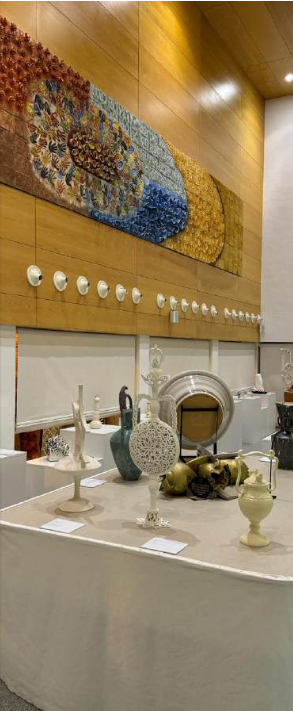
The exhibition allows us to trace the history of local ceramics from the first prehistoric evidence to current creations, also explaining the processes of clay extraction, the manufacture of the pieces and their marketing. The exhibition also highlights the centennial Exposición de Alfarería y Cerámica de La Rambla, today known as ENBARRO, considered the oldest monographic ceramics fair in Spain.
Through this heritage selection, the public will be able to discover how everyday objects explain the history, traditions and identity of a territory that continues to be one of the great references of artisanal ceramics.
Sergi Pahissa: when fire becomes a brush
The historic Casa Puig i Cadafalch will be the setting for the exhibition dedicated to the ceramist Sergi Pahissa Raventós, which presents a selection of pieces from his series Containers of Time and Theia .
With over twenty-five years of experience, Pahissa has developed a very personal language focused on work on the wheel, where the creative process is based on the constant dialogue between hands and clay. Far from wanting to dominate the material, the artist lets himself be carried away by its natural behavior, seeking the balance between control and spontaneity.
His works stand out for their surfaces of great plastic richness, with intense chromatic contrasts that turn each piece into a true three-dimensional painting. Fire plays a fundamental role: more than a cooking tool, it becomes a creative element capable of drawing unrepeatable textures, colors and atmospheres.
To achieve these results, Pahissa usually works with high-temperature refractory clays and combines techniques as diverse as Japanese raku, Etruscan sigillata, Mayan-inspired burnishing and various experimental firing processes.
His work is attracting growing interest internationally and is currently part of private collections and interior design projects, especially in the Asian market, where several of his pieces have already been acquired by collectors and gallery owners in China.
With these three exhibitions, Argillà Argentona broadens its view of contemporary ceramics and claims this artistic language as a space where memory, heritage, innovation and experimentation coexist. A proposal that confirms the festival as one of the essential events for lovers of ceramic art.
You may be
interested
...