Exhibitions
Eastern Empordà
In the summer, activity begins in the Empordà, small galleries open with temporary programming and it is a matter of choosing and giving them a place in the present. This is the case of the Asian Spring exhibition at ASSAI Gallery in Pals from June 12 to July 5. This spring is an Empordà "link" with its major precedent, the "Printemps Asiatique – Asia Week" in Paris.
There are not many opportunities to open the window to let the scents of the East in. Alexandra Planas did it in Bonart with the article on the Rebel Stroke by Gerardo D. Cristante, one of the artists participating in this exhibition .
An oriental dream
S. Dalí liked to say that he was the first inhabitant of the peninsula to see the sun rise from the East from his bed in Port Lligat. "Ex oriente lux", this light coming from the East seems to have interested him since he was young, as demonstrated by the current exhibition in his birthplace in Figueres: An oriental dream. Exoticism and modernity in the young Dalí curated by his colleague Ricard Bru and open until September 13, 2026. The curator points out that, when Dalí at nineteen years old made a screen with Japanese reminiscences, interest in the Orient had already been circulating in Catalonia for more than forty years and that he would later develop a much more intellectual and rigorous approach to this theme in his painting.
For years, the presence of artists from the East has been common in the Empordà lands, many of whom end up residing and working here, seduced by a Mediterranean landscape that is very different from their places of origin. It is a fact alien to the Greco-Latin idiosyncrasy of the Empordà lands. Perhaps one of the most rooted in time is the Taiwanese Dai Bin In in Llers who more than forty years ago caught the attention of Antoni Tàpies with his gesturality and free strokes. Also those who often exhibit at the Horizon gallery in Colera which since 1992 has always given a place to the gaze towards the East, as was demonstrated in 2023 with the exhibition East Meets West . In this exhibition, Ralph Bernabei and Enric Ensesa exhibited with artists such as Takesada Matsutani, a member of the Gutai group and of which a retrospective was held at the Center Pompidou in 2019, and also the Japanese Mariko Kumon, Matsuoka, Hiro Nobuko, Nihira Tsubaki, Toshio Yamamoto, Masafumi Yoshiyashu, Zenitani and the Korean sculptor Yoon-Hee resident in France.
Now, the Asian Spring exhibition at ASSAI Gallery, a small gallery in Pals, offers us a collective that brings together artists from diverse backgrounds and sensibilities, ways of understanding the language of ink and painting, in a new dialogue between two Asian and two Western artists. Danhôo (Vietnam, 1966) and resident in France and Su Jing (China, 1994) lives in Paris and the versatile Corentin Candi (Belgium 1975), and Gerardo D. Cristante (Buenos Aires, 1979) who currently lives in the Vall de Llémena (Girona). All four have in common the fascination for painting, ink, gesture, matter, emptiness and above all the energy of the stroke carrying an inner search. It is also a good opportunity to reflect on the links between abstract painting and oriental calligraphy.
The art of drawing or painting without meaning.
The art of the stroke is an expression that interests me especially as an art critic and as a calligrapher. The art of the stroke occurs when, whether through painting or even with calligraphic writing, all the emphasis is placed on visual expression, when it is written with unrecognizable words. An invented and meaningless language, as Luigi Serafini did with the well-known “Codex Seraphinianus” (1981), an encyclopedic book written entirely in an invented and asemic language, that is, without meaning. In a way, it is the form most similar to wordless music that we hear without any desire to understand, as happens with the musical mantras of Éliane Radigue. When the sound reaches our ears and at the same time we look at a painting, the senses, the whole perception are set in motion and we give entry to the body as a reception platform. When the intellectual mind is deactivated and other mechanisms take over, we become in tune with Asia. No meaning is given, we understand nothing, but there is aesthetic emotion through the skin and the senses.
I say that this exhibition is a good opportunity to claim an art of line and painting without apparent meaning. When we see the vaporous ink stains of Coranti Candi (1975, Belgium), with works of atmospheric abstraction, of grays, blacks, dark browns and touches of ochre, fog, smoke or ashes on a wide white background, we see nothing more than a work constructed through stains, glazes and spontaneous strokes that favor the expansion of the pigment on Chinese and Japanese papers.
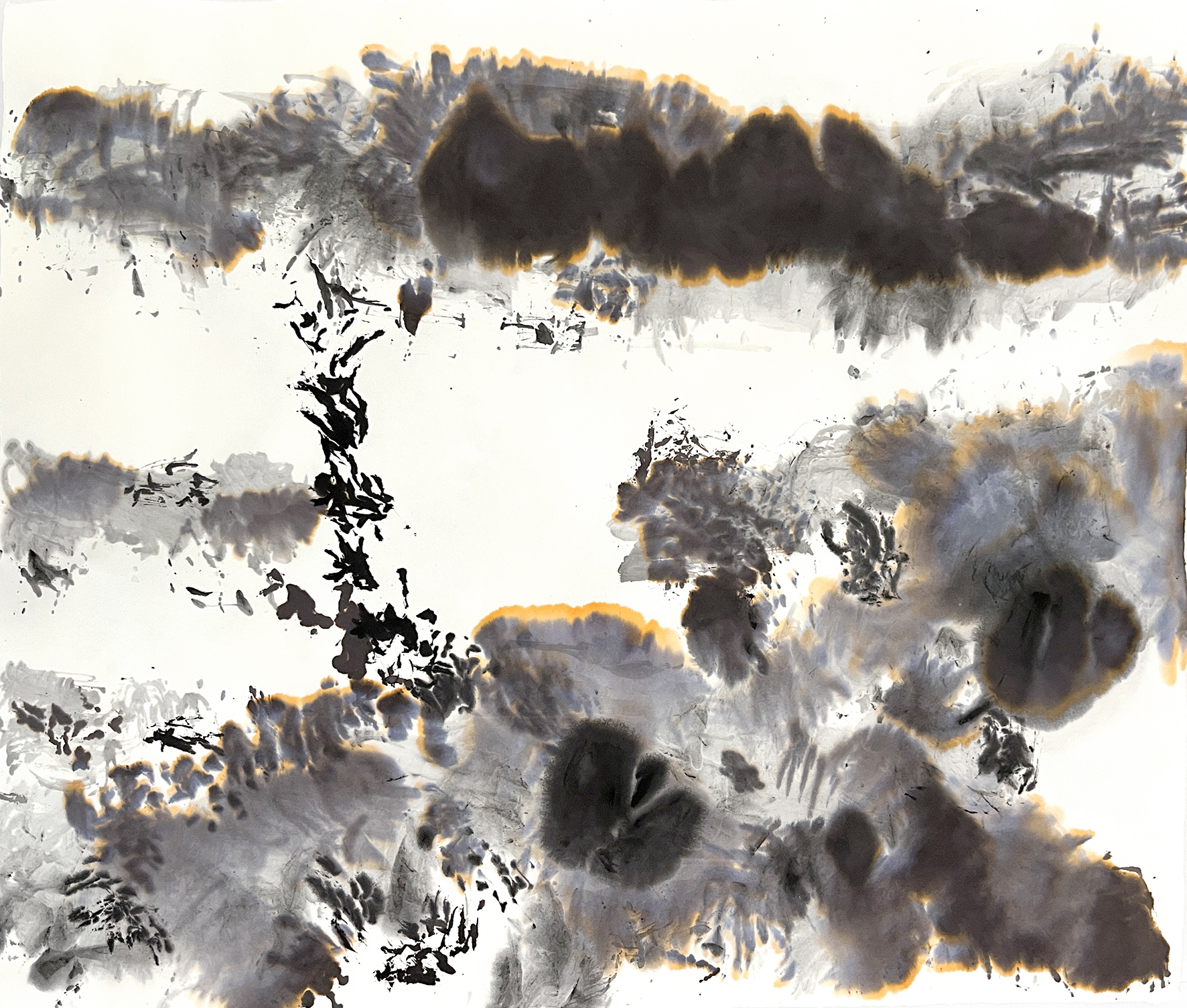
We know that it does not want to tell us anything more than what we see. The meaning becomes a contemplative state, a kind of indecipherable vision, a new interior landscape. There are no clear meanings, but we know how to detect that we are facing a painting that speaks to us in a different way. A certain contemplative quality, as demanded by the Eastern tradition, where emptiness is as important as matter, an inevitable duality between chaos and order, the essential dialectic. This is the meaning.
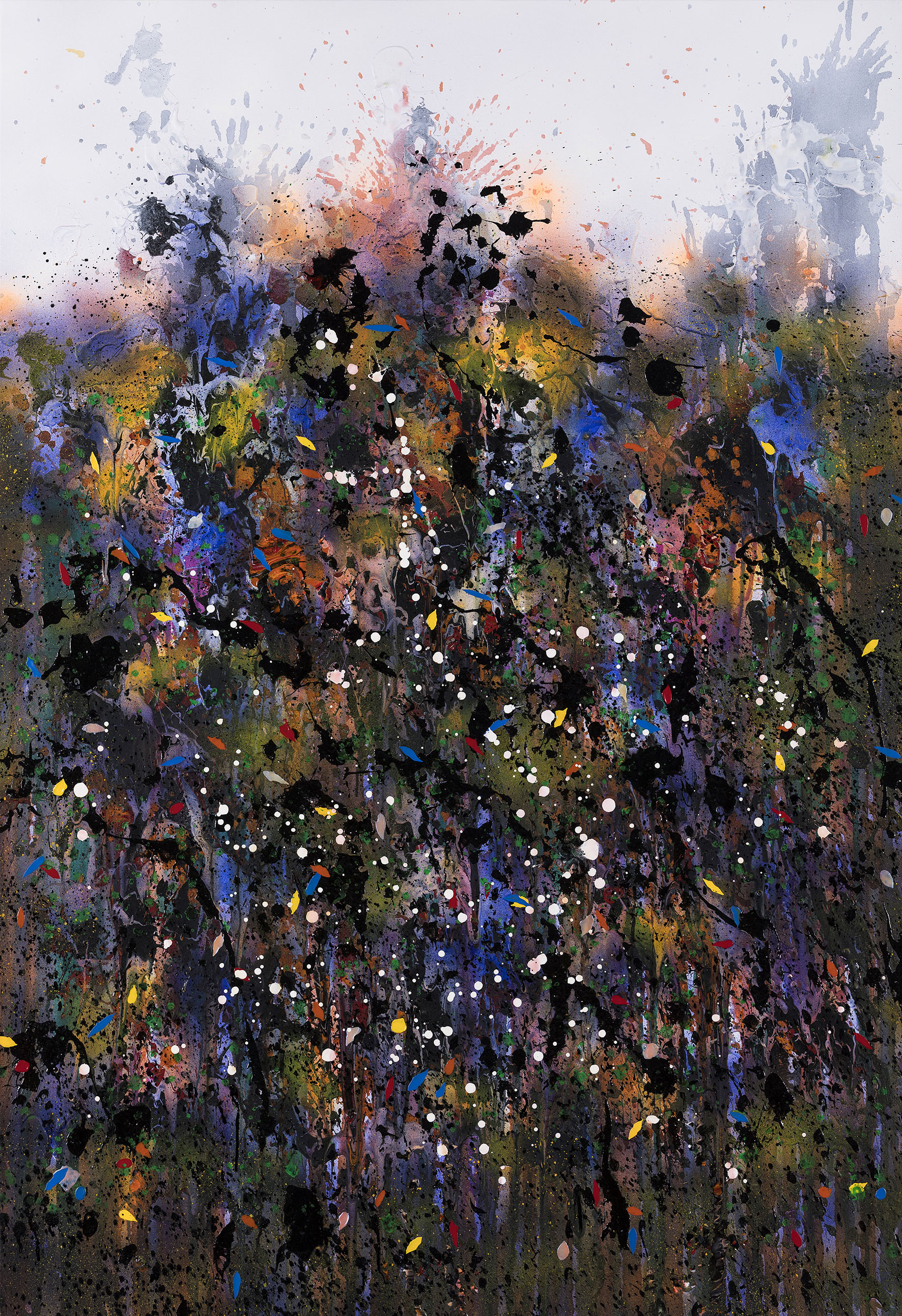
Dahoo (Vietnam, 1966). When instead of vaporous spots we find micrographs of paint that cover all or part of the surface, as Danhoo does, the works deploy a dynamic pictorial language inspired precisely by this abstract calligraphy that does not want to mean anything, but this time with color. The compositions are crossed by movement and depth, where energy arises from the rhythm of the gesture. Just as Pollock threw the paint onto the canvas to make his “drippings”, here it is thrown, dripped or spread in a micro-gestural way. The colors violet, electric blue, green, ochre, pink, orange and black are superimposed in multiple layers. Numerous drops, drips and white splashes run across the canvas like flashes of light. In this case, the essential energy of Qi manifests itself inevitably transformed into visual energy, a wild, vital, organic and abstract garden. It is inevitable not to associate these works with the notion of mystery and complexity.
I want to emphasize that this painter, despite being well-legitimized for writing traditional Chinese characters like love, happiness or dream and deforming them, what he does is hide them, deconstruct them by painting. Instead, he places emotional painting, rhythm through a gesture, hiding them between layers of matter and color.
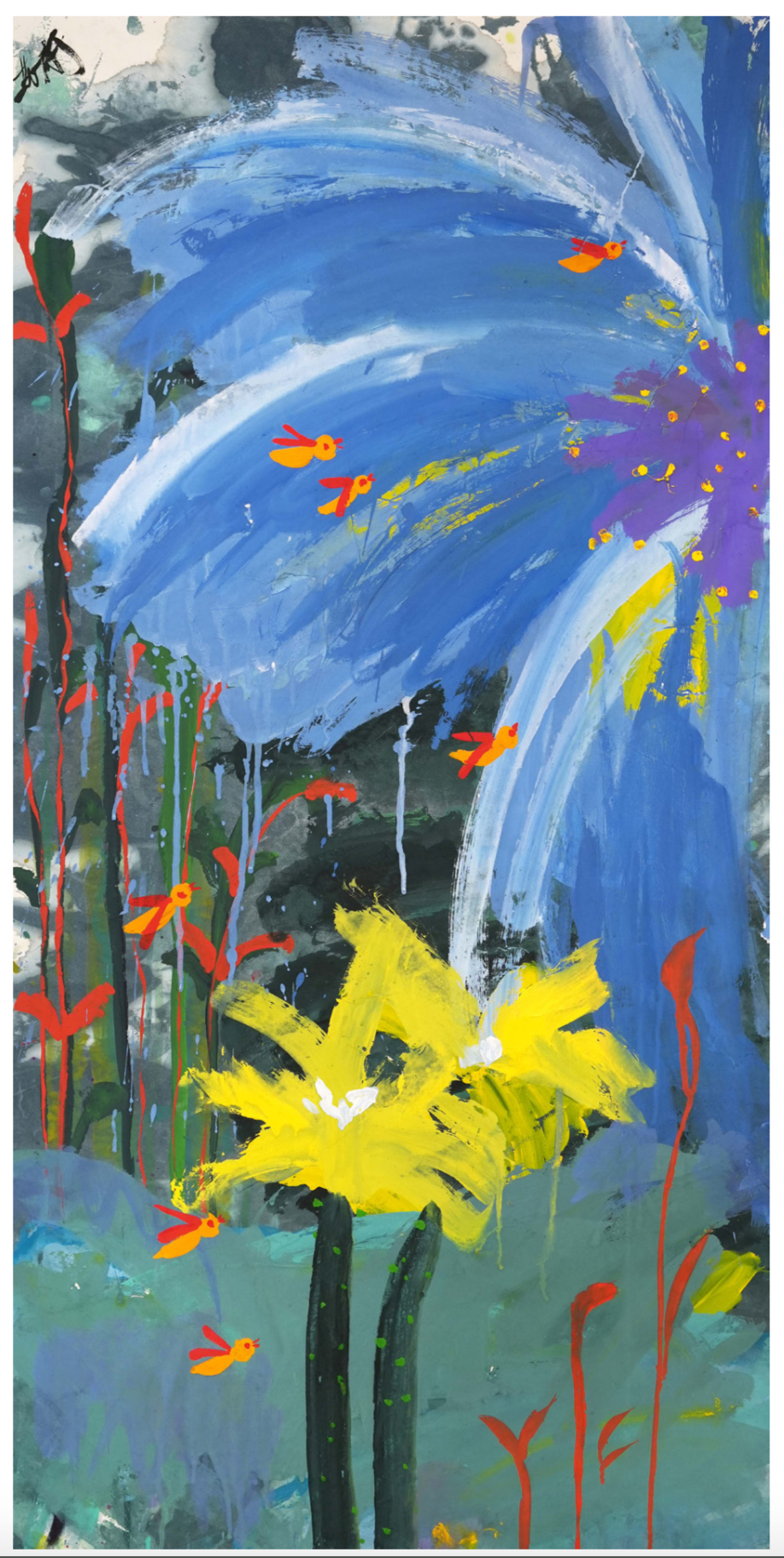
Su Jing (1994 in Wuhai, China) is the most interdisciplinary and conceptual participant of the four, as she also works with video and installations. But what we see here are her “Vegetable Drifts” (2026); between expressive figuration and lyrical abstraction she paints leaves on Xuan paper. Painting and color are dominant. From the great mass of blue brushstrokes, purple floral forms, stems and red buds emerge vertically from the background, as if the image were in a process of growth or transformation. Su Jing explores the notions of identity, memory, roots and transformation. Here too the reds and oranges act as energetic accents with quick and spontaneous strokes. Energy or qi is the key word throughout my chronicle.
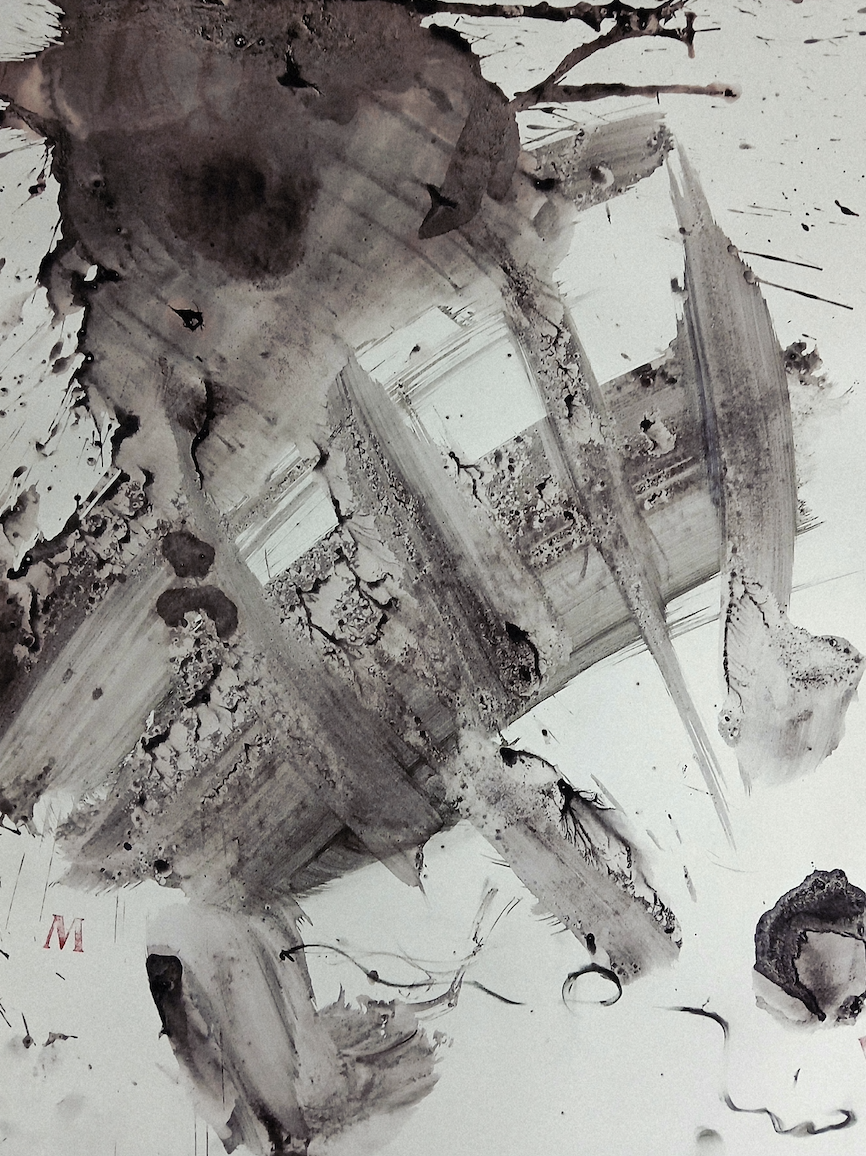
Finally, the aforementioned Gerardo D. Cristante (Buenos Aires, Argentina, 1979) is the best example to nail down the theme of meaningless art that defines this exhibition. The painter creates works in black and white, and all the shades of brownish gray that medieval ink gives him, which served to attack the word, the character, the best-known “kanji” of the Zen tradition: MU. Gerardo D. Cristante proposes a personal, very subjective reinterpretation of shodō, the path of Japanese writing, as Paloma Fadón, author of “Els Delirios del trazo en la ruta de la seda” (Libros de Aldarán, 2026), has done.
These works do not need the calligraphic tradition, they are placed directly in the territory of the monochromatic gestural abstraction of contemporary art. Here there is no dependence on color, but on texture, movement and the trace of the gesture. The composition is built almost exclusively with a range of blacks, grays, sepia and whites. Splashes, drips and small visual fractures appear scattered, like traces of a rapid and physical action. The wide white space that accompanies the forms acts as a field of silence, despite the noise of the gesture. The result preserves the memory of each gesture; it does not hide how it was made, but rather turns the process itself into the protagonist.
Gerardo Tristante, as a painter, unlike his colleagues, does not seem to hide the meaning in his work. I say seems because he wanted to use a very well-known word in the philosophical tradition of Zen Buddhism and Eastern calligraphy that has great meaning: MU. It has been very well chosen because, paradoxically, this Sino-Japanese character is a devastating negation of the meaning of things, an emblem of the renunciation of the logical meaning of language. It is an allegory of nothingness, of negation. We can read it, know what it tells us, but what it tells us is a negation of meaning and of all interpretation. It denies everything, renounces everything, means nothing, distorts all possible understanding. It is a word that is related to the abstract painting of his colleagues in the exhibition, which do not pretend to mean anything and say EVERYTHING.
You may be
interested
...