Opinion
Gaudí in five bursts, on the centenary of his death
I admit it right from the start: I have always tried to avoid the essayistic encounter with the figure of Gaudí. For the sake of being polite, for sure. For the sake of a priori ideas, too. To blame him for the tourist centrifuge that we are experiencing in Can Fanga, yes. For the forest of academic or neo-Catholic or neo-scientific or retro-design books that accumulate , of course. And also, and above all, to leave unchanged my sensitivity of the purely artistic encounter with his creations, which have haunted me since childhood , like when Cortázar evokes the trencadís among his first childhood memories of a trip to Barcelona.
Telluric
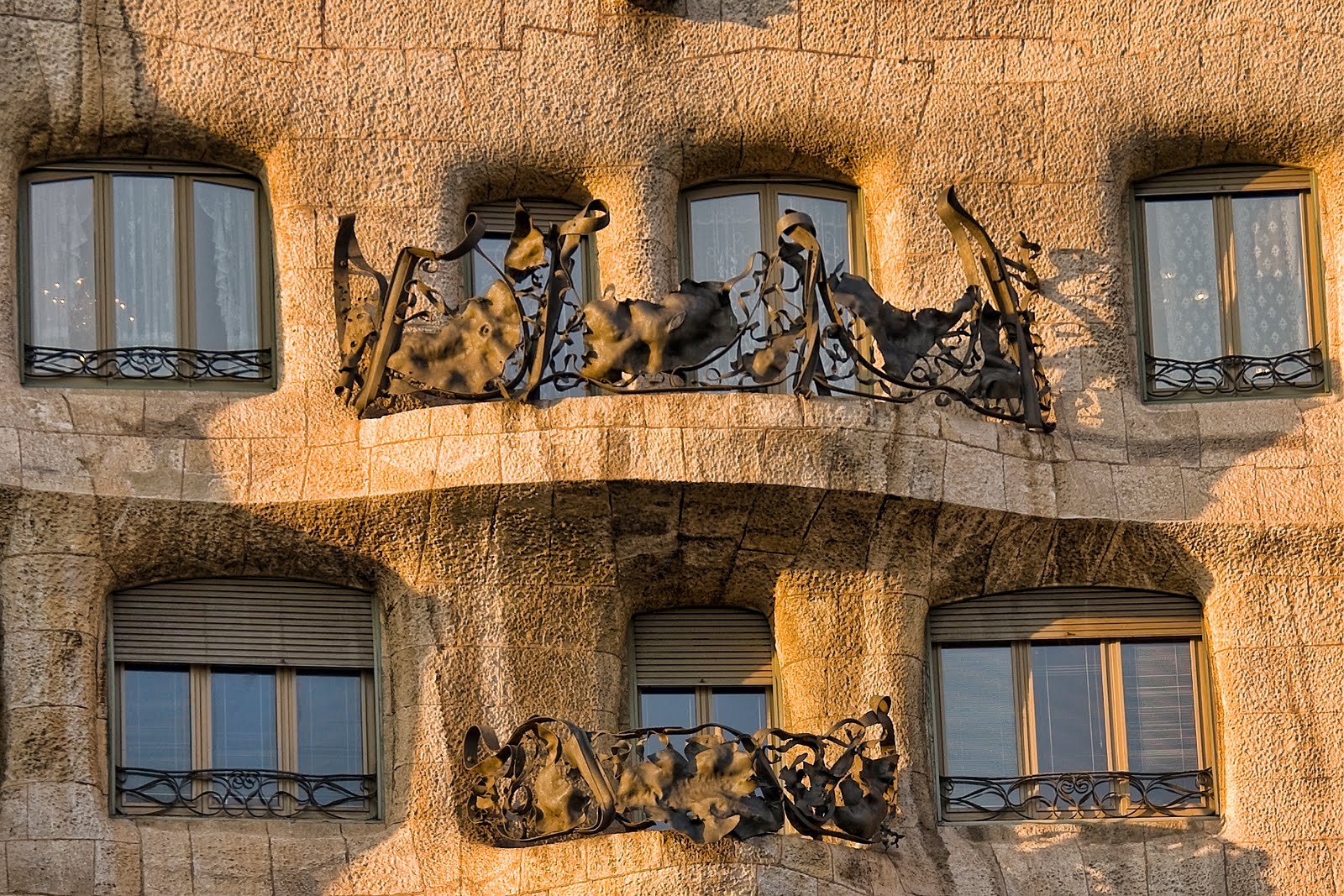
Gaudí is more than organic: he is telluric. He is not just someone who has delved into the generative laws of nature and understood them, but he has soaked himself in them to the core, coming to connect with the germinal nucleus of the natural , which is also tragic, expressive and abyssal, and not only beautiful, luminous and pastoral. When I see La Pedrera I see the bare mountains battered by the wind of Prades and Montsant. Its slanted columns that support bridges and cathedrals remind me of the twisted and dry trees that survive torrents, winds and droughts in the Camp de Tarragona. When I feel the benches of Park Güell, I see the crumbled ceramics that emerge from the plowed lands of southern Catalonia, accumulated by generations of farmers who abandoned such an infertile land. I see a suffering art that, like the vineyards of Priorat, desperately seeks the light by raising its branches and stretching its roots in a stony soil.
Procedural
Chiara Curti, architect, restorer and scholar of Gaudí and the Sagrada Família, author of El meu Gaudí (Triangle, 2025), has made us realize this when she asks how many of Gaudí's buildings are actually finished. There is a long list of unfinished ones, more than completed ones. The Sagrada Família, of course, but also the Güell buildings, such as the Finca, the Park or the Colònia, La Pedrera, where the five-meter virgin on the facade is missing (fortunately), the Mataró Cooperative, the Mallorca Cathedral and so many other mutilated ones, such as Casa Vicens. This was not fateful destiny, but his way of working, since he never thought about doing what he had to do, but about putting his fantasy on earth, no matter how crazy it was. And he didn't care, because he did it all the while enjoying the work process: step by step, grid by grid, stone by stone, side by side with the craftsmen or laborers who helped him and whom he guided and with whom he collaborated. Every day Gaudí added a new stone to the line for his imagined building that he knew he could not finish, but with the certainty that, leaving a solid and original mark in each gesture and in each well-crafted process, someone would finish it. There are those, like Dalí or Bohigas -I join them-, who consider that this attitude must be defended without the need to finish the master's works, because it is of an artistic and metaphorical power, in itself, incontestable.
Luminous
That architecture is light is a commonplace, but in Gaudí's case it is an axiom: the true germinal nucleus of his work. This is evident in the interior of the Sagrada Família where, although the tree-columns are important, it is even more so that these replace the lateral buttresses and allow the building to rise by filtering light from the roofs and the lateral windows. We find this obsession with light in many buildings. Let's take for example one that has not been mentioned much: the Escola de les Teresianas de Barcelona, an early building from 1888. Seen from the outside, the building looks like a massive and unsympathetic medieval castle, but when you go inside , you come across a central courtyard that bathes an interior cloister on the second floor —what fool would think of making a cloister on the second floor!— supported by catenary arches painted white, creating one of the dwellings or dwellings that Saint Teresa of Jesus glimpsed in her spiritual writings as the light of the world. Lux mundi!
Multisensory
His surname betrays him: Gaudí, someone who enjoyed himself in some way through art , and this can only be in a sensitive and sensual way, like a mysticism that finds its redemption in the eroticism of art . That is why the senses are all excited, such as touch, hearing and eye , of course, first and foremost. The bell towers of the Sagrada Família are all hearing, connecting human sounds with natural ones. In its crypts and hermitages you also enter olfactory, among the incense condensed in filtered atmospheres. Everything in La Pedrera has been touched with hands, from the stones to the railings and balconies, sharpening and transmitting the tactile sense of art . The eye is caught in the cascades of color and light that he proposes on the facades, vaults and interiors, creating a new art that renews the Mediterranean artistic spirit and makes it evolve for centuries, because for centuries it had been trapped in neo-baroque, neo-gothic or neo-classical fritters and fritters. Dalí said that we need all five senses to understand Gaudí, and he was right.
Mystic
When we talk about modern Gaudí we always try to tiptoe around, but the reality is that Gaudí was a Catholic fundamentalist. We don't really know how he got it, because Reus didn't have such radically religious nuclei. Surely this mysticism came from his personality, from having adapted the furniture of his soul to contact with religion, and from his relationship with the neo-Catholic currents of the bourgeoisie at the end of the century in Barcelona. But let's not deceive ourselves: Gaudí lived religion in an ironclad, daily and obsessive way. Every day he took communion in the church of Sant Joan de Gràcia, and in the afternoon he had mystical conversations. He went to prison so as not to lose the consecrated host, and a believer like Joan Maragall became an enemy of him because he considered him too extremist in his more pietistic and penitent side. So to fully understand Gaudí, we cannot skip the class of faith: whoever does so will not understand a single bit of his art, and will be left with a superficially formalistic interpretation.
You may be
interested
...