Exhibitions
Gino Rubert's great allegory arrives in L'Escala
Vanity Fair (an altar without a hero), one of the most celebrated works by the artist from Escaldes-Engordany and part of the Peralada Art Collection, can be seen at the Alfolí de la Sal in an exhibition that brings together 181 figures from the Catalan artistic and cultural scene.
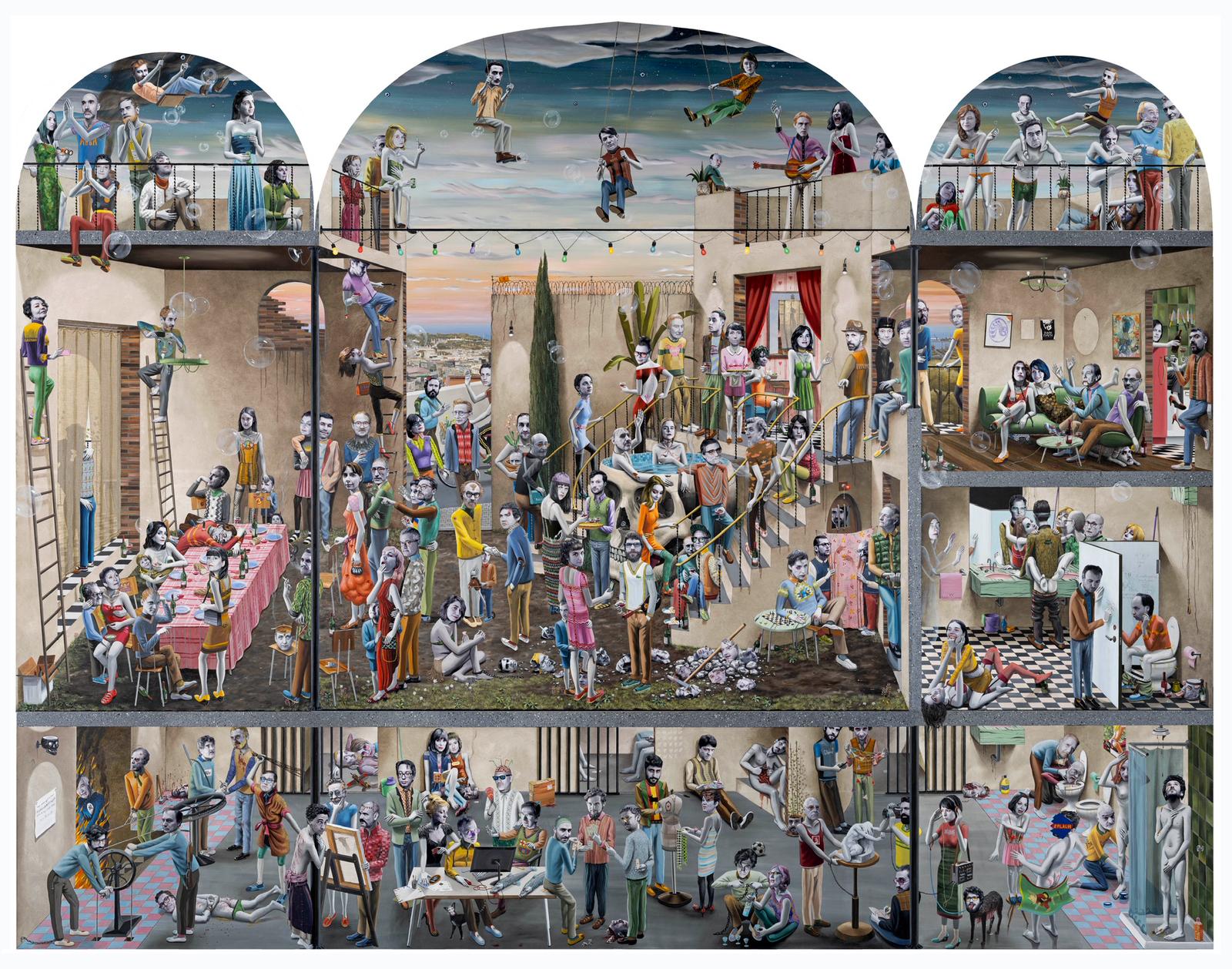
On June 6, the Alfolí de la Sal – Museu de L'Escala inaugurated Vanity Fair (an altar without a hero) , one of the most outstanding creations by the Escala artist Gino Rubert. Initially produced by the Museu Nacional d'Art de Catalunya (MNAC) and currently part of the collection of the Museu de Peralada, the work now arrives in the Empordà in a new presentation that highlights its validity and ability to generate critical reading.
Conceived as a large contemporary altarpiece, the piece brings together 181 protagonists from the world of Catalan art and culture—artists, gallerists, collectors, curators and critics—in a choral scene marked by irony, visual exuberance and an ambiguity loaded with meanings. Its complexity has led some observers to compare it to an imaginary encounter between Bosch's Garden of Earthly Delights and the popular universe of Francisco Ibáñez's 13, Rue del Percebe .
Rubert developed the work between 2020 and 2022, in the context of confinements and restrictions resulting from the pandemic. Initially presented in the Gothic painting rooms of the MNAC and later integrated into the Fata Morgana exhibition at the Tecla Sala Art Center, the piece had already aroused considerable anticipation during ARCO Madrid 2021, where a first version in process was highlighted by several specialized media as one of the most unique proposals of the fair.
The arrival of Vanity Fair in L'Escala coincides with the preparation of a monographic catalogue promoted by the L'Escala City Council, with the collaboration of the Peralada Museum and the MNAC. The publication, scheduled for the end of August, will include critical texts, testimonies, working materials and various interpretative approaches to a work that, over time, has transcended its dimension of generational portrait to become a reflection on vanity, representation, the desire for belonging and contemporary forms of coexistence.
As the artist himself recalls, “while the outside world stopped and galleries, museums and cinemas closed, my studio filled with people.” This paradox between physical isolation and the intensity of imagined social life runs through the entire composition and becomes one of the keys to reading the work.
With this exhibition, Alfolí de la Sal recovers an essential piece of recent Catalan painting and places it, for the first time, in direct dialogue with the Empordà landscape and with the vital universe that has nourished much of Gino Rubert's creative career.
You may be
interested
...