Exhibitions
María Alcaide. The Catalan gaze
María Alcaide explores at Tecla Sala 'The Catalan Gaze' the interferences between archive, memory, identity, and tradition, opening new ways of thinking about cultural representation.
It seems that when two waves of light or sound meet, they do not simply overlap or cancel each other out, but rather interfere with one another, generating new unexpected patterns. Like when two pebbles fall close to each other, almost simultaneously, into a pond, and the ripples they create on the surface of the water eventually meet. From their interference, new shapes emerge, irreducible to each of the original waves that made them possible. Physics calls this phenomenon diffraction.
A few years ago, concerned with the ways in which we know and produce worlds, biologist and philosopher of science Donna Haraway saw in this physical phenomenon a fertile ground from which to think about semiotics and meanings. Haraway noted this in a 1997 text: the suspicion that diffraction offered a very interesting model for producing heterogeneous, new, different narratives. But it was not until a decade later, in 2007, that Karen Barad picked up this intuition from Haraway and developed it in Meeting the Universe Halfway: Quantum Physics and the Entanglement of Matter and Meaning.
In the book, Barad describes diffraction as 'a critical practice of engagement', an expression difficult to translate that refers both to the mutual implication of things and to a way of knowing that does not observe from a distance, but participates in what it looks at, assuming responsibility for its role as a constituent part. As a critical practice, diffraction comes to be a methodology for thinking from encounter, from mutual affectation or interference.
Seen from this diffractive perspective, María Alcaide’s most recent project could be understood as an investigation that approaches this kind of critical methodologies. Conceived as a contact zone where archive, memory, and representation come into friction with speculation, play, and fiction, Alcaide’s new proposal invites us to think about the forms that emerge when different voices, temporalities, and regimes of representation meet. How do materials affect each other, and what patterns of interference are created when we cross visual ethnography with documentary science fiction, or when we put into dialogue the supposed objectivity of anthropological studies with ways of narrating that overflow pre-established patterns.
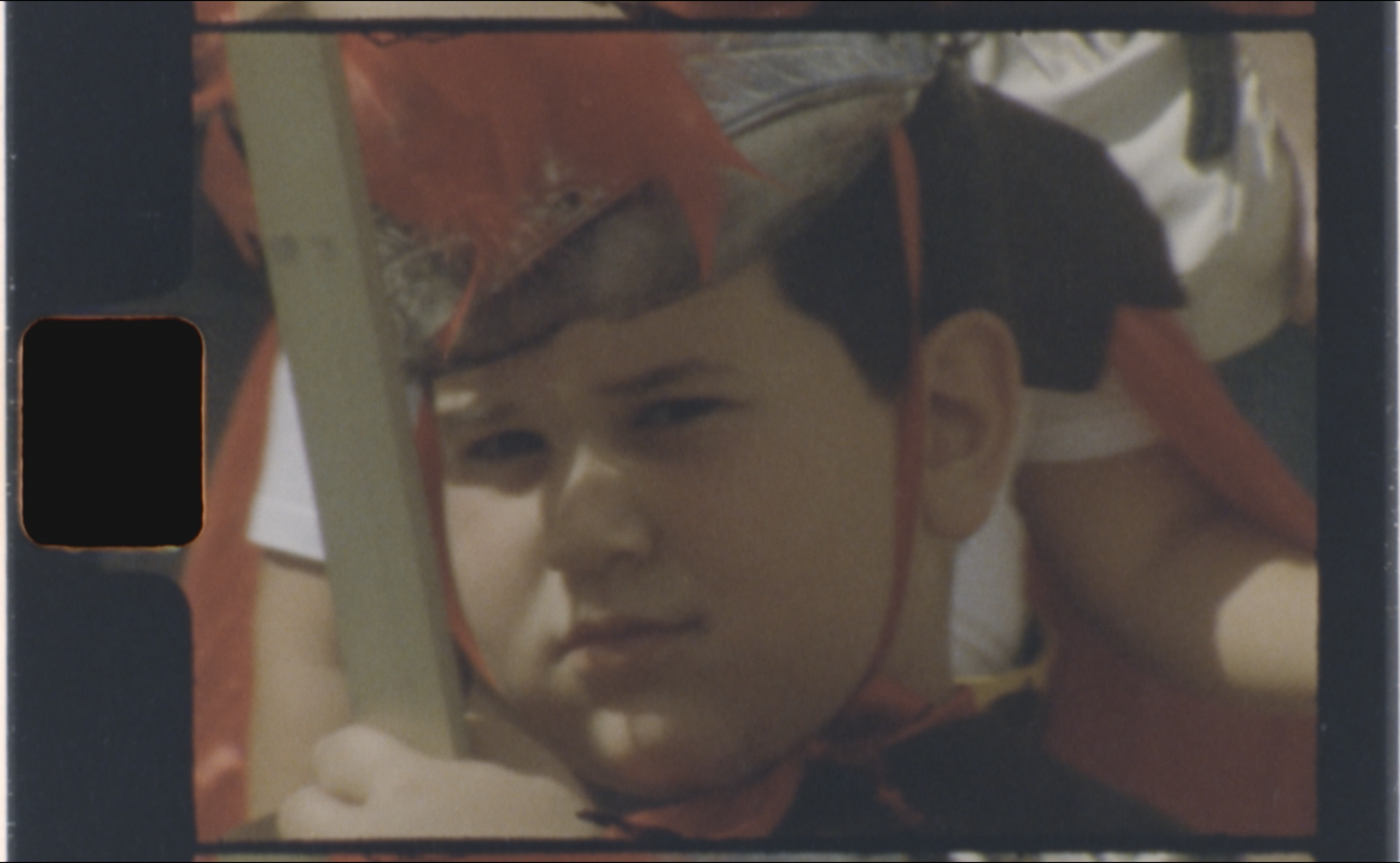
The project, titled The Catalan Gaze, questions the construction of a shared imaginary around identity, territory, and cultural traditions, addressing these concepts from an intermediate and mestizo space. The exhibition is structured around an audiovisual piece that starts from the film archive of Catalan anthropologist Josep Maria Comelles to question how we look at, narrate, and represent southern Spain and its ritualities.
In the piece, Alcaide intertwines Comelles’ recordings of the Rocío pilgrimage or the Holy Week in Zamora during Spain’s transition period with other archival materials and current recordings, as well as narrative voices that displace the story, disorient it, and resignify it from new coordinates. The result is a complex work of fiction seeking to imagine other possible ways of relating to a tradition that is disappearing, or rather, transforming under the logics of capitalism and touristification. Faced with this appropriation of rituals and meeting places that arose as celebrations of the people, the project proposes opening new spaces for dialogue from which to rethink transmission. Both the video and the installation that accompanies it—built from fabrics inspired by the booths of the Seville Fair, stitched line by line to unite the weavings of the past with those of the present—become in this sense metaphors for confluence. The confluence of materials and meanings, but also of gazes, voices, and narratives that come into contact to imagine other ways of inhabiting a tradition that will soon cease to be one and simply become spectacle.
You may be
interested
...