
News
Four beautiful covers, four perspectives, one same publishing universe
Bonart 204 and Malart 2, in Catalan, and Bonart Internacional 3 and Malart Internacional 3 present four covers that establish a dialogue between architecture, contemporary creation, memory, and territory. Four images that express the diversity of languages and sensitivities that coexist in the Bonart universe.
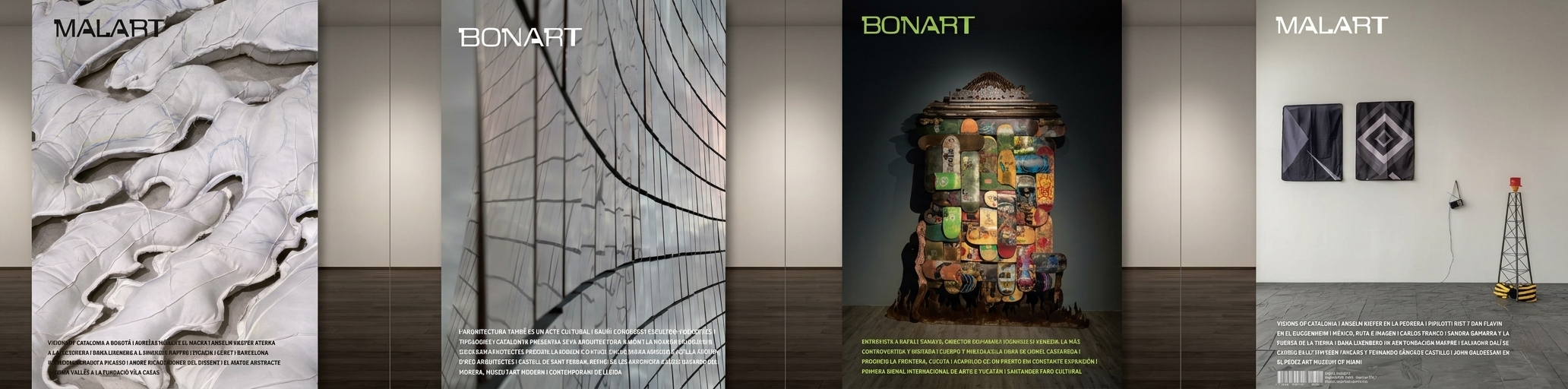
The four covers of the new editions of Bonart and Malart offer a journey through different ways of understanding and inhabiting contemporary art. From architecture to installation, through urban culture, material research, and practices linked to collective memory, each cover is also a statement of intent about the editorial perspective of the publications. Four projects, four contexts, and four approaches that highlight art's capacity to generate new spaces for thought, relationship, and experimentation.
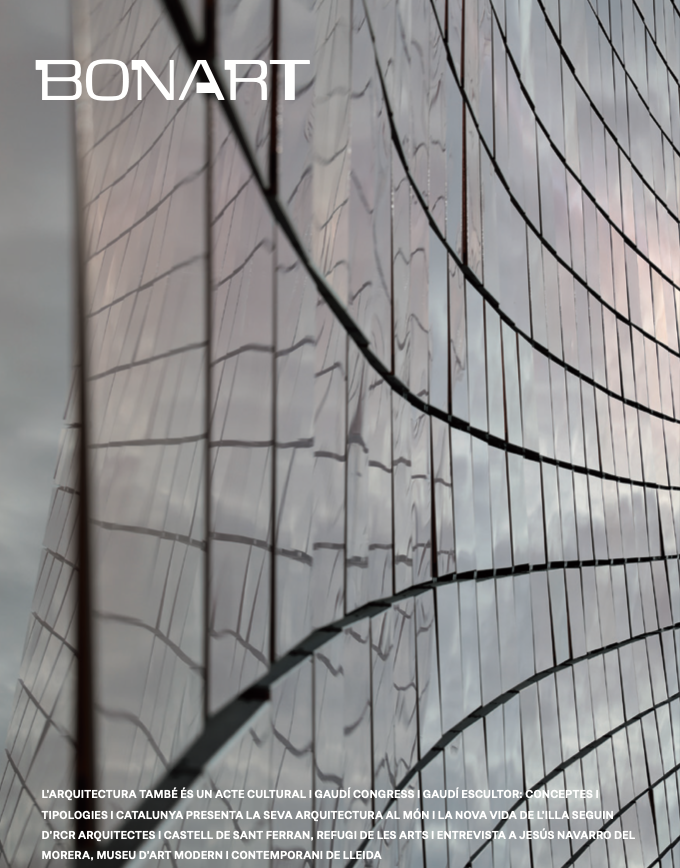
The cover of Bonart 204, in Catalan, is led by Le Large (2026), an image documenting the new contemporary art center designed by RCR Arquitectes, in collaboration with CALQ Architectes. Inaugurated in autumn 2026 on Île Seguin, in Boulogne-Billancourt, the project, promoted by Groupe Emerige, transforms a former industrial site into a new cultural space open to the public. The architecture unfolds through natural light, changing spaces, and a sensory experience that seeks to establish a renewed relationship between the works and visitors. RCR’s proposal, with its particular sensitivity towards landscape, material, and space, positions architecture at the center of a reflection on meeting and dialogue places needed by contemporary art.
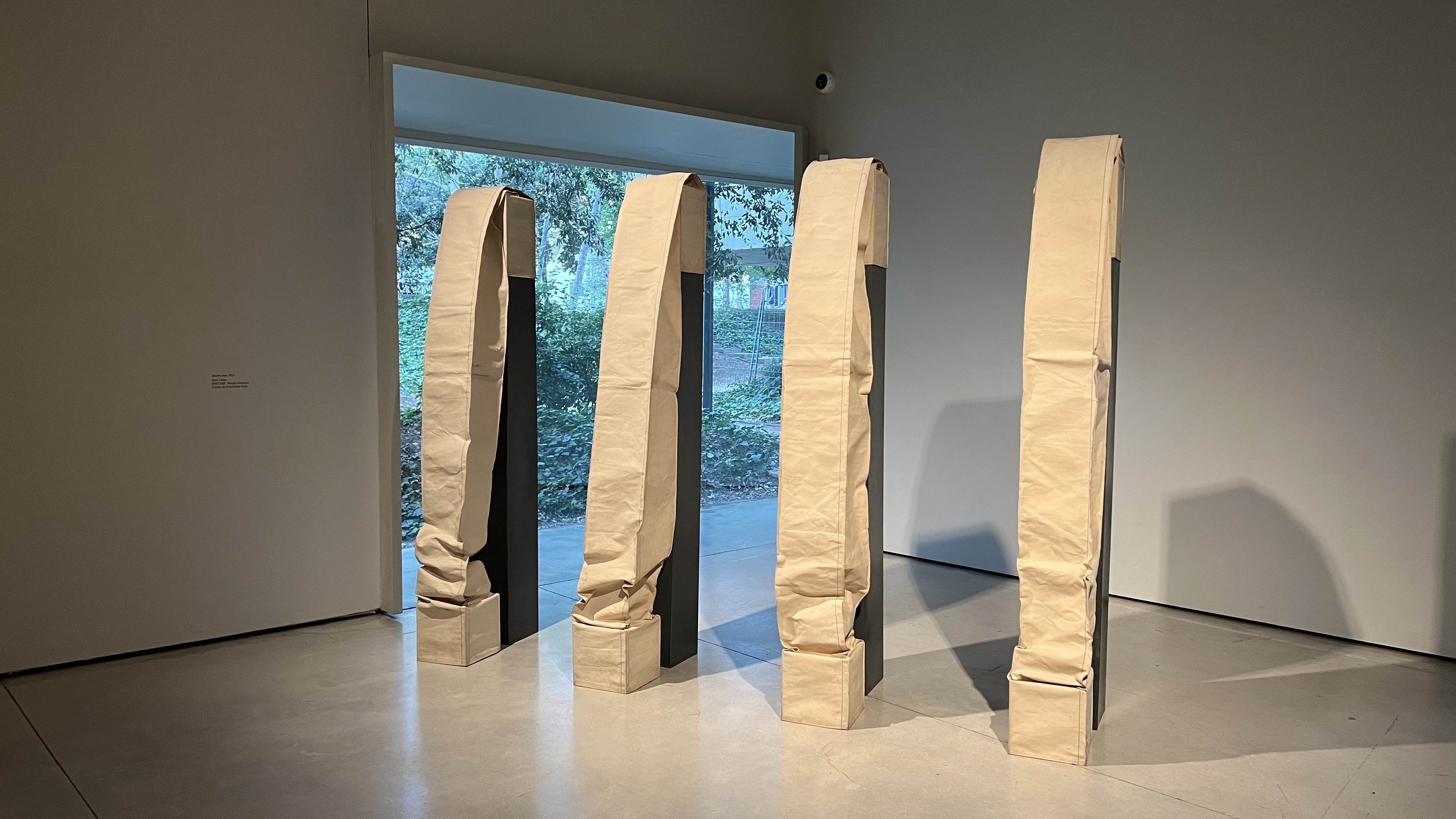
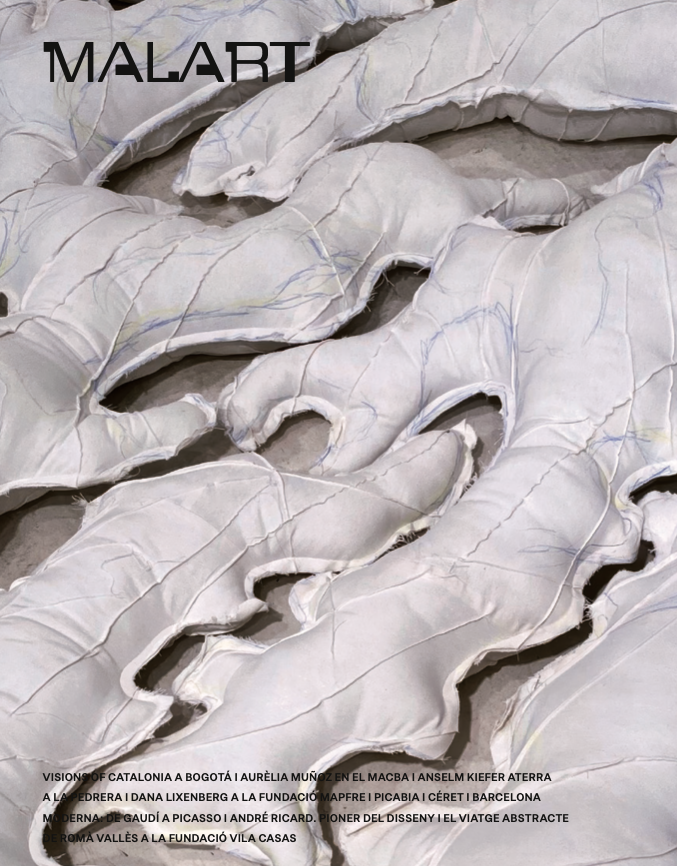
The second cover of the Catalan edition, corresponding to Malart, brings us closer to the universe of Anna Irina Russell with Tangram I. The work, made with untreated canvas fabric, synthetic cotton, and air, is a three by two meter installation consisting of seven soft pieces, irregularly shaped and variable in size. In this proposal, air and play, two structuring elements of Russell’s artistic practice, become materials and construction instruments. The pieces establish a relationship between their edges and the space that separates them, generating tension between contact and overflow. The play is not limited to the creative process but continues in the final configuration of the work, which leaves open the possibility of new arrangements. Air thus acquires an active presence, breathing between the volumes and giving meaning to an installation that explores the possibilities of form, space, and transformation.
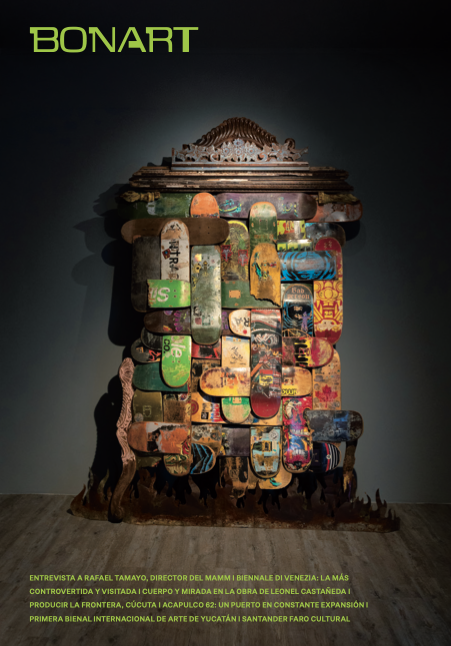
In the international sphere, the cover of Bonart International 3 presents De la manta al mudéjar (2023), an installation of found objects by Colombian artist Alejandro Tobón, photographed by Camilo Díaz. The work, constructed with skateboard decks, wood, and ornamental elements, establishes a connection between urban culture and decorative tradition. Tobón (Medellín, 1978) creates a kind of hybrid monument where the wear marks and usage imprints on the decks introduce a dimension of memory and temporality, while the ornamental elements evoke historical and religious references. Belonging to the series Monumentos del futuro, the piece, measuring 280 × 182 × 55 centimeters, questions cultural hierarchies and the boundaries between urban art, popular culture, and artistic tradition. A recomposition operation that transforms everyday materials into a new form of monumentality.
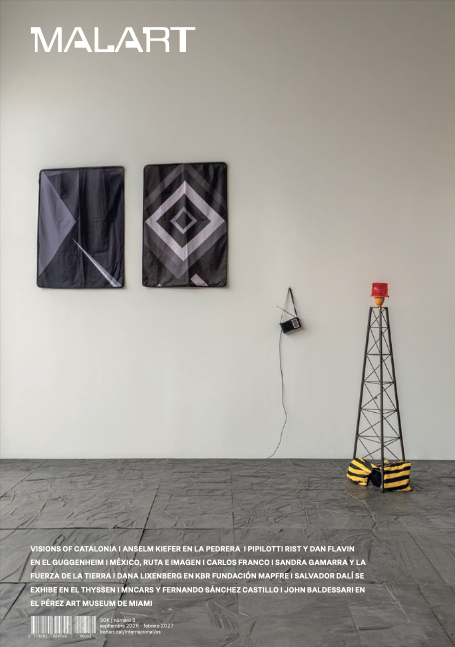
Completing this quartet is the cover of Malart International 3, featuring Ecos del cerro Kwet Tul (Kwet tul wejxa sxwa’w) (2026), a work by Sandra Rengifo and Kostas Tsanakas, courtesy of Fragmentos, Espacio de Arte y Memoria, and photographs by Juanita González. The collaboration between Rengifo (Bogotá, 1979) and Tsanakas (Athens, 1972) articulates photography, video, landscape, memory, and territory in a practice that finds in this installation a dialogic space with the Nasa La Gaitana community in Cauca. Community radio and fique cultivation become the two essential elements upon which a research on knowledge, voices, and images linked to the territory is built. The work recovers these materials to activate a living and shared memory, where the image ceases to be merely a record and becomes a tool of relationship between community, identity, and experience. From their backgrounds in audiovisual, photographic, and videographic fields, the two artists propose a reading that connects different geographies and temporalities.
You may be
interested
...