Exhibitions
Antoni Muntadas brings to Lagos the art that museums make invisible
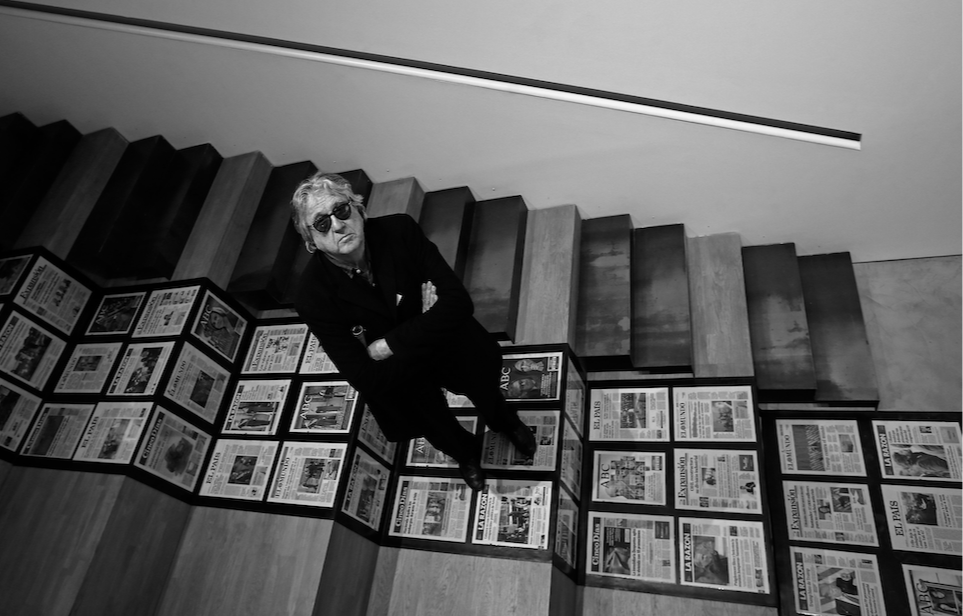
Many questions shape The Museum of Things Unseen , the project that will form the backbone of the fifth edition of the Lagos Biennial, to be held from November 14 to December 6, 2026. Among the selected artists is Antoni Muntadas (Barcelona, 1942), whose career has been characterized by a critical investigation into communication systems, power structures and the mechanisms that condition our perception of reality.
The biennial proposes imagining a different kind of museum, one capable of questioning the historical inequalities that have determined the circulation, preservation, and legitimization of cultural objects. Under the concept of a speculative museum, the exhibition will bring together works that have rarely been shown to the public or that remain virtually unknown, focusing on the reasons for their invisibility. Cultural biases, economic power, political influences, curatorial decisions, and conservation challenges are some of the factors involved in the construction of a profoundly unequal international art canon.
In this context, Muntadas's participation is part of a call for proposals that invites a critical examination of the mechanisms through which knowledge is produced and transmitted. Her inclusion in the main selection places her work in dialogue with international artists such as Hito Steyerl, Kara Walker, Aki Sasamoto, Amie Siegel, and Arcangelo Sassolino, whose practices address, from diverse perspectives, the relationships between art, society, history, and power.
The Museum of Things Unseen does not simply aim to recover forgotten works, but rather seeks to examine the structures that have contributed to keeping them out of the public eye. The project invites contemporary artists to reinterpret and reimagine the presented pieces, generating new readings and questioning the narratives that have traditionally accompanied their reception. In this way, the museum presents itself as a space open to the revision of its own criteria, where the changing identities of the works, the invisible labor that sustains them, and the forces of the market acquire central relevance.
The proposal also challenges the idea of a universal artistic canon constructed from positions of cultural authority. In contrast to an art history that has privileged certain geographies, institutions, and traditions, the biennial aims to establish new relationships between objects, contexts, and communities. The intention is to broaden the frameworks of interpretation and recognize the multiple histories that coexist in the global art scene, including those that have remained on the margins of major institutional narratives.
This reflection will take concrete form with the inauguration of the Àkéte Collection, an international art collection launched within the framework of this fifth edition. Conceived as a pioneering public initiative in Africa, it will bring together artistic objects from around the world through donations and loans from museums, foundations, and private collections. The project aims to facilitate physical access to works that are usually difficult to view and, at the same time, critically examine the models of acquisition and representation upon which the idea of universal heritage has been built.
The choice of Lagos as the venue introduces another dimension to this debate. By bringing the artworks into the city and placing them in relation to its infrastructure, communities, and historical layers, the biennial proposes to alter the usual contexts of exhibition. The encounter between the pieces and the urban environment aims to generate new temporal and cultural connections, challenging the separation between traditional centers of artistic legitimation and other spaces of knowledge production.
The artistic direction of this edition is by Folakunle Oshun, who has appointed Chinyere Obieze, Furen Dai, and Sam Hopkins as curators. The team will work in dialogue with museums, institutions, and artists to develop a project that combines critical research, curatorial experimentation, and reflection on the international circulation of cultural goods.
The program will be rounded out with an international colloquium bringing together academics and museum specialists to discuss issues such as the circulation of heritage, the restitution of cultural property, and the concept of a universal museum. These meetings will broaden the discussion beyond the exhibition sphere and allow for an examination of the historical, political, and ethical implications for institutions that safeguard and disseminate artistic heritage.
The Lagos Biennial thus presents a deliberate paradox: to construct an inclusive space within a system marked by exclusion, to imagine new institutional forms without abandoning concrete intervention, and to question existing structures through the very act of exhibiting. Within this framework, Antoni Muntadas's participation reinforces the call for proposals' interest in analyzing the mechanisms that shape our perception and determine which stories gain visibility.


You may be
interested
...