
News
Gaudí, between sound, gardens and geometry
The Gaudí Congress 2026 brings together research that delves into lesser-known dimensions of the architect's work, from the acoustic comfort of Casa Milà to the digital reconstruction of the loudspeaker of the Cathedral of Mallorca.
The work of Antoni Gaudí continues to offer new perspectives for study beyond its architectural forms, its structural resources and its artistic dimension. The Gaudí Congress 2026 focuses on this diversity of perspectives with a program of invited lectures that explore less common aspects of his production, such as the acoustic behavior of heritage spaces, the conception of gardens, the symbolic interpretation of ceramic coverings and the possibilities of digital technologies to recover missing elements.
One of the research presented focuses on the acoustic comfort of Casa Milà, popularly known as La Pedrera. The presentation Acoustic comfort in the heritage spaces of Casa Milà–La Pedrera: a study of in situ measurements , by Rosa M. Alsina-Pagès, professor in the Department of Engineering at La Salle–Ramon Llull University and researcher in the Human–Environment group, addresses a dimension of Gaudí's architecture that has received less attention than its formal and constructive aspects.
The study analyses representative spaces of the building, especially the period floor and the main floor, including the balcony facing Passeig de Gràcia. Through a campaign of in-situ acoustic measurements, with omnidirectional sound sources and specialised microphones, the research team has studied reverberation, sound clarity and speech intelligibility. This data has been complemented with measurements of ambient noise and perceptual assessments of interior and semi-open spaces.
The research examines how geometry, materials, furniture and exposure to urban noise condition the sensory experience of architecture. The results highlight that acoustic comfort does not depend solely on noise levels, but also on spatial configuration and the way people perceive and inhabit spaces. The methodology also has an educational dimension, as a simplified version has been developed for international secondary school students within the framework of the Barcelona International Youth Science Challenge, held annually in La Pedrera.
Gardens constitute another research theme of the congress. M. Mercè Compte i Barceló, a graduate in Fine Arts from the University of Barcelona and associate professor at the Faculty of Fine Arts, presents the project Gardens in Gaudí's work , a research project planned for the period 2026-2030 that aims to delve deeper into the architect's relationship with the landscape and plant spaces.
The project, developed by a team of specialists, proposes a historical and artistic approach to the gardens and gardening elements designed by Gaudí. The analysis will address issues such as design, architectural components, plant composition, landscape integration, symbolism and functionality. After studying the different spaces individually, the research proposes a transversal reading that allows establishing connections between the solutions adopted and providing new interpretations of Gaudí's production as a whole.
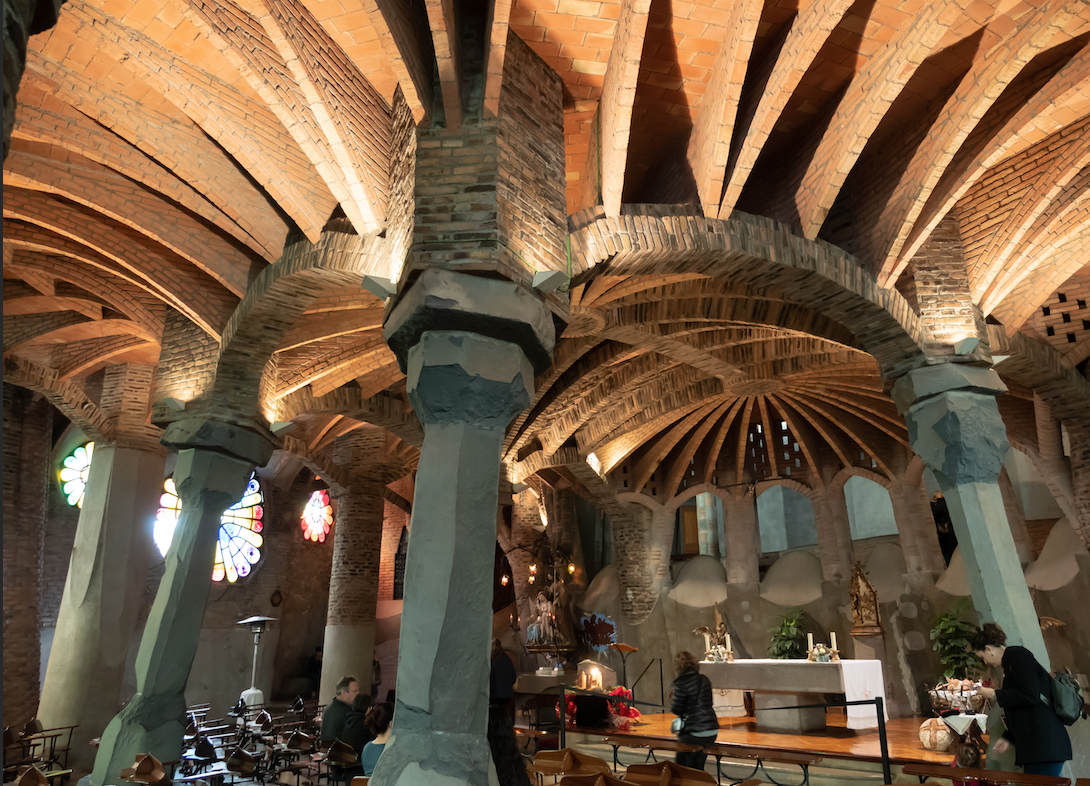
The symbolic dimension of Gaudí's architecture is also the focus of the intervention of Miquel Domènech Roig, former technical manager of the Colònia Güell Consortium between 1994 and 2018 and author of the book Symbolic Interpretation of the Colònia Güell Crypt , published in 2024. His presentation, entitled Symbolic Figuration and Abstraction in the Breaks of the Windows of the Colònia Güell Crypt , examines the ceramic ornamentation of the windows of this emblematic building.
The study starts from the arrangement and composition of the windows to analyze the characteristics of the trencadís on both the intrados and the extrados. Through the identification of figurative motifs and forms of abstraction, Domènech proposes to delve deeper into the possible symbolic readings of these elements, in relation to the general discourse of the crypt and with other references present in Gaudí's work. The research thus highlights the importance of ornamental details as part of an architectural language in which form, material and meaning are closely linked.
The digital recovery of a missing element is the focus of another of the invited talks. In Redescobrint el tornaveu perdut de Gaudí: geometria i reconstrukció digital , Albert Samper Sosa, architect and full professor at the Escola Técnica Superior d'Architecture of the Rovira i Virgili University, presents research aimed at reconstructing the original shape of the tornaveu that Gaudí designed for the main pulpit of the Cathedral of Mallorca.
Disappeared in 1970, this element is only preserved in documentary form through some historical photographs and a sketch by Le Corbusier. The combination of laser scanning, photographic restoration and geometric analysis of parabolic surfaces allows us to approach its reconstruction with scientific criteria and delve deeper into the geometric principles that guided the original project.
A PhD holder from the Universitat Rovira i Virgili and the University of Girona, Samper focuses his research on geometry applied to architecture, heritage digitization, three-dimensional modeling and technologies for documenting, analyzing and conserving architectural heritage. He is also the founder of Scandraw, a spin-off of the URV specializing in the digitization and graphic representation of heritage.

You may be
interested
...