
Exhibitions
Ricardo de Madrazo, the talent that remained in the shadow of a saga
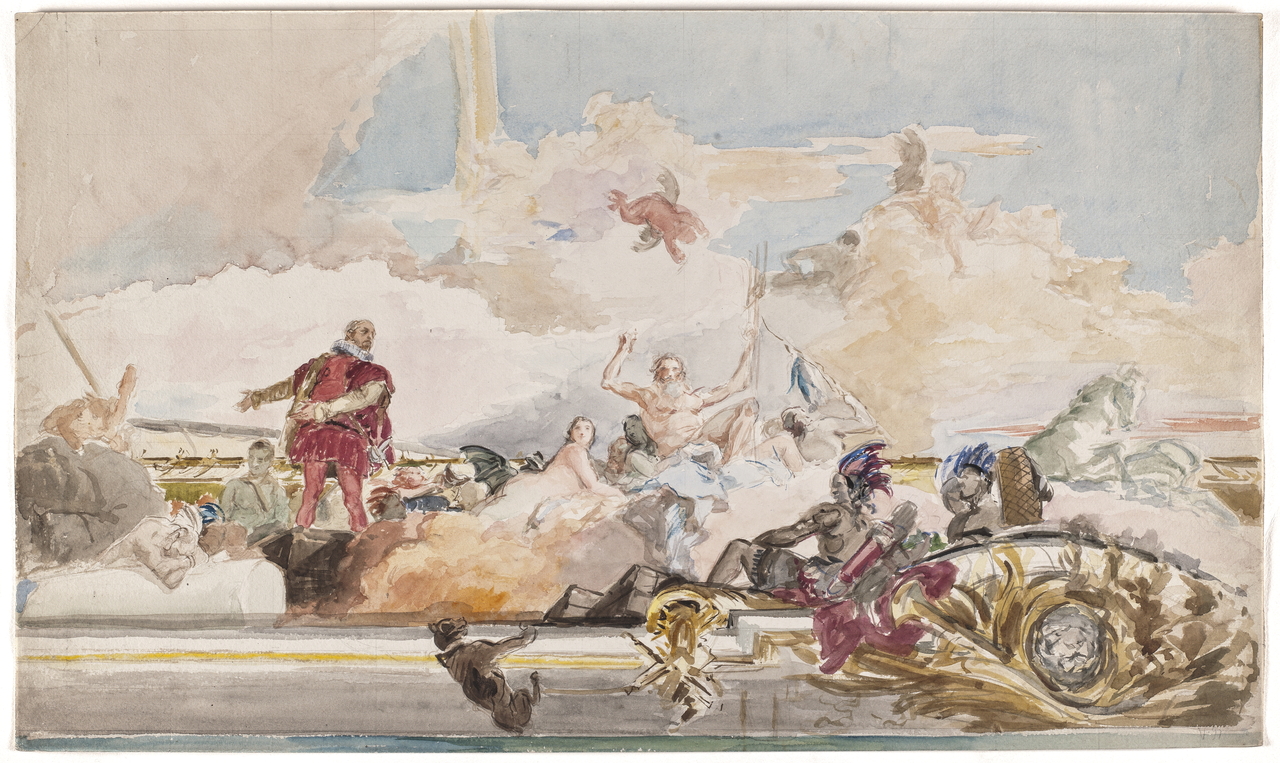
The history of art is also built upon figures who, despite developing their own unique careers, are overshadowed by the brilliance of the names surrounding them. Ricardo de Madrazo y Garreta (1852-1917) is one of those artists whose work deserves a fresh look. Linked to one of the most influential artistic dynasties in 19th-century Spain, his output was largely eclipsed by the international acclaim of his brother-in-law Mariano Fortuny y Marsal and his brother Raimundo de Madrazo. Now, the Prado Museum is recovering his legacy on paper and reclaiming the singularity of an artistic practice that found its most personal means of expression in drawing and watercolor.
Until January 17, 2027, Room 60 of the Villanueva Building is hosting, as part of the Open Warehouse program, the first exhibition dedicated to Ricardo de Madrazo. The show brings together sketchbooks, watercolors, drawings, a self-portrait, and personal documents that allow us to reconstruct a career spanning almost fifty years. Virtually unpublished as a whole, the works offer a direct glimpse into the interests, processes, and evolution of an artist whose contribution had remained in the background of his family history.
The exhibition reveals his mastery of pencil, pen, and watercolor, as well as the breadth of his artistic interests. Copies of the great masters coexist with Orientalism, cityscapes, landscapes, and intimate, family scenes. Beyond their documentary value, these works reveal a keen eye for reality and its variations, capable of moving between meticulous study and spontaneous observation.
The exhibition also underscores the importance of the Prado Museum's acquisitions policy, which has enabled the collection of 29 of the artist's notebooks. This set constitutes an exceptional source for tracing his creative process and understanding how drawing functioned as a tool for learning, recording, and experimentation throughout his life.
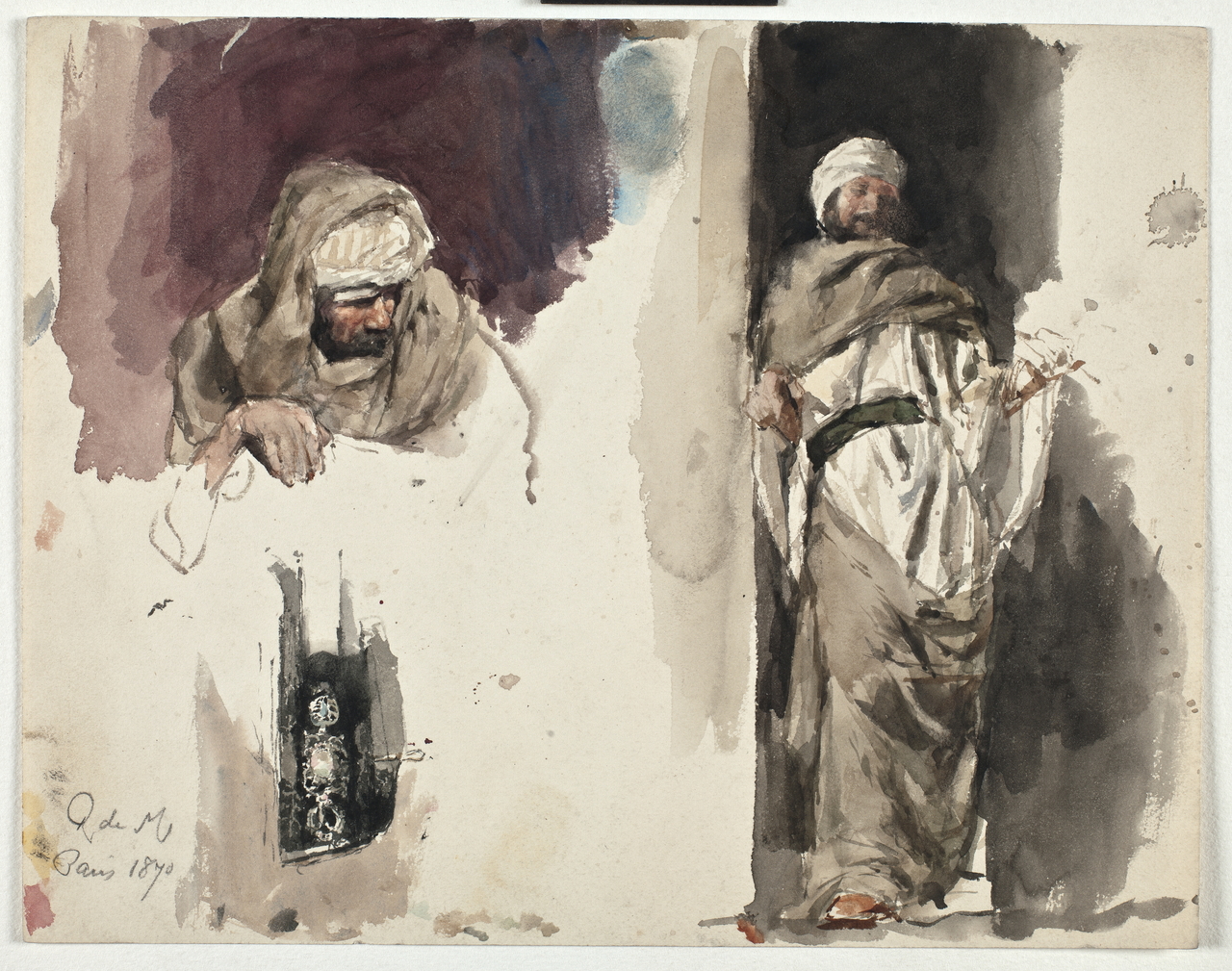
Two studies of a figure dressed as a Moor by Ricardo de Madrazo y Garreta. Watercolor on laid paper, 1871. Signed and dated. Madrid, Museo Nacional del Prado. Acquired in 2012.
An artistic identity beyond the surname
The youngest son of Federico de Madrazo and grandson of José de Madrazo, Ricardo grew up in an environment where artistic practice was an integral part of daily life. His education was marked by his father's influence and, especially, by his close relationship with Mariano Fortuny, in whose studio he began working at a very young age. This contact with one of the most internationally renowned Spanish artists of his time proved decisive for his development, although the extraordinary fame of Fortuny and Raimundo would ultimately contribute to overshadowing his own artistic identity.
Although he also worked in oil painting, portraiture, and illustration, and showed an interest in photography, it was in works on paper that he found a particularly fertile ground for developing his artistic concerns. His notebooks are not only a collection of preparatory sketches, but also a kind of visual diary in which observation of his surroundings, learning of the pictorial tradition, and recording of personal experiences intertwine.
Dated between 1867 and 1917, the notebooks accompanied the artist throughout his career. Madrid, Rome, Naples, Granada, Toledo, Venice, Tangier, Fez, Biarritz, and Lekeitio appear as settings for a practice nourished by travel and contact with diverse landscapes, architecture, and ways of life. Their pages contain preparatory studies, copies of masters, models, urban panoramas, and domestic scenes that reveal both the breadth of his interests and the continuity of his work.
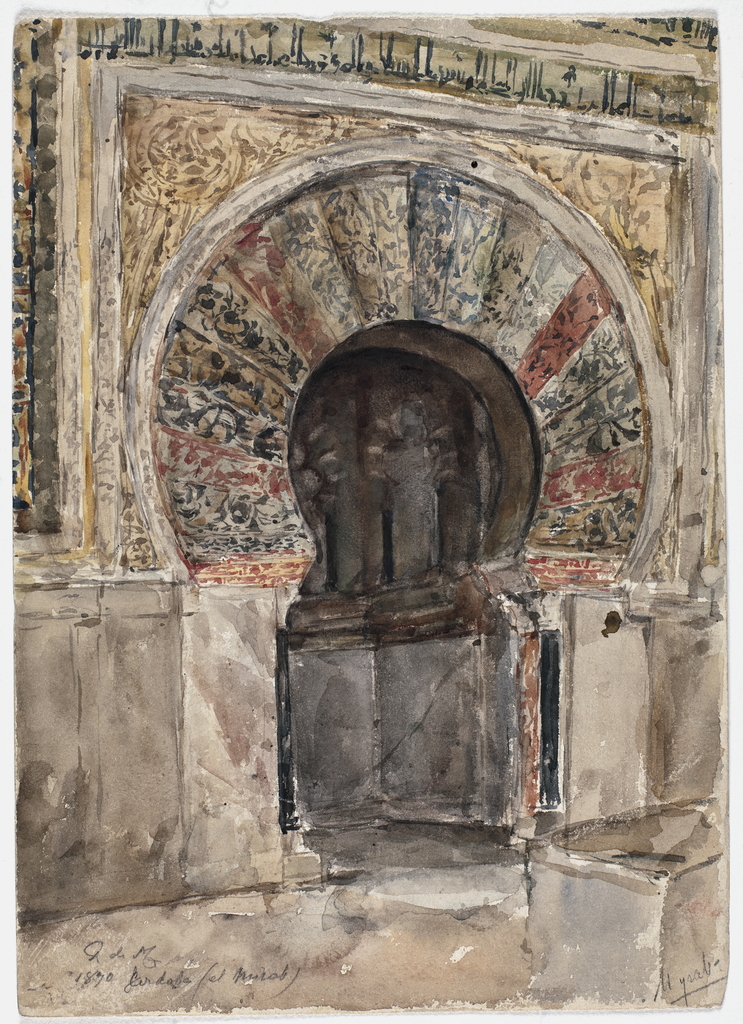
Mihrab of the Mosque of Cordoba by Ricardo de Madrazo y Garreta. Pencil and watercolor on laid paper, 1870. Signed and dated. Madrid, Museo Nacional del Prado. Acquired in 2012.
Travel as a laboratory of observation
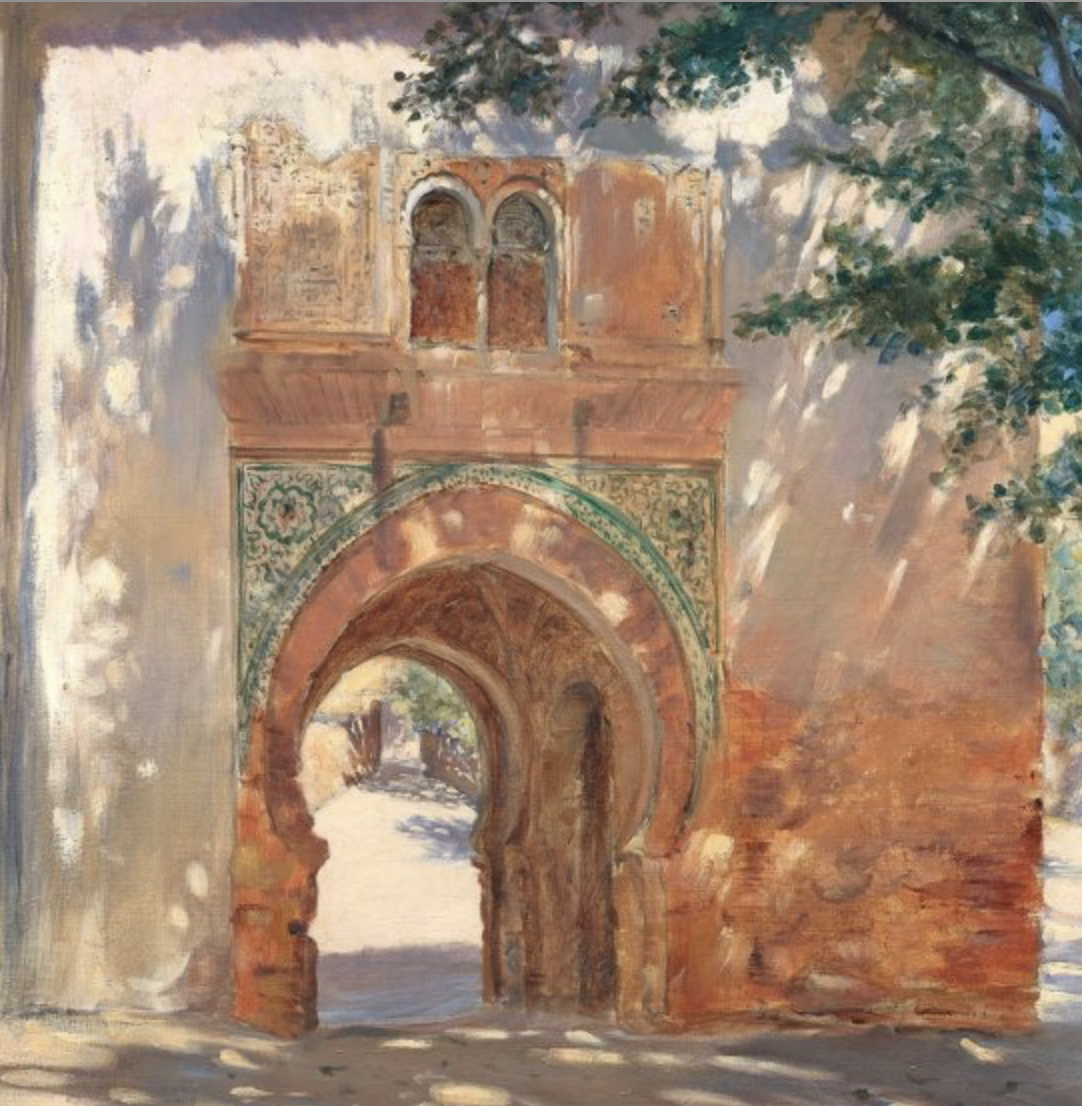
Travel occupies a central place in Ricardo de Madrazo's work. The watercolors he created during his stays in Córdoba and Granada, some of them in the company of Fortuny, reveal his fascination with Islamic architecture, its ornate richness, and the ever-changing effects of light. In works such as Mihrab of the Mosque of Córdoba , Hall of the Abencerrajes in the Alhambra of Granada, and Trees on the Cuesta del Rey Chico, Granada , attention to detail is combined with a special sensitivity to chromatic and luminous variations.
These works reveal a way of observing that goes beyond architectural or landscape description. Watercolor allows him to capture the particularities of each space, record the play of light, and translate the atmosphere of the places he visits onto paper. The precision of his drawing and the lightness of his technique are thus combined in a practice that oscillates between rigorous study and immediate impression.
His 1877 trip to North Africa broadened his repertoire and reinforced his interest in Orientalist themes, also present in the work of other artists in his circle. His notebooks contain numerous sketches made in Tangier and Fez, evidence of direct observation that would later inform new compositions. Some of these sketches were reused as starting points for other works or reproduced in illustrated magazines, demonstrating the circulation of his images beyond the strictly private sphere.

You may be
interested
...