Exhibitions
From Empúries to Spider-Man
Empordà enters the vignette and reviews its relationship with graphic narrative, from comics and fanzines to fictions constructed from outside the territory.
Before comics existed, there was already a need to tell stories with images. Prehistoric cave paintings, Greco-Latin vases and mosaics, medieval altarpieces, Aztec stones and the Bayeux Tapestry are examples of the same desire: to order the world through a visual sequence. Centuries later, the street vendors, often sold by the blind, continued this narrative tradition until, at the turn of the 19th century, the industrial revolution and new production and distribution systems led to the emergence of the modern comic strip.
Comics were thus born as a mass communication medium closely linked to large cities and their publishing centers. But what happens when this language reaches the periphery? What happens when a territory that is not one of the major centers of publishing production stops being simply a consumer of comics and becomes a space for creation, inspiration and even fiction?
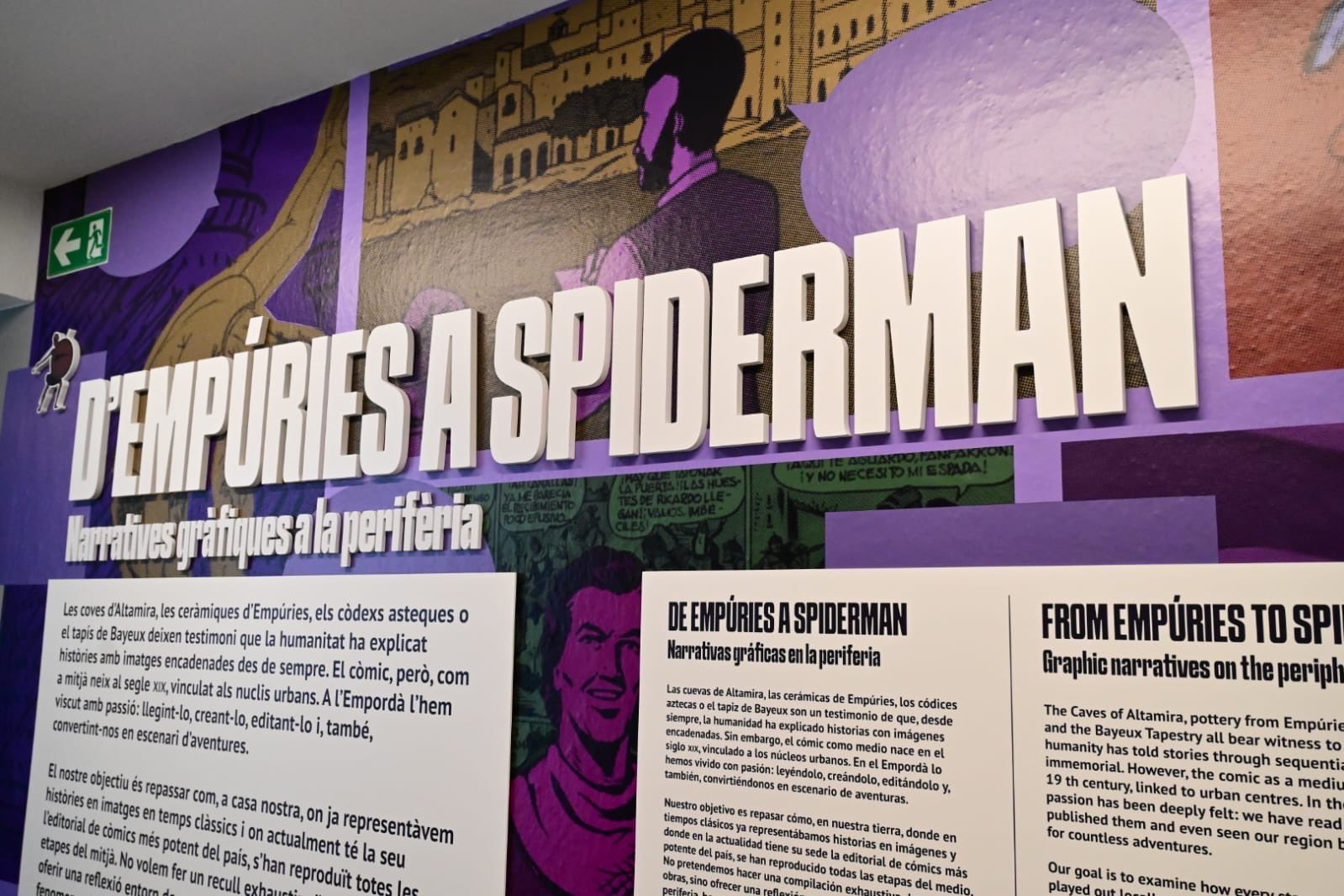
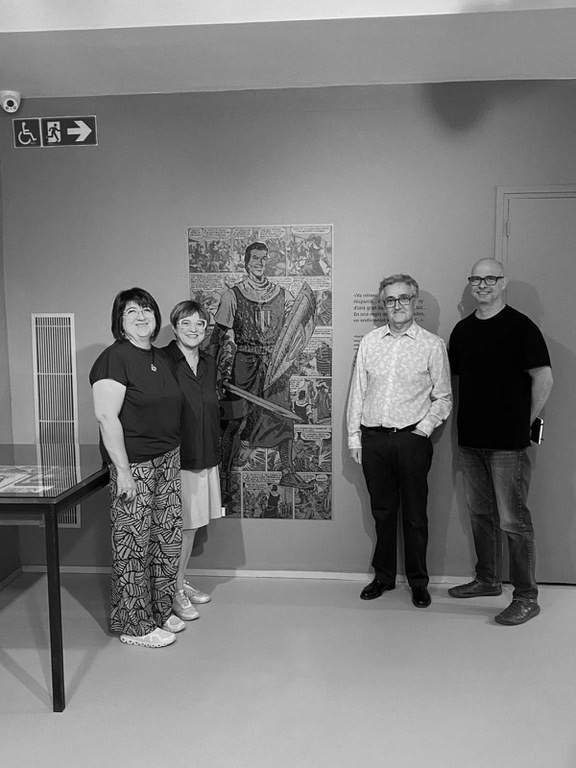
This is one of the questions that crosses D'Empúries in Spider-Man. Graphic Narratives on the Periphery , an exhibition at the Museu de l'Empordà that proposes to review the relationship between graphic narrative and the Empordà territory. Curated by M. Mercè Cuartiella and Joan Manuel Soldevilla, the exhibition starts from an unusual perspective: not only studying the authors or works linked to comics, but also observing what happens when this language comes into contact with a specific territory.
The Empordà appears, in this way, from different perspectives. It is a territory of creators, but also of authors who arrive from outside; a space of consumption, but also of production; a real landscape, but at the same time a setting for fictions. And this last dimension is especially significant because the Empordà has often been converted into an imaginary construction, loaded with references, clichés and visions that have contributed to consolidating a certain cultural image.
The exhibition attempts to go beyond this superficial view. It does so by recovering names such as Joan Cos, Àngel Nadal or Joan Antoni Poch, cartoonists linked to the territory who developed diverse trajectories, but also incorporating those foreign creators who found in the Empordà a landscape, an atmosphere or a repertoire of images that could be transferred to the cartoon.
The map proposed by the exhibition, however, is not limited to cartoonists. It also gives prominence to scriptwriters and the processes of story construction, with figures such as Sebastià Roig and Àngels Gardella. It is a way of broadening the perspective on comics and remembering that behind each image there is also a narrative architecture, a voice and a certain way of interpreting the territory.
One of the most revealing chapters is the one dedicated to the underground expressions that proliferated in Figueres during the eighties and nineties. In that context, alternative publications such as Pus de iaia or Empordà Funeral appeared, linked to a graphic culture that operated outside the conventional publishing circuits. Fanzines here become witnesses to another way of understanding creation: more immediate, more irreverent and also more linked to local cultural networks.
This peripheral dimension is, precisely, one of the most interesting contributions of the exhibition. The periphery is no longer synonymous with absence. It can be a place from which to look differently, experiment with other formats and construct discourses that do not necessarily respond to dominant models.
The tour also proposes a broad chronological arc that connects the current state of comics with a much older tradition of visual narrative. The starting point is Empúries and the graphic culture of antiquity, a choice that allows us to situate comics within a much more extensive history than that of modern comics. The cartoon does not appear, therefore, as an isolated phenomenon, but as one more episode of a persistent human need: to tell, remember, imagine and transmit stories through images.
The journey reaches the present and also incorporates figures such as Vicenç Pagès, as well as the powerful imprint of Dalí's imagination. Because if there is an artist who understood the Empordà as a territory capable of transforming itself into fiction, it is Salvador Dalí. His relationship with the landscape, with local myths and with the construction of his own imagination contributed decisively to turning the Empordà into something more than a geographical space.
In this sense, the title of the exhibition functions almost as a declaration of intent. From Empúries to Spider-Man brings together two seemingly distant extremes: the Greco-Latin world and one of the great characters of contemporary popular culture. Between the two there are centuries of visual representation, but also a common need to create stories through images.
The question is no longer, therefore, whether the Empordà has been sufficiently present in the history of comics. The question is what this relationship explains about the territory itself. The cartoons allow us to discover an Empordà that is not only that of postcards, the ruins of Empúries or Dalinian landscapes, but also that of local creators, fanzines, alternative circuits and imagined stories.


You may be
interested
...