Exhibitions
Teresa Margolles facing the traces of violence
From September 25, 2026, through the summer of 2027, MoMA presents Teresa Margolles: Approaching the Scene , the first large-scale solo and institutional exhibition dedicated to Teresa Margolles (Mexico, 1963) in the United States. The show brings together sculptures, photographs, and audiovisual works created by the artist over the past three decades, along with large-scale installations and a new work produced specifically for the occasion.
The exhibition stems from an artistic practice deeply connected to the material traces of violence. Since the 1990s, Margolles has worked with physical remains from sites of deaths and violent incidents, transforming them into material for a body of work that questions the social and political consequences of these tragedies. Broken glass from gunshots, blood, soil, and architectural fragments cease to be mere waste and become testimonies of what has happened, testimonies that often risk disappearing from public memory.
Trained in forensic pathology and photography, Margolles has developed a career focused on the implications of transnational violence, with particular attention to the relationship between Mexico and the United States and the border that separates the two countries. Her artistic methodology stems from rigorous research and materials directly linked to scenes of loss and death. Through various media, her works address disappearances, murders, forced political displacement, and situations of social neglect, while also questioning traditional forms of commemoration.
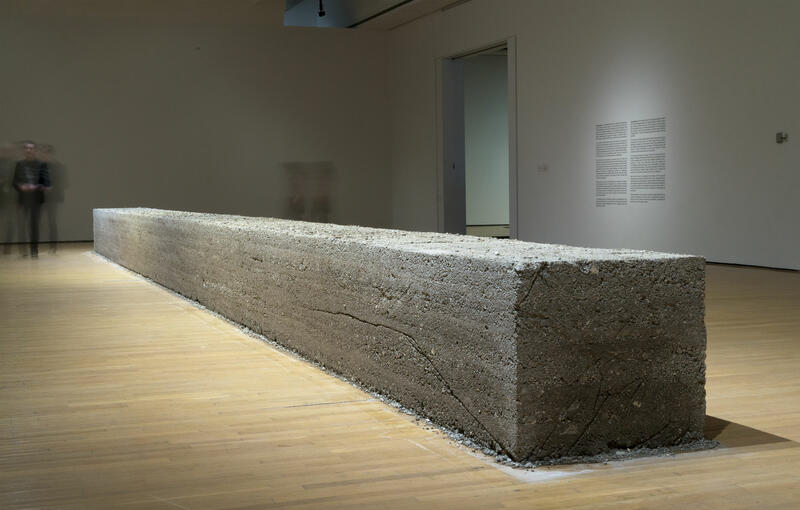
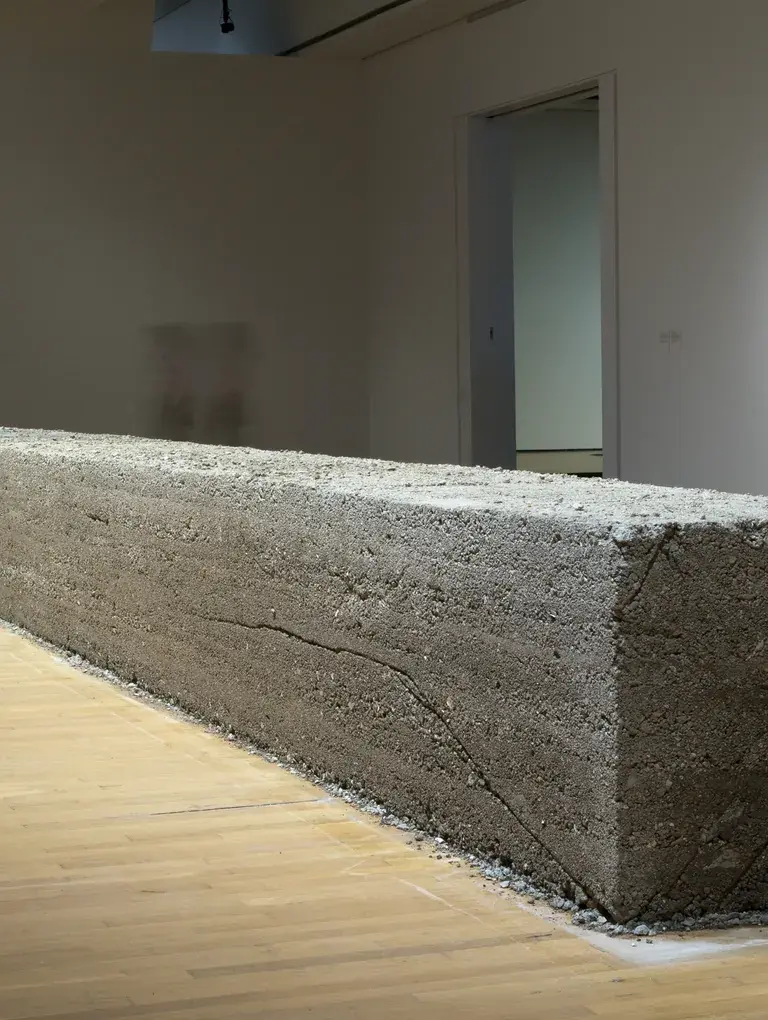
The journey through these three decades finds one of its central points in La promesa (2012), a monumental sculpture constructed from an abandoned house in Ciudad Juárez. The artist acquired the house and dismantled it over eleven days in a city marked by a high rate of femicides, where she conducted extensive research. With the remains of the structure, she initially created a geometric barrier that was subsequently disintegrated progressively by volunteers until it was reduced to dust.
The installation presented at MoMA PS1 preserves 13 tons of that rubble, a portion of the house's total weight, accompanied by archival material documenting the demolition process and the context of border violence from which the work emerged. The house, reduced to ruins and then to dust, thus functions as a material laden with memory and as a record of a reality that can hardly be separated from its social context.
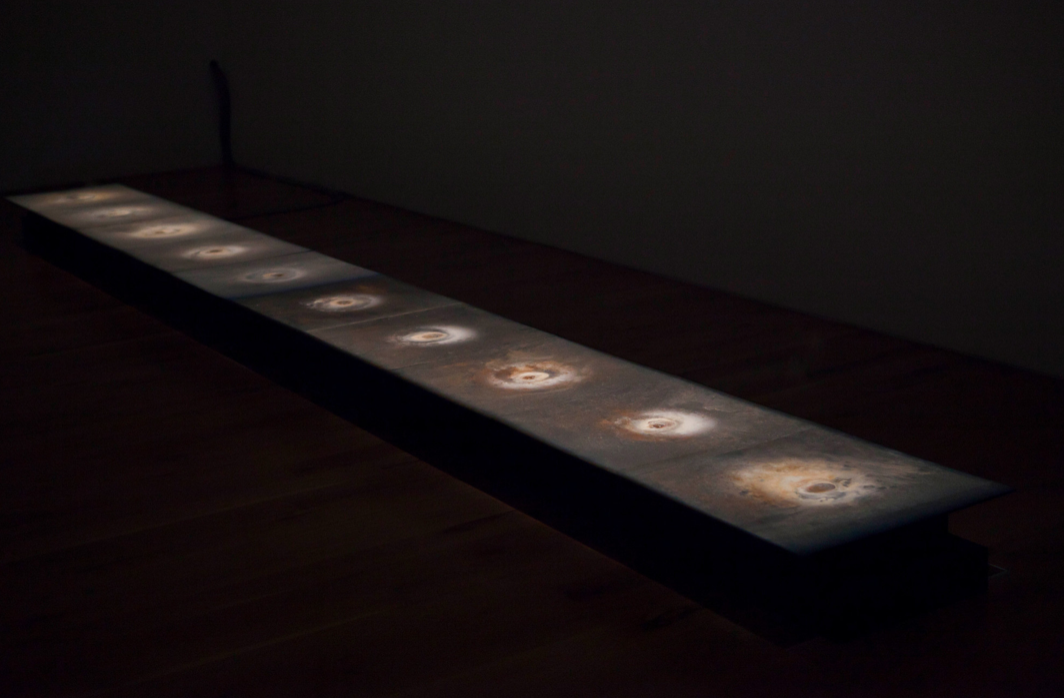
The new installation that gives the exhibition its title focuses on more recent events in Minnesota, California, and Texas. "Approaching the Scene of the Crime" combines heated metal plates with water infused with debris that Margolles has collected from murder sites in these states. The water falls onto the plates at regular intervals, generating a high-pitched hissing sound accompanied by steam.
Time plays a direct role in the artwork. As the drops fall, the plates begin to oxidize, giving rise to a continuous cycle of evaporation, erosion, and disappearance. The installation does not reproduce a scene of violence, but rather activates its material traces and transforms them into a physical experience that forces the visitor to confront the persistence of what has occurred.
This material dimension permeates all of Margolles's work. Her art seeks not only to represent violence, but also to make visible what remains afterward: the remnants, the spaces, the marks, and the absences. The artist uses materials laden with meaning to construct situations in which memory ceases to be an abstract concept and acquires a physical presence.
The interconnected histories of the United States and Mexico form a fundamental axis of this research. Migration, drug wars, systematic murders of women and girls, and various forms of structural violence are linked to a reflection on those lives that have been left out of public narratives. Margolles transforms the remnants of places of loss into a form of memory and, at the same time, into an invitation to consider what happens when a society stops looking at such traces.
The exhibition thus creates a space for contemplation and public dialogue. Sound, steam, dust, rust, fragments of a house, and documentary images function not merely as formal elements, but as devices capable of triggering reflection on violence and its consequences. In Margolles' own words: 'One murder changes the world.'


You may be
interested
...