
Exhibitions
Albert Aparicio and the mystery of the origin
Twenty years after Traces, the artist returns to the Valvi Foundation with a contained and enigmatic painting, inhabited by transforming forms, empty architectures and landscapes suspended in time.
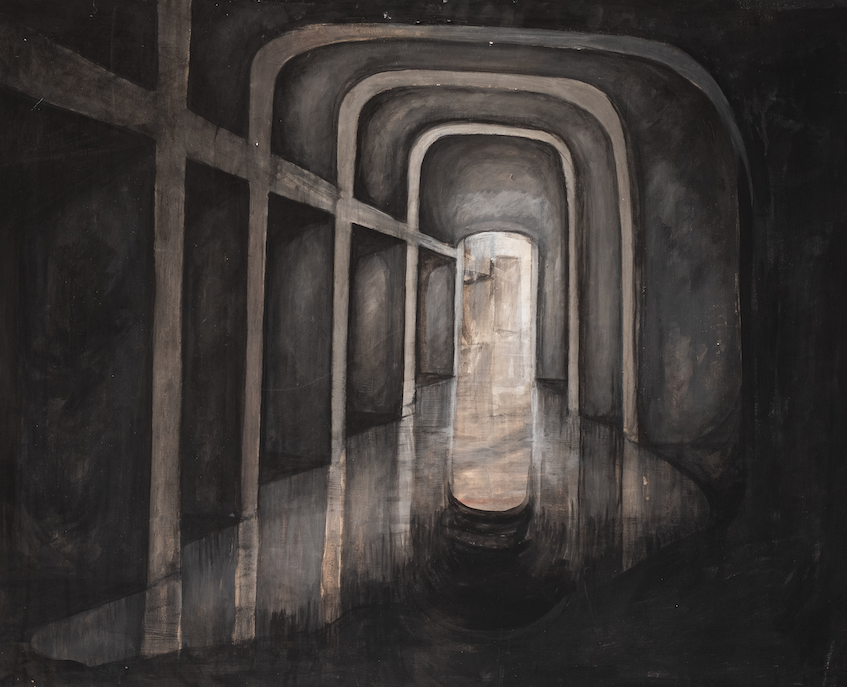
Albert Aparicio's painting does not solve the enigma, but preserves it. Twenty years after presenting Traces at the Valvi Foundation, the artist returns to this space with Origen , an exhibition that can be understood as a return, but also as a new look at questions that, far from having found an answer, have been acquiring greater density.
The title already contains a paradox. Origin seems to refer to a starting point, to an inaugural moment, but in Aparicio's work the origin is not necessarily a beginning. It is a zone of return, a mental place to which one returns to review forms, atmospheres and intuitions. Painting thus becomes a form of memory without a narrative, in a space where past and future cease to be opposing categories and become confused in a suspended present.
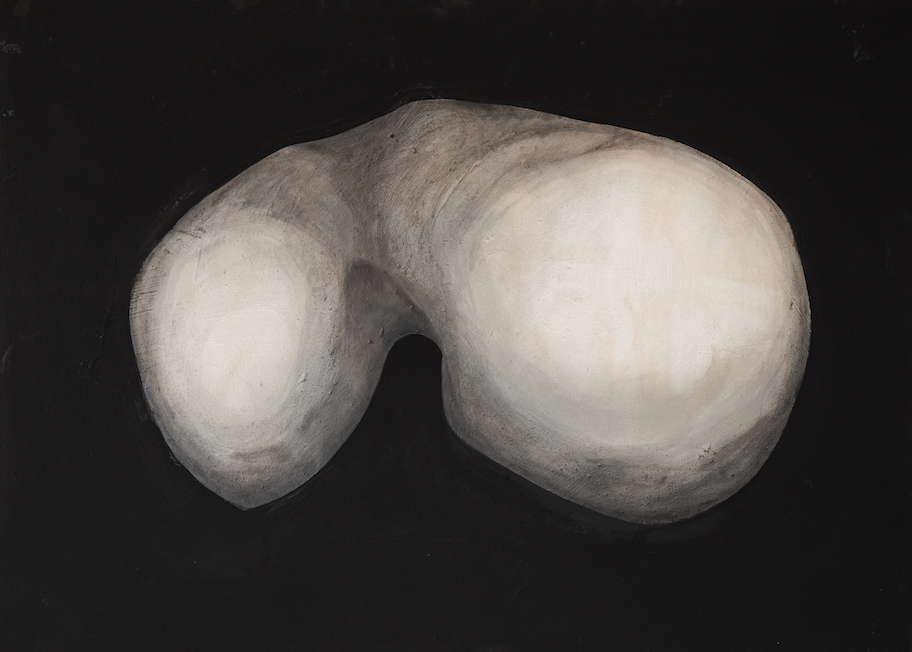
This feeling is especially evident in the biomorphic forms that appear in his works. They are difficult to classify presences, organisms or fragments of organisms that seem to be in an intermediate state: half-formed, about to disappear or simply waiting for a transformation. Their indefinability is not a lack of concreteness, but precisely what gives them strength. Aparicio avoids turning them into closed symbols and allows them to retain a certain opacity, as if they belonged to a world prior to their identification.
In parallel, the architectural landscapes introduce an apparently opposite dimension. Where biomorphic forms suggest growth, mutation and life, the architectures appear bare, silent and without inhabitants. These are spaces that could be ruins, but also unfinished constructions; vestiges of a vanished world or possible scenarios of a future that has not yet arrived. This temporal ambiguity constitutes one of the most suggestive aspects of the exhibition.
Aparicio's architectures do not function, therefore, as recognizable urban landscapes. They are mental structures. Their absence of human figures accentuates the feeling that we are faced with a world that exists outside our presence. The walls, volumes and empty spaces acquire an almost archaeological, but at the same time futuristic quality. What seems like a ruin can also be a project; what we interpret as a remnant of the past can contain the possibility of a new beginning.
This temporary suspension brings Aparicio's work closer to the tradition of metaphysical painting. But rather than reproducing its codes, the artist assumes an attitude: the conviction that an image can reveal itself precisely when it stops wanting to explain itself. In this territory, the painting does not illustrate a story or offer a narrative response. It constructs an atmosphere capable of provoking a feeling of strangeness in the face of what, apparently, we already know.
The reference to Giorgio Morandi is particularly significant. Aparicio shares with the Italian painter a way of understanding painting as a slow approach to things and, above all, a resistance to exhausting their meaning. In Morandi, everyday objects acquired an almost metaphysical density through small variations in shape, light and tone. In Aparicio, this same desire for containment shifts towards organic forms and architectural spaces that seem to exist in a parallel reality.
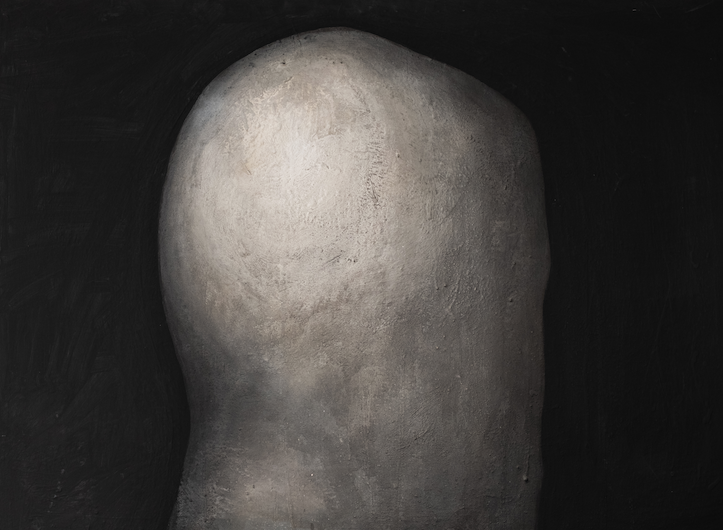
Light is one of the fundamental instruments of this construction. Far from simply describing the volumes, it determines the emotional quality of the scenes. The relationship between illuminated areas and shadows helps to turn the figures and architectures into spectral presences, as if they were subjected to a light that came not so much from a specific exterior as from an interior time. Color also participates in this strategy of containment: instead of competing with the forms, it accompanies them and places them in an atmosphere of disturbing calm.
Aparicio works in this way from synthesis. He eliminates what he considers accessory until he leaves only the elements necessary for the image to maintain its tension. But this formal economy does not lead to a cold painting. On the contrary, the reduction allows each form to acquire a greater perceptual charge. An opening, a shadow, a surface or a horizon line can become pictorial events because the artist has deliberately reduced the noise that surrounds them.
In this sense, Origen establishes an obvious dialogue with Traces , but not as a simple recovery of the past. If in that exhibition the trace could be understood as a gesture of research, now this same idea reappears transformed. The trace continues to be a way of approaching what is not yet understood, but the current works seem interested above all in what happens after this first gesture: what remains when the form begins to acquire presence and, at the same time, retains an irreducible part of mystery.
It is here that the concept of origin takes on its full force. There is no zero point, no definitive answer as to where these figures come from or where these landscapes are headed. There is, instead, a succession of intermediate states. Aparicio's painting inhabits this space of transition, where something is ceasing to be what it was without having yet become something else.


You may be
interested
...