Exhibitions
Carlos Franco, from the line to space
Almas de Oggún explores at the Miguel Marcos Gallery the sculptural dimension of an artist who has made line, mythology and color a territory of freedom.
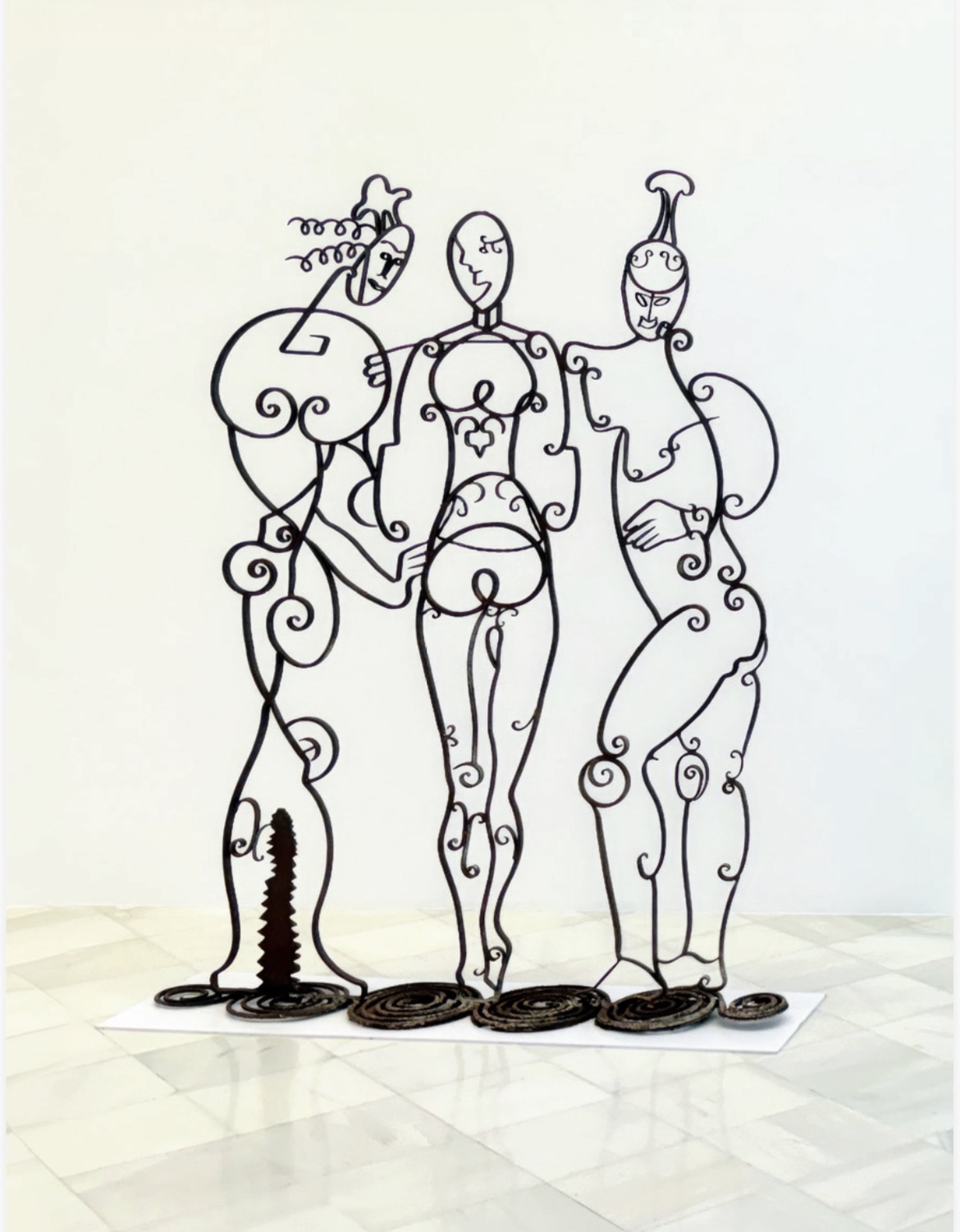
The line, in the work of Carlos Franco (Madrid, 1951), has never simply been a tool to delimit forms. It is an impulse, but also a way of thinking and constructing images, a movement that crosses paper, painting and now also space. In Almas de Oggún , the new exhibition that the Miguel Marcos Gallery is presenting in Barcelona until the end of October, this principle acquires a particularly revealing dimension: for the first time in the framework of his relationship with the gallery, the artist presents sculptures together with a selection of paintings. The exhibition, where the material seems to follow the same free gesture that had previously crossed the paper, thus opens a new door to a creative universe that has always escaped the rigid borders between disciplines.
Franco is part of that generation of the New Figuration in Madrid that, during the seventies, questioned both the academic tradition and the conventions of representation. But his career soon acquired a very particular autonomy. The figure, in his case, is never a stable reality or a simple representation of the visible world. It is a door to other layers of consciousness, to cultural memory, desire, fantasy, mythology or the darkest mechanisms of the unconscious. From here is born a painting populated by bodies, animals, gods, impossible scenes and mental architectures that relate to each other without necessarily submitting to a single narrative.
The artist has the ability to superimpose times, cultures and references and it is one of the constants of his work. Franco dialogues with the Western tradition -from Goya and Rubens to Ingres, Manet, Picasso or Bacon-, but also with surrealism, pop, Pompeian painting and other imaginaries that allow him to build his own iconography. Classical mythology appears there not so much as an erudite quotation but as a still living repertoire of forms, archetypes and conflicts. The same happens with his approaches to other cultures and symbolic systems: the interest in transculturality responds to the desire to find those common roots that can explain human behaviors, drives and needs.
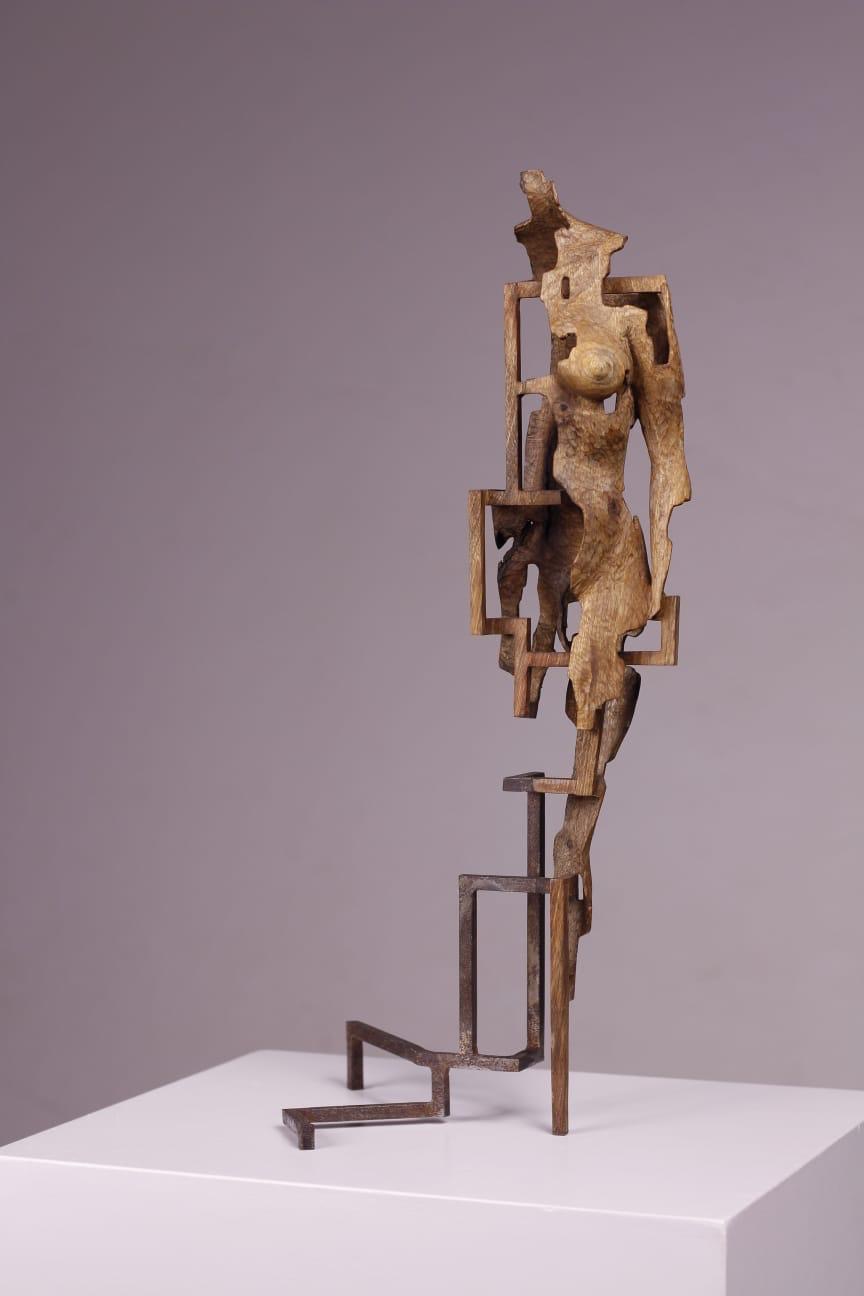
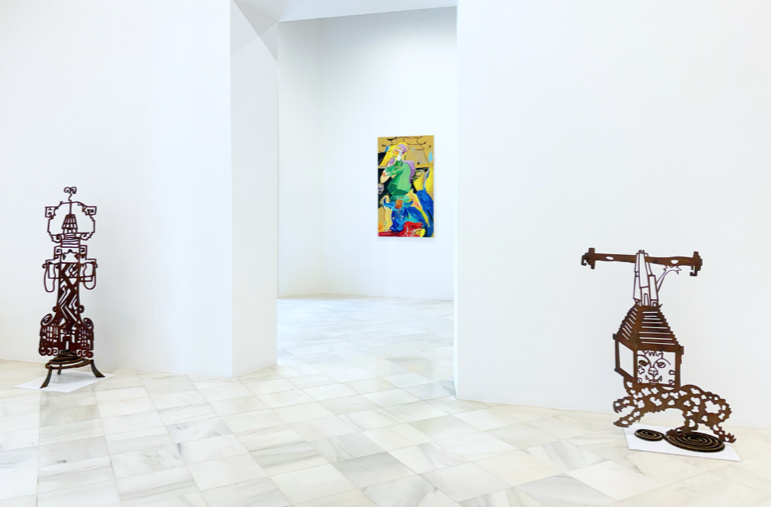
In this sense, Almas de Oggún is a natural extension of this research. The sculptures start directly from the drawing and the desire to convert the line into a three-dimensional structure. Made mainly with wrought iron and cut iron sheet, they do not seek to impose the usual forcefulness of metal sculpture. On the contrary, the iron behaves almost like a suspended line, as if a drawing had left the paper to begin to occupy the space. To make this transfer possible, Franco has worked with the blacksmith from Villaviciosa de Odón Manuel Guardia, responsible for materializing the forms conceived by the artist on a definitive scale.
The spirals that appear on the bases accentuate this sensation of movement. They are a continuation of the graphic gesture and suggest that the figures have not been constructed from the volume, but have fallen or unfolded to the ground after an imaginary journey through the air. Among these presences appear The Three Graces , a motif that belongs to a central genealogy in the history of Western art, alongside other mythological and symbolic figures that have emerged during the same creative process.
The title of the exhibition also introduces another layer of meaning. Oggún is one of the warrior orishas of Yoruba mythology, associated with iron, work and the transformation of matter. Iron, therefore, ceases to be simply the material of the sculptures to become an essential part of their meaning. The hardness of the metal coexists with the fragility of the line, while the artisanal work introduces a physical and almost ritual dimension in the process of constructing the pieces. Matter is transformed through fire, gesture and force, but also through imagination.
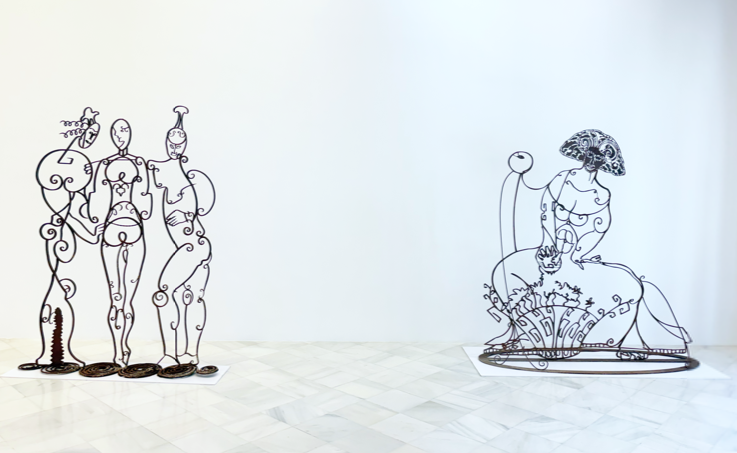
This tension between matter and imagination is present in much of Franco's career. Drawing occupies a particularly important place in his practice because it allows him to record the internal movement of ideas, obsessions and fantasies before they become a finished image. In previous exhibitions dedicated specifically to his work on paper, the Miguel Marcos Gallery had already highlighted this conception of drawing as a space for research and even as a final work in itself. Now this same logic is physically deployed in space.
The painting in Almas de Oggún also participates in this process. Franco builds his compositions from the juxtaposition of images, perspectives that contradict each other, figures that seem to emerge from each other and scenes that function more as mental associations than as closed stories. Traditional perspective thus loses its authority and the pictorial space becomes a passable, almost labyrinthine territory. In his Metal Paintings , the same gallery had defined this painting as a work of "daedalic" character, marked by the multiplication of planes and the questioning of the central perspective.
And if drawing is the skeleton of his work, color is probably its most immediate drive. Franco works with a luminous, intense and sensual palette, capable of distancing figuration from any strictly naturalistic will. Color is not limited to describing bodies or objects: it alters them, makes them vibrate and places them in a reality that is both recognizable and impossible. This chromatic freedom reinforces the vitalist character of a language that can move from delicacy to grotesque, from erotic to mythological and from humor to restlessness in the same pictorial space.


You may be
interested
...