Exhibitions
Saul Steinberg, drawing as a language
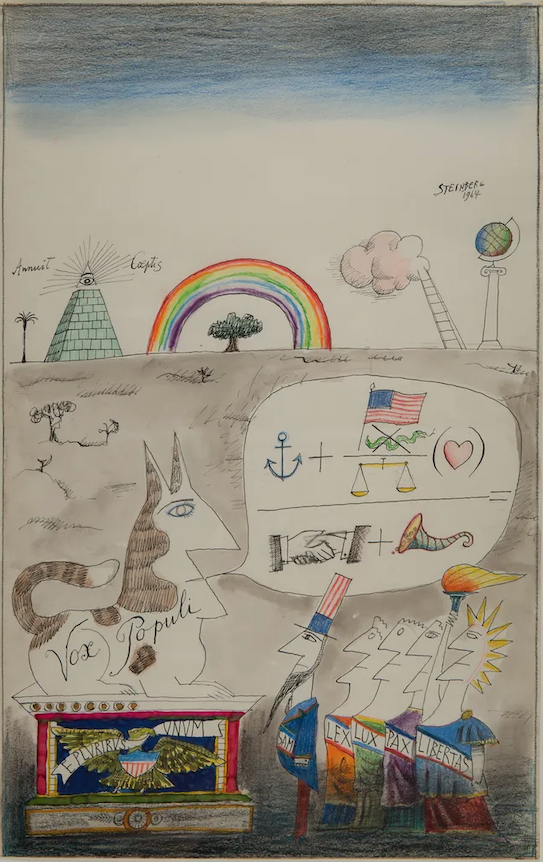
“Drawing is a form of reasoning on paper.” — Saul Steinberg.
The Galerie Claude Bernard in Paris presents, from September 17 to November 14, 2026, an exhibition dedicated to Saul Steinberg that brings together around twenty works created between 1951 and 1990. Drawings, collages and assemblages allow us to approach the singular universe of this American artist born in Romania, whose line, seemingly simple but of extraordinary precision, contributed to profoundly renewing the possibilities of drawing during the twentieth century.
Initially trained in literature and philosophy in Bucharest, Steinberg moved to Italy in 1933 to study architecture at the Politecnico di Milano. It was there that he began publishing his first cartoons in Bertoldo , an anti-fascist satirical newspaper. In 1941, he left fascist Italy and settled in the United States. Even before arriving in the country, while waiting for his visa in Santo Domingo, he managed to publish his first cartoon in The New Yorker . That episode would mark the beginning of an exceptional collaboration that would last for almost six decades.
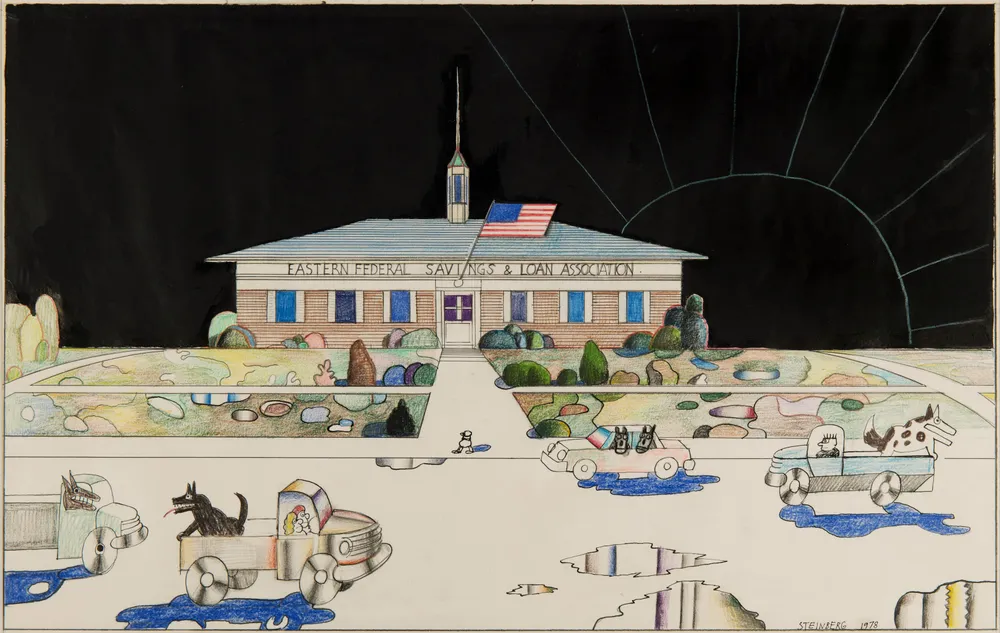
Eastern Federal savings and loan association, 1978.
During that period, Steinberg created nearly ninety covers and more than 1,200 drawings for The New Yorker , making his unique perspective on American society one of the magazine's defining characteristics. His work also appeared in publications such as Life and Harper's Bazaar , while numerous exhibitions steadily solidified his international recognition. In 1943, he also participated in Fourteen Americans , an exhibition at the Museum of Modern Art (MoMA) in New York, where he shared space with artists such as Isamu Noguchi and Robert Motherwell.
But to reduce Steinberg to the figure of a caricaturist would be to limit the scope of a much more complex practice. An architect by training, he was also a draftsman, graphic designer, muralist, fashion and advertising illustrator, and set designer. His work occupies a hybrid territory where writing and image cease to function as separate languages. Often described as "a writer who draws," he developed his own visual vocabulary in which every line, sign, and detail participates in a reflection on the codes with which we construct and represent reality.
His deliberately austere style, sometimes bordering on the apparent naiveté of children's drawings, conceals an extraordinarily sharp eye. Through subtle and, at times, biting humor, Steinberg questions social conventions, manifestations of power, national myths, and the contradictions of modernity. Without resorting to gratuitous caricature, his images reveal the invisible mechanisms that condition how we see, think, and represent ourselves.
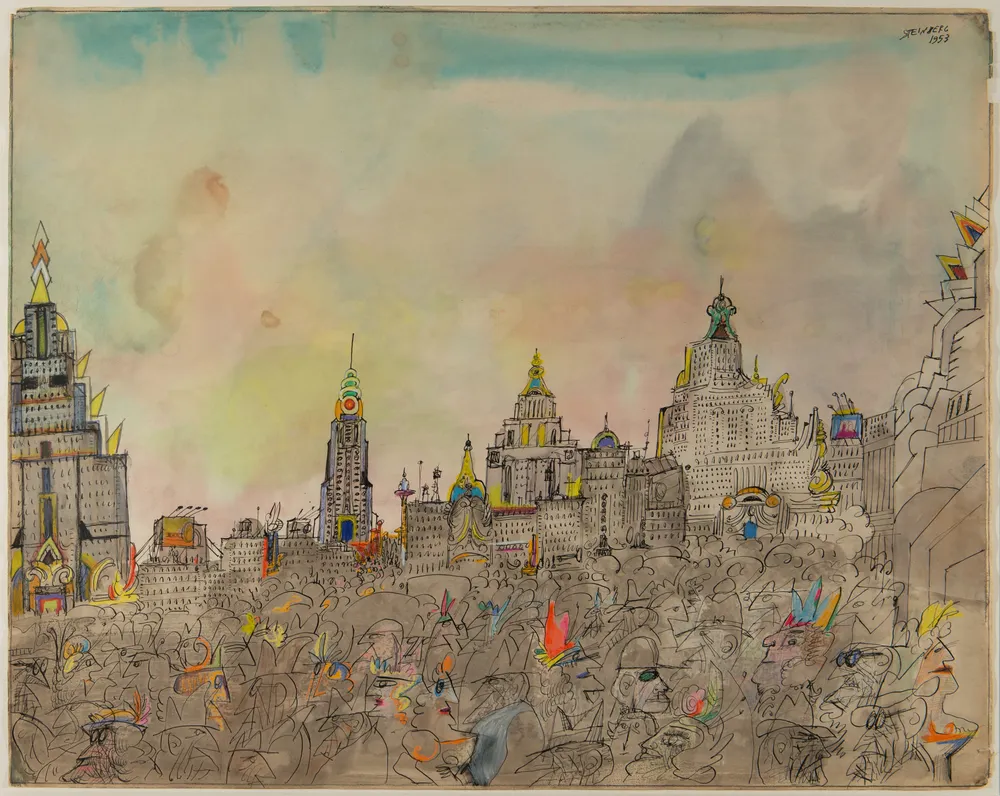
Times Square, 1953.
One of the keys to his work lies precisely in this need to decipher it. As one critic noted, his compositions, simultaneously imbued with wisdom and joy, should be read almost like the narrative and initiatory scenes of ancient Egypt, where hieroglyphs and pictograms construct a common language. In Steinberg's work, the line does not merely describe: it writes, suggests, satirizes, and poses questions about what we take for granted.
The exhibition at Galerie Claude Bernard allows visitors to observe the evolution of this visual language through an exceptional selection of some twenty pieces, primarily drawings, accompanied by several collages and assemblages. Some of the works graced the covers of The New Yorker , while others, conceived as studies or preparatory drawings, allow us to trace the origins of certain images and understand how Steinberg constructed his unique visual grammar.


You may be
interested
...