
Exhibitions
Gino Rubert begins the history of painting again
'Absolute Beginners' brings together in Bucharest a new set of mixed paintings where Picasso, Duchamp, Frida Kahlo, Leonora Carrington, Remedios Varo, Dalí, Miró and Tàpies share the stage.
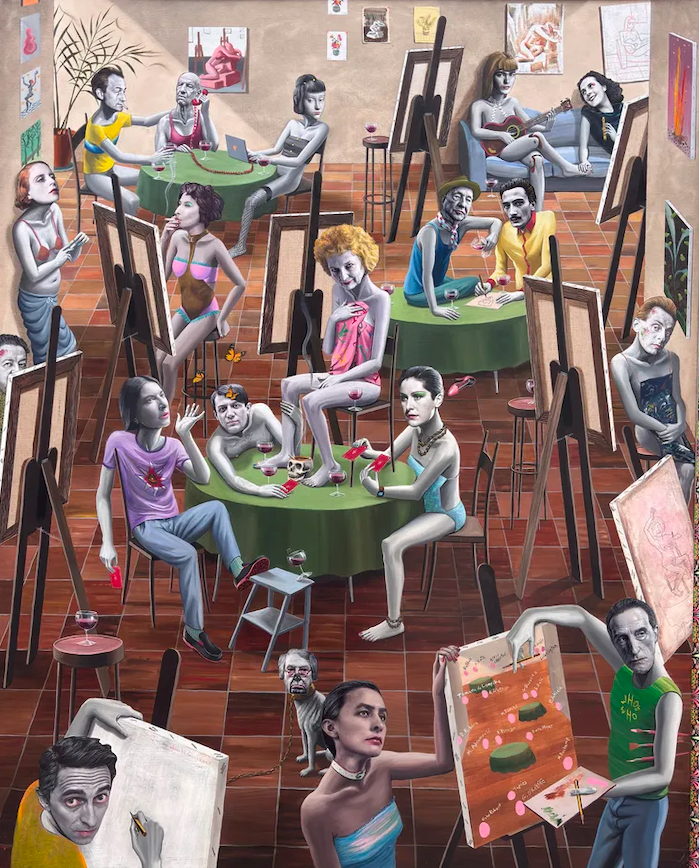
The history of painting can also be a territory of play, a shared fiction in which the great masters cease to be untouchable figures to become characters in an open, unpredictable and even a little disturbing story. This is one of the premises from which Gino Rubert works in his new exhibition, Absolute Beginners , which Mobius Gallery in Bucharest presents from September 18. This is the second solo exhibition of the Spanish artist at the gallery, three years after Time to Set the Cage on Fire , with which Rubert entered the Romanian contemporary scene.
In this new set of works, Rubert summons a good part of the figures who have built his own pictorial imaginary. Picasso, Marcel Duchamp, Frida Kahlo, Leonora Carrington, Remedios Varo, Salvador Dalí, Joan Miró and Antoni Tàpies appear together in impossible encounters, but represented with surprising naturalness. They are not so much conventional homages as scenes from an alternative history of art, built from coincidences, displacements and anachronisms. The painter places these characters in drawing academies and artist studios, spaces traditionally linked to learning, and thus returns them to an essential condition: that of someone who is still learning.
Hence the title of the exhibition. Absolute Beginners claims precisely this capacity to start anew shared by the artists who have transformed painting. Despite the weight of their names and their myths, they can all be seen as eternal beginners, driven by curiosity and the need to question what they already know. Rubert uses this idea to propose a desacralizing view of the history of art, but also to talk about painting as an always unfinished practice.
The technique contributes decisively to this atmosphere. The paintings combine photographic collage with oil and acrylic, fabrics, needles and found materials, in a dense construction that turns each canvas into something more than a pictorial surface. The works function as small stages where each figure, each look and each gesture seems to occupy a previously calculated place. There is in Rubert a theatrical conception of painting: the characters enter the scene, establish relationships between them and, at the same time, look directly at the viewer.
This proximity is one of the features that distinguish the artist's work. His figures are not locked into the fiction represented, but rather seem aware of our presence. His gaze establishes a kind of complicity with the viewer and dissolves the boundary between spectator and protagonist. The painting thus becomes a meeting space, but also a place where reality and fiction, memory and desire, life and death can coexist without the need to resolve their contradictions.
In this universe, full of humor and erudition, Rubert recovers some of the great myths of modernity to subject them to a new coexistence. His gaze is not iconoclastic, but affectionate and irreverent at the same time. The masters appear devoid of solemnity, but not of their capacity for fascination. It is precisely this tension between knowledge and play, between history and fantasy, that gives the works a particular strangeness.


You may be
interested
...