Exhibitions
Isabel Oliver, against the landscapes of barbarism
Bodies that flee. Landscapes of barbarity in Valencia traces five decades of the career of an artist who has questioned the male gaze, violence, inequalities and forms of representation in contemporary society.
The painting of Isabel Oliver (Valencia, 1946) has never been a neutral territory. Over five decades, the artist has used color, figure, popular culture and art history to question the social structures and forms of power that determine what we see and, above all, what remains outside our field of vision. Now, her hometown is hosting one of the broadest approaches to this trajectory with Bodies that flee. Landscapes of barbarity , an exhibition that can be visited until September 27, 2026 at the Palau Joan de Valeriola, headquarters of the Chirivella Soriano Foundation, under the curatorship of Isabel Tejeda Martín.
The exhibition brings together works from different moments in his production and allows connections to be established between series that, despite having been created in different contexts, share the same critical will. The Woman , Pop Landscapes , Housework by Profession , Walks through the Museum , The Commercialization of Art and Mediterranean Sequences build a journey through a body of work in which painting becomes a tool for reviewing the social, cultural and political narratives of our time.
The tour highlights the social commitment of an artist who has made painting a space for denunciation and questioning. Inequalities, the roles imposed on women, violence, cultural consumption, the commodification of art and migratory conflicts appear as different faces of the same concern: who decides the images that form part of our imagination and from what perspective we interpret them.
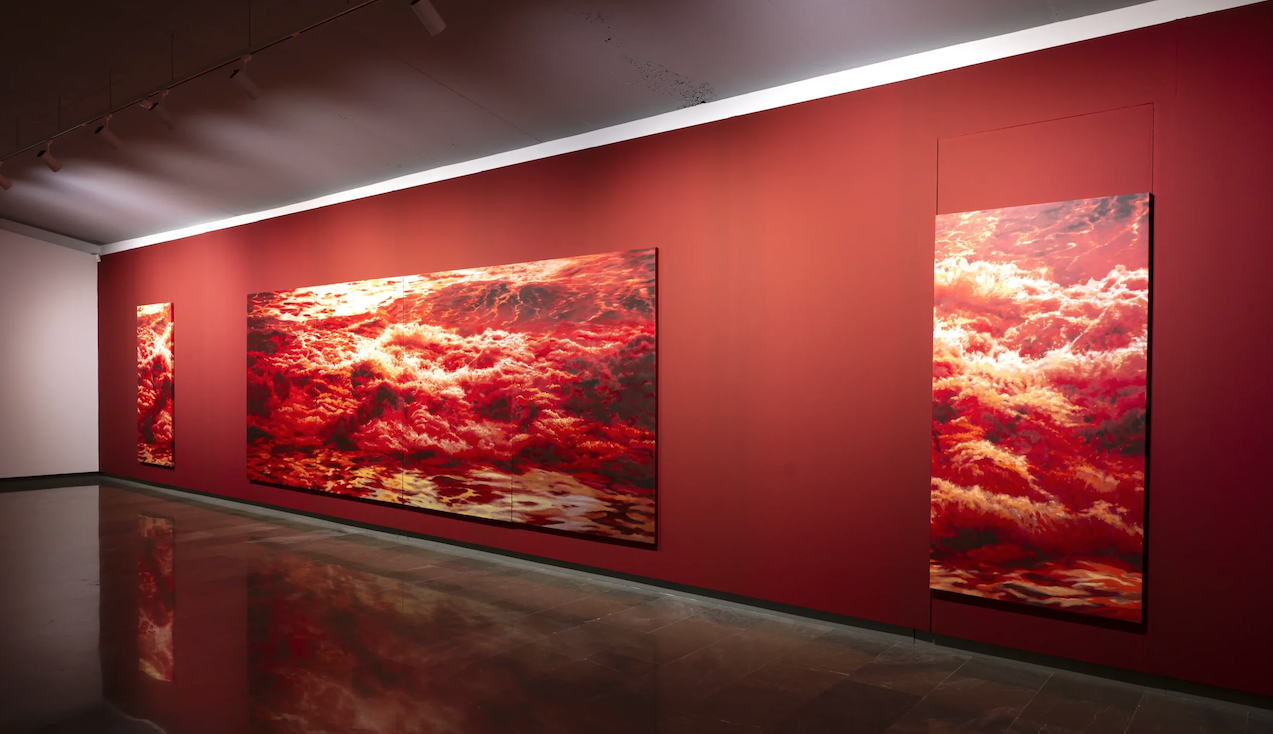
Among the most compelling pieces are those linked to Mediterranean Sequences , a series in which Oliver abandons any idealization of the Mediterranean landscape to turn the sea into a witness to the tragedies that take place in its waters. A large mural presents a blood-red wave as a symbol of the people who try to reach Europe in dinghies and who end up losing their lives during the crossing. The Mediterranean thus ceases to be an idyllic landscape to become a border, a scene of death and witness to a humanitarian crisis that continues to determine the present. The same series also incorporates references to Gaza and the drama of immigration.
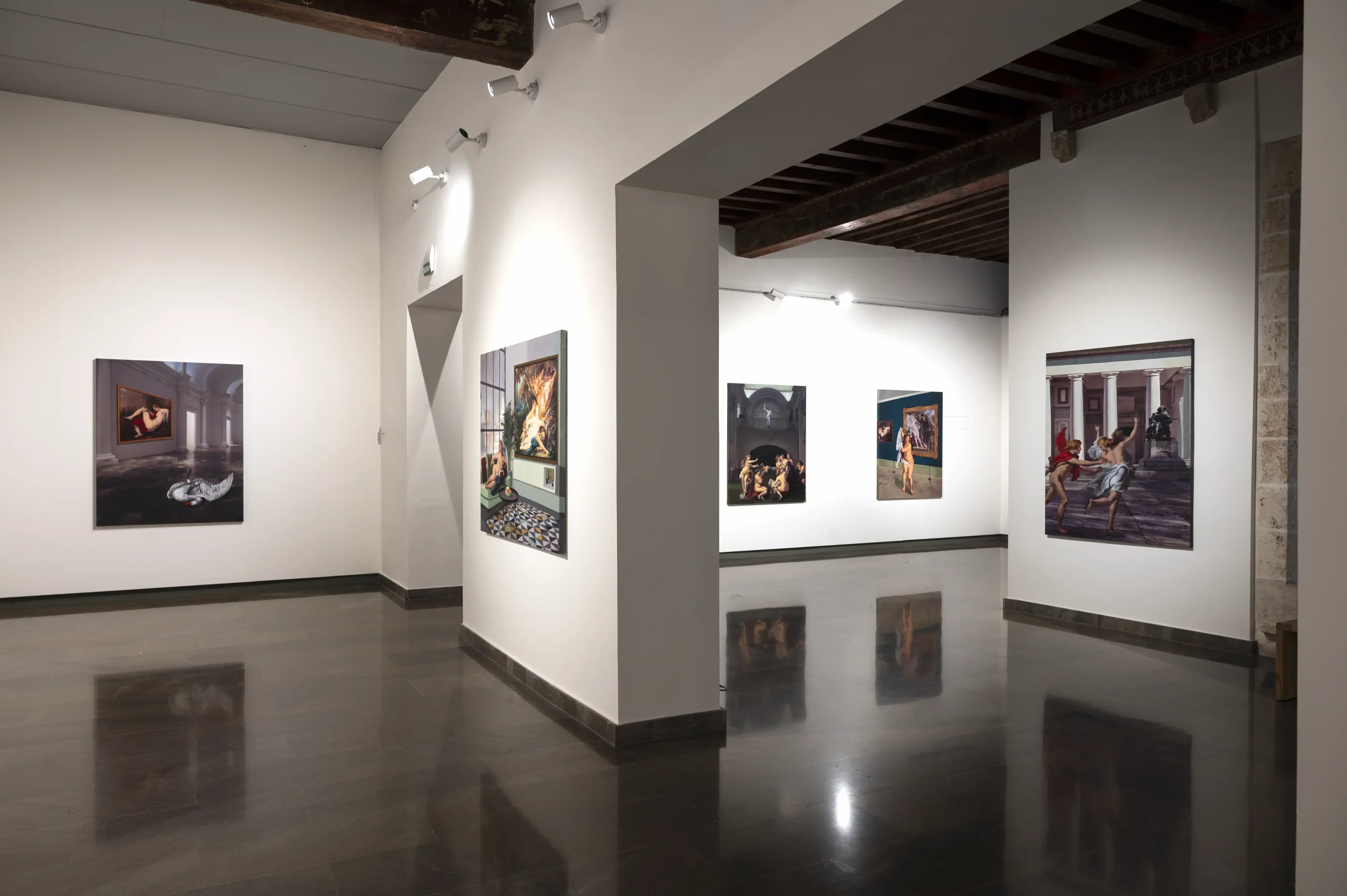
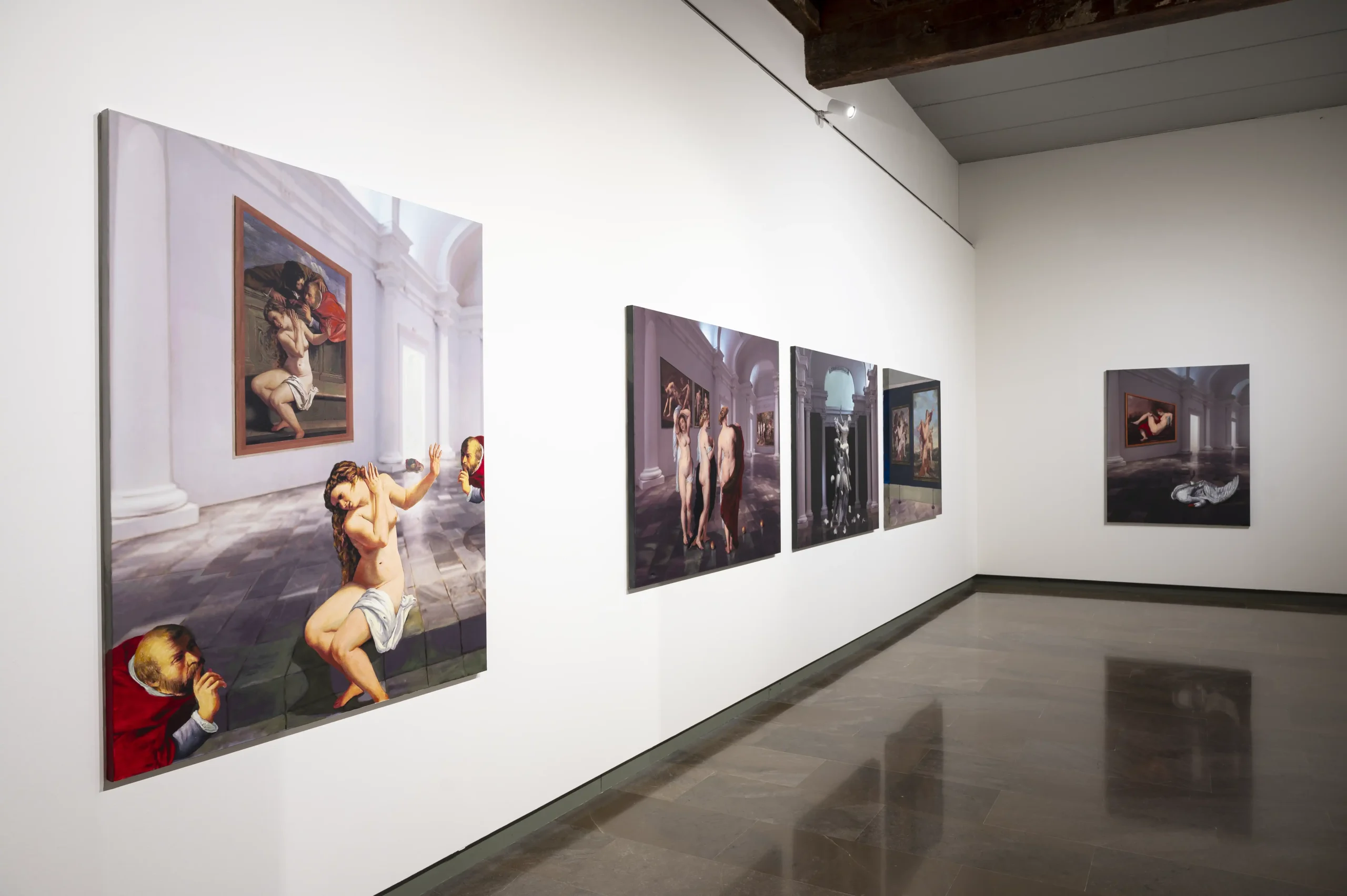
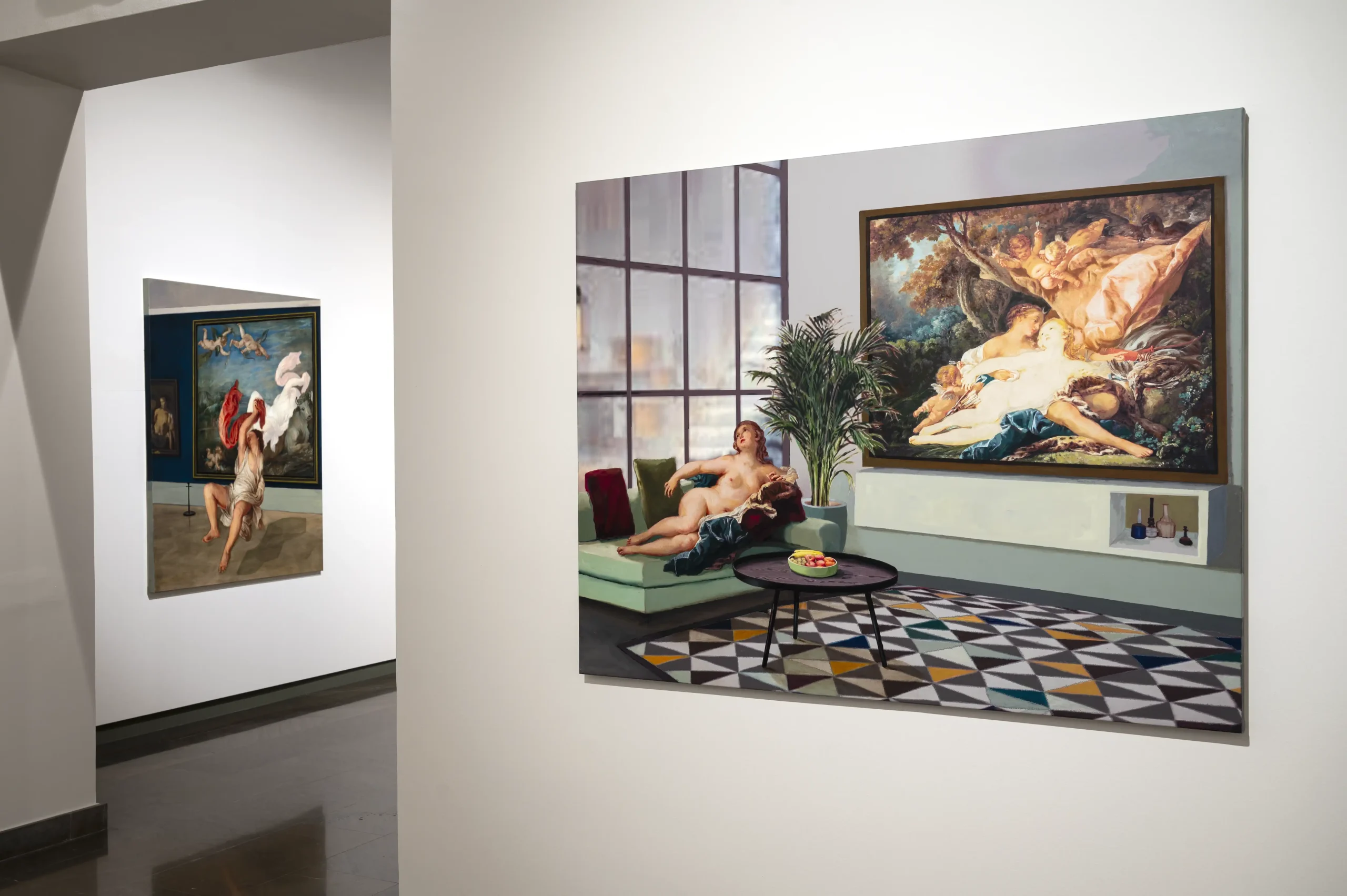
The critical view of the history of images appears with particular force in Walks through the Museum . Oliver here draws on great works of the Western pictorial tradition, especially the allegorical representations of Titian and Rubens, to question narratives constructed from an essentially masculine perspective. Danae, Callisto and Europa, figures who for centuries have been represented as objects of desire, are no longer trapped within the original compositions. Oliver takes them out of the paintings and returns them to a new space, far from the role that tradition had assigned them.
This gesture contains a whole declaration of intentions. The artist calls for another reading of mythology and, at the same time, another history of art, a history that incorporates the gender perspective and reviews the mechanisms through which representations of women have been constructed. Her painting is not limited, therefore, to reinterpreting images from the past, but uses them to put the gaze of the present into crisis.
This attitude also runs through De professionió la feina de casa , a series focused on the female condition and the social roles imposed on women. In these works, Oliver focuses on an everyday reality that for a long time was relegated to the private sphere and that she turns into artistic and political matter. The woman ceases to be a secondary figure within the story to become the protagonist and subject of her own story.
With The Commercialization of Art , criticism is directed towards the mechanisms that transform artistic creation into an object of consumption and a commodity. Alongside this series, Paisatges Pop incorporates the languages of popular culture and images from the media, a territory that the artist has explored to highlight the contradictions of a society increasingly conditioned by visual culture.
This ability to combine criticism and formal experimentation is also one of the constants of his career. The mastery of color, drawing and composition coexists with a desire to question established codes and to turn painting into a space for reflection. Oliver works with the traditional tools of painting, but puts them at the service of discourses that often go beyond the painting itself.
The social dimension of her work cannot be separated from her own career. Oliver was born in Valencia, the city where she began painting and where she still lives and maintains her studio. She studied at the Escola de Bellas Artes de Sant Carles and later developed a long teaching career as a professor and full professor in the Painting Department of the Polytechnic University of Valencia. For years she combined teaching with painting, at a time when for many women turning artistic practice into a profession meant challenging a social structure that placed them under the dependence of their father or husband.
The art world also presented significant obstacles for female authorship. Women's access to institutions, the market and recognition circuits was much more limited than that of their male colleagues. In this context, Oliver's career becomes an example of perseverance and the affirmation of one's own voice.
International recognition would come, however, when the artist was approaching seventy. The Tate Modern in London contacted her to participate in The World Goes-Pop , an exhibition held between September 2015 and January 2016. That participation helped to arouse the interest of Spanish institutions in her production and, subsequently, the Reina Sofía Museum and the IVAM incorporated her work into their collections.
Since then, recognition of his career has continued to grow. The Art Collection of the Bank of Spain has incorporated work number 34 of the series The Commercialization of Art , while in 2024 Oliver received the Alfons Roig Prize for Visual Arts from the Valencia Provincial Council, a recognition of a career marked by independence, criticism and the ability to maintain a voice of his own over time.
Bodies that flee. Landscapes of barbarity thus functions as a practically complete retrospective, but also as an opportunity to look again at a work that remains fully connected to the conflicts of the present. The different series allow us to follow the evolution of an artist who has gone from questioning female roles and mechanisms of representation to addressing issues such as migration, war, the consumption of images or the commodification of culture.
The title of the exhibition summarizes much of this perspective. There are bodies that flee, women who abandon the frames that imprison them, people who cross borders and victims who disappear in landscapes that have become scenes of violence. But there are also figures who escape the representations that had immobilized them for centuries.
You may be
interested
...