Exhibitions
Dancing among the ruins
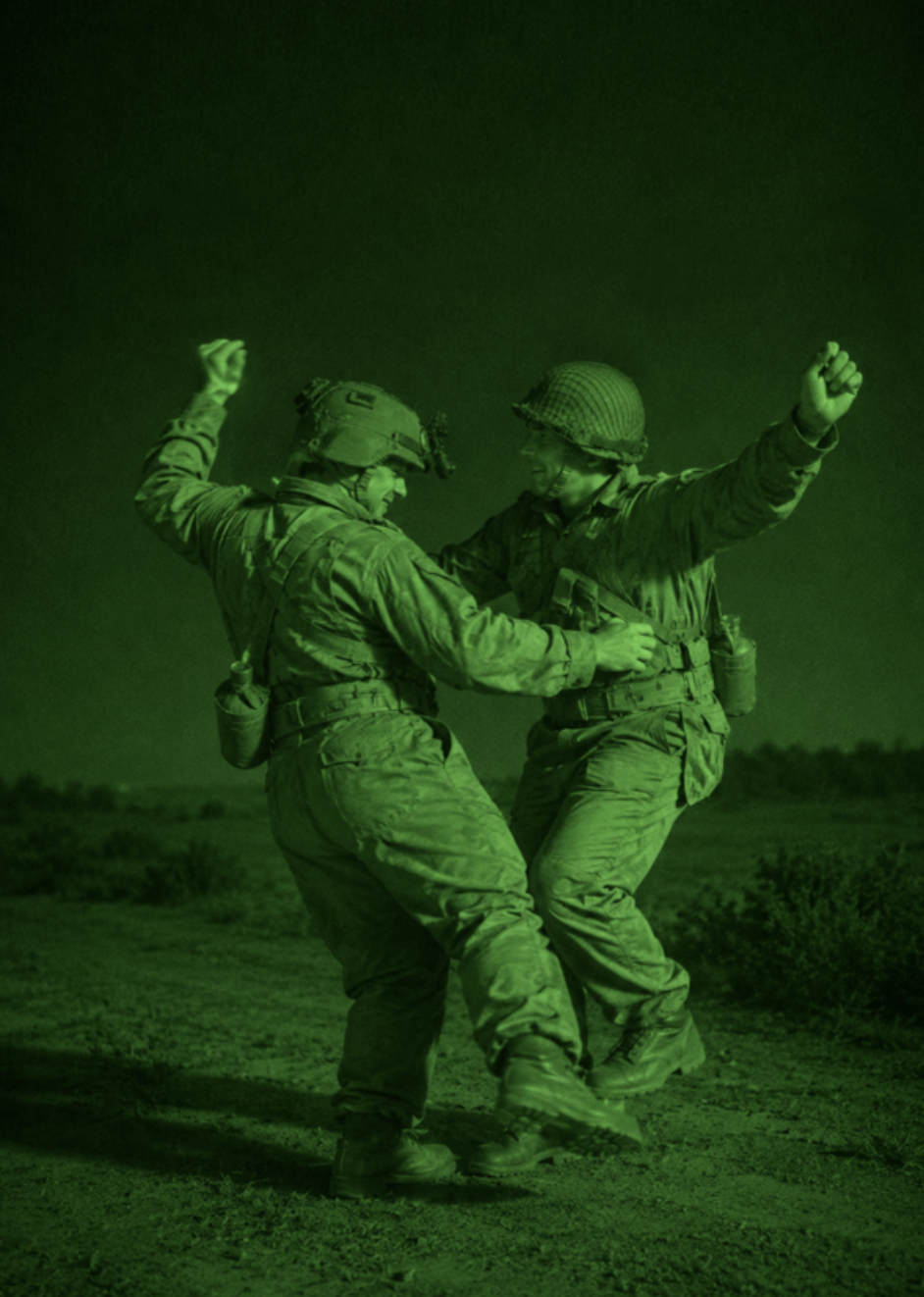
Nave 0 at Matadero Madrid, the former cold storage chamber of the municipal slaughterhouse, still bears the scars of a fire and an architecture marked by the memory of its original function. It is precisely on these wounds that Carlos Aires constructs Bailad, bailad, malditos (Dance, Dance, You Damned ), a site-specific installation that transforms the ruin into a stage and dance into an ambiguous form of resistance.
From September 11, 2026, to January 24, 2027, Aires occupies this space as part of the Abierto x Obras program, with an intervention curated by José Luis Romo. The proposal does not simply aim to fill Nave 0 with objects: it modifies our perception of it. More than a hundred structural supports and around twenty screens construct a landscape somewhere between a dance floor, a metallic forest, and an architecture threatened by its own weight.
The visitor thus enters a space that seems to be held up by a temporary structure. The supports allude to an architecture that needs to be kept upright, but also to a body under tension. In this context, the party takes on a disquieting dimension. There is music, movement, and characters appearing on screens, but also darkness, silence, and a persistent sense of danger.
Aires works precisely in this territory of contradictions. Her artistic production moves between celebration and catastrophe, between pleasure and suffering, frequently using images from popular culture, musical references, photographs, everyday objects, and recognizable symbols to introduce a critical reading of contemporary society. Her work addresses issues such as power, economics, violence, desire, and memory, but she does so through an aesthetic that can be seductive before revealing its political dimension.
Dance as resistance
The exhibition's title itself alludes to They Shoot Horses, Don't They? (1969), Sydney Pollack's film set during the Great Depression in the United States. In it, several couples participate in a grueling dance competition where continuing to move means continuing to endure. Dancing ceases to be merely a celebration: it becomes an obligation, a means of survival, and a source of exhaustion.
Aires reclaims that image and transposes it to a present equally marked by precarity, uncertainty, and the need to carry on. In Dance, Dance, You Damned , dancing could be a form of escape, but also a response to a world threatening to collapse. The party doesn't eliminate the disaster; it coexists with it.
This tension is one of the installation's greatest strengths. Nave 0 doesn't function as a mere container, but as an active part of the work. The traces of the fire and the memory of the violence associated with the former slaughterhouse are incorporated into Aires's discourse. The artist doesn't conceal these marks, but rather amplifies them through a scenography that seems to prolong the building's wounded condition.
The result is a deliberately sensory experience. Screens introduce presences and scenes that alter the visitor's perception, while the soundscape transforms the journey into an almost cinematic experience. The familiar becomes strange, and the dance floor ceases to be a meeting place, acquiring an almost spectral dimension.
An aesthetics of contradiction
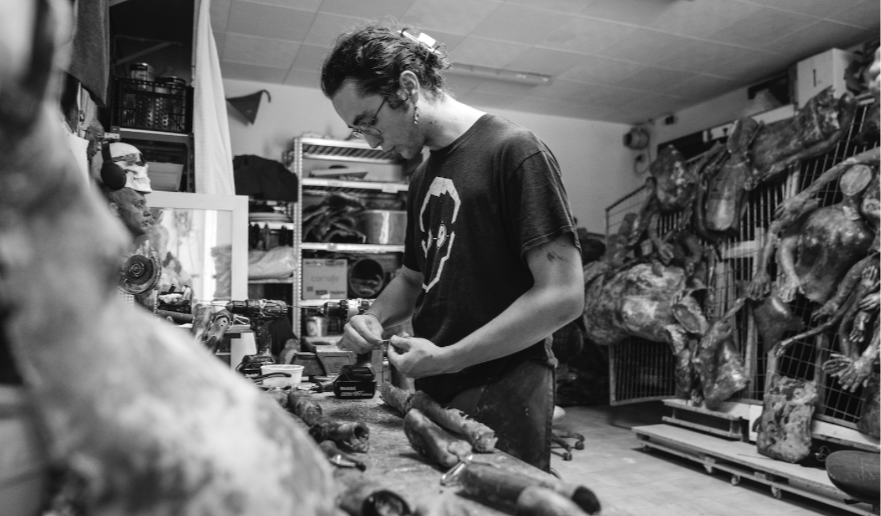
Born in Ronda in 1974, Carlos Aires studied Fine Arts in Granada and later pursued further studies in Tilburg, Antwerp, and Ohio. Throughout his career, he has developed a multidisciplinary language that combines photography, sculpture, and installation, often drawing on materials and images linked to popular culture. His work has been exhibited at institutions such as the MACBA in Barcelona, the Contemporary Art Center of Málaga, the Carrillo Gil Art Museum in Mexico City, and the Museum für Angewandte Kunst in Vienna, among others.
One of the most recognizable characteristics of his practice is precisely the ability to make seemingly incompatible elements coexist. Festivity can conceal violence; beauty can lead to conflict; humor can become critique. Aires uses this friction to question the images and values we take for granted.
In Dance, Dance, You Damned , this strategy finds a particularly physical expression. This is not a work to be viewed from a distance. The viewer must walk through it, circle the supports, listen to their sound, and confront images that appear in the shadows. The installation transforms the visitor's body into part of the artwork.
And therein lies its political dimension. The dancing body is a body that insists on remaining, even when everything around it seems to need to be propped up. The celebration ceases to be innocent and becomes a response to collapse.
A dance floor after the fire
Carlos Aires' first solo exhibition at a public institution in Madrid thus arrives with a work deeply connected to its venue. It's not simply a matter of placing an installation inside Nave 0, but rather of constructing one from what the building already contains: its scars, its history, and its status as an industrial space transformed into a center for contemporary creation.
The visitor enters a dance floor, but soon discovers that the ground beneath their feet is built upon a history of violence. The music invites movement while the supporting structures serve as a reminder that nothing is ever truly safe.
Aires, in short, proposes a celebration on the edge of the abyss. A party that knows it could end. And perhaps that's precisely why it insists on dancing.
Dance, dance, you damned ones can be visited in Nave 0 of Matadero Madrid until January 24, 2027, with free admission.

You may be
interested
...