Exhibitions
The light of nature takes shape at the Pollença Museum
Albano Alfonso transforms the church of the Convent of Santo Domingo into an immersive landscape of glass, reflections and movement within the framework of the Biennial B.
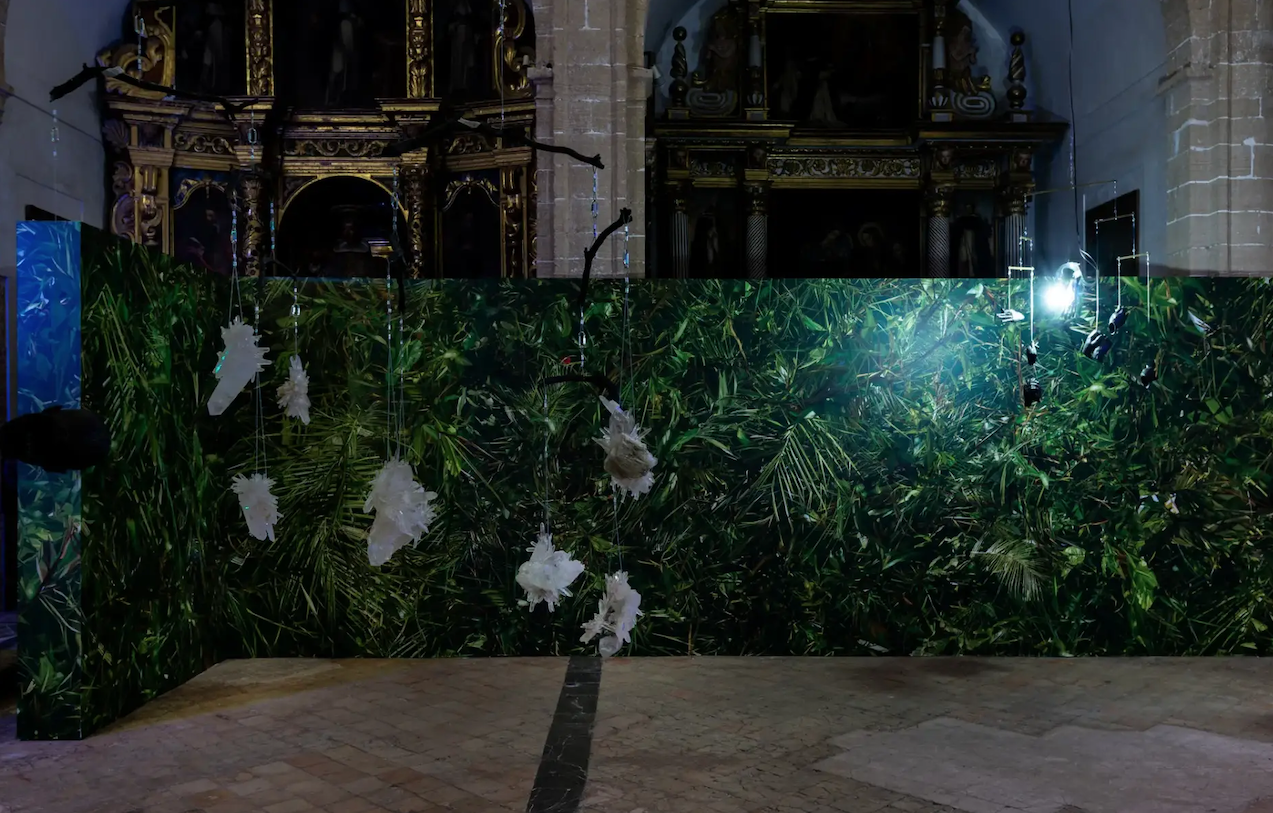
The Portuguese artist Albano Alfonso and the Gordiola glass factory establish a dialogue with the Pollença Museum through A Natureza , an exhibition and intervention conceived within the framework of the Biennial B. The proposal occupies the church of the Convent of Sant Domingo and explores the relationships between human beings and the natural world through glass, light, movement and architectural space.
Curated by Jackie Herbst, the exhibition draws on the Japanese concept of shinrin-yoku , known as 'forest bathing', to present nature as a space for presence, contemplation and rediscovery. In this context, the exhibition invites the visitor to stop and experience an environment in constant transformation, where the boundaries between reality and fiction become deliberately blurred.
The proposal is also the result of the collaboration between Es Baluard Museu d'Art Contemporani de Palma and the Museu de Pollença, a relationship that allows for the establishment of a bridge between institutions and cultural spaces in Mallorca. David Barro, director of Es Baluard, has defined A Natureza as a project that 'gives meaning to our idea of an empathetic museum' and has highlighted the desire of Biennal B to relate, through spaces and institutions, the uniqueness of the island.
Barro explained that the Pollença Museum was "the first place" he thought of when the Biennial B began to take shape. For his part, the head of the Pollença Museum, Aguiló, highlighted the "good harmony" between both institutions, especially since Barro's arrival at the helm of Es Baluard, and expressed his desire for this relationship to be maintained in the long term.
In the artistic sphere, one of the main challenges of the project has been to ensure that Alfonso's works dialogue with the blown glass pieces produced specifically by Gordiola. The Portuguese artist has defined this process as "the most difficult of the entire project", precisely because of the need to find a balance between materials, forms and presences.
The architecture of the Convent of Santo Domingo plays an essential role in this dialogue. Alfonso has described the church as a "spectacular" space, full of history, which has allowed him to introduce his own particular "scenarios that we do not know if they are real or not". The works do not simply occupy the space, but establish a direct relationship with it and transform it into a territory of uncertainty and perception.
Light is the backbone of the installation. Glass and mineral crystal capture, transform and project light onto the architecture, images linked to nature and the bodies of visitors. Reflections and flashes constantly shift and change, generating an experience that is never exactly the same and that refers to the dynamic, changing and unattainable nature of nature.
The exhibition, inaugurated on July 5, can be visited at the Pollença Museum until October 25, 2026, offering an immersive tour through the different dimensions of the proposal during the summer and autumn months.
In this tour, Em Estado de Suspensão (2016/2026) stands out, a mobile installation made with bronze and crystal elements that functions as one of the axes of the exhibition. The pieces seem to acquire a life of their own when they come into contact with the movement of the air and the presence of visitors, making displacement and fragility an essential part of the work.

You may be
interested
...