Exhibitions
Pap Souleye Fall imagines refuges from digital control
The MIT List Visual Arts Center in Massachusetts presents, in celebration of its 40th anniversary, an exhibition dedicated to the artist Pap Souleye Fall, whose artistic practice explores technological errors as spaces of refuge from large-scale control systems. The exhibition will be on view from July 30 to November 29, 2026, at the visual arts center of the Massachusetts Institute of Technology (MIT).
An artist and comic book creator, Fall develops a multidisciplinary body of work that combines installation, performance, drawing, sculpture, video, and graphic narrative. Much of his recent work revolves around DEAD PIXEL (2020-ongoing), a project that uses the language of technology and video games to reflect on surveillance, identity, and power relations in contemporary society.
The very concept of a 'dead pixel' is the starting point for this research. In the realm of video games, the term refers to the black dots that appear on a screen when a hardware failure causes a pixel to become permanently unresponsive. For Fall, this interruption of the perfect, continuous image is not merely an error: it becomes a crack, a gateway to hidden territories where it is still possible to imagine forms of autonomy.
A universe built around escape
The protagonist of DEAD PIXEL lives being pursued by THE DATA COLLECTOR, a figure who seeks to appropriate his senses through the organs associated with them. At first, DEAD PIXEL willingly surrenders his eyes, ears, mouth, and skin, only to discover that the relationship is profoundly unequal.
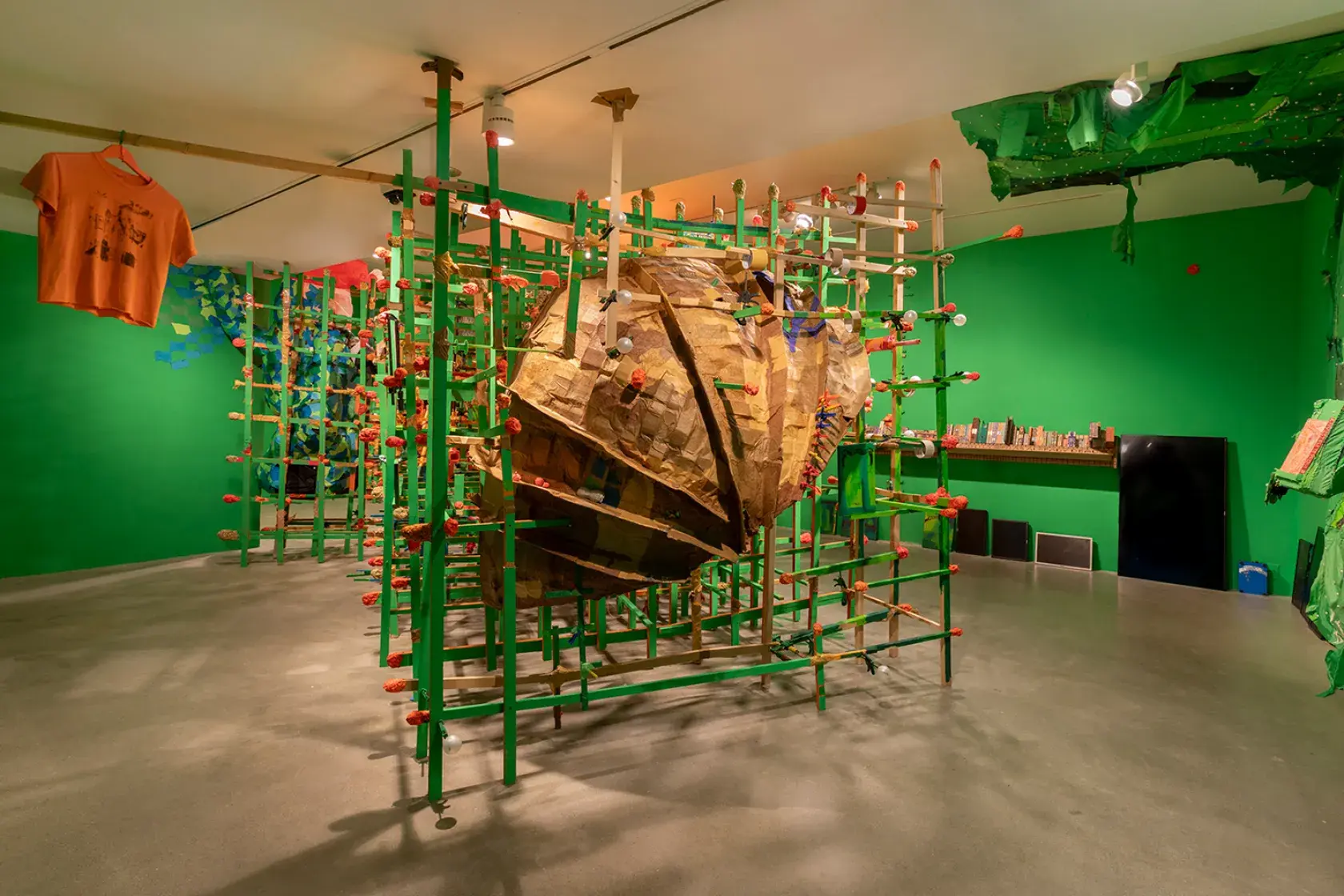
The escape then begins with the concealment of his nose, the last sense he retains, and with the creation of a new green skin, similar to a chroma key screen, which gives him an extraordinary ability to camouflage himself.
From this confrontation, Fall constructs an allegory about contemporary surveillance. The senses in DEAD PIXEL function as a metaphor for personal data, understood by the artist as a material of enormous value. Information thus approximates the soul and the knowledge that people accumulate both individually and collectively and culturally.
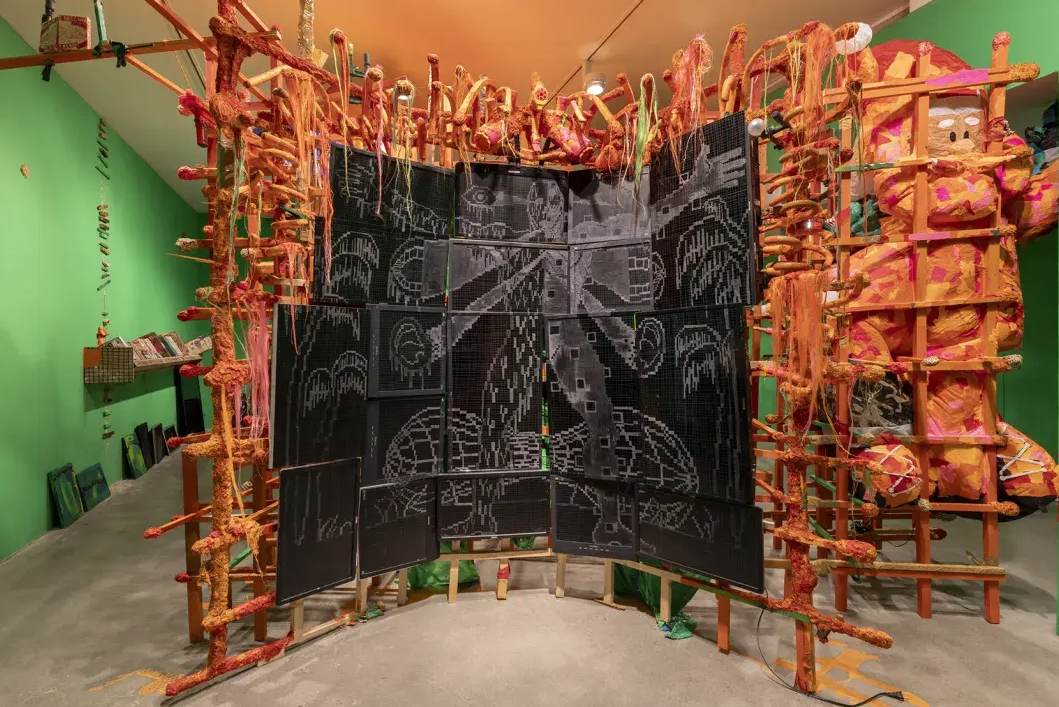
This narrative dimension is expanded in the new installation NOMANISANISLAND REDIRTRENDER (2026), conceived specifically for the exhibition. In it, the universe of DEAD PIXEL acquires a physical dimension through sculptures made from electronic waste from the MIT campus, wooden structures, and papier-mâché objects incorporating found materials.
The installation stems from a line of work that Fall began in 2023 during his residency at Recycled Artist in Residency (RAIR) in Philadelphia. The artist situates DEAD PIXEL and THE DATA COLLECTOR within what he defines as 'the endless digestive system of digital space,' a structure capable of connecting virtual worlds with their material consequences.
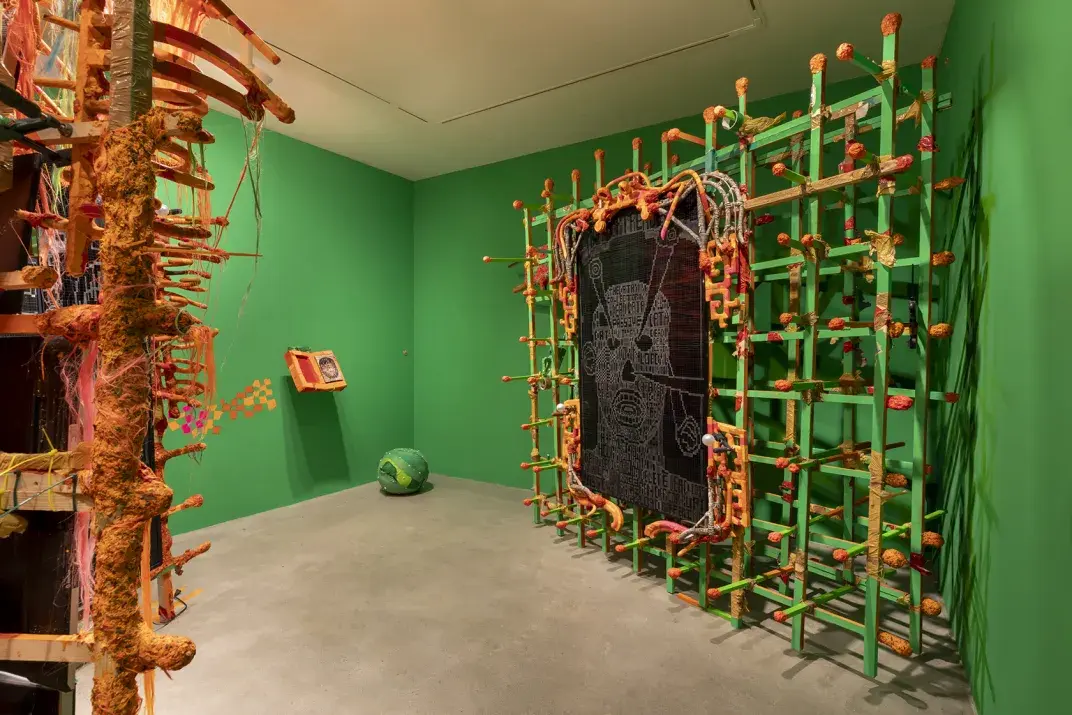
Data centers, electronic waste, and landfills are part of this hidden landscape behind the apparent immateriality of technology. In this context, NOMANISANISLAND REDIRTRENDER transforms the remnants of a culture marked by hyper-consumption into a lush environment where what had been discarded becomes visible once more.
Unused monitors become surfaces for meticulous drawings, while small, hinged wooden books incorporate new fragments of the DEAD PIXEL story. These elements also point toward one of Fall's long-term projects: the creation of a library dedicated to DEAD PIXEL and THE DATA COLLECTOR, conceived as a collection of thousands of volumes intended to progressively expand this narrative universe.
Technology, surveillance and resilience
The exhibition also places Fall's work in dialogue with the ideas of fugitiveism developed by thinkers such as Fred Moten. The concept alludes to certain forms of Black life, thought, and creativity that seek to escape the capture and classification imposed by dominant systems of power.
In DEAD PIXEL , this tension is represented through the constant pursuit between the protagonist and THE DATA COLLECTOR. The ability to hide, disappear, or remain beyond the reach of the one who seeks to control the information thus becomes a form of resistance.
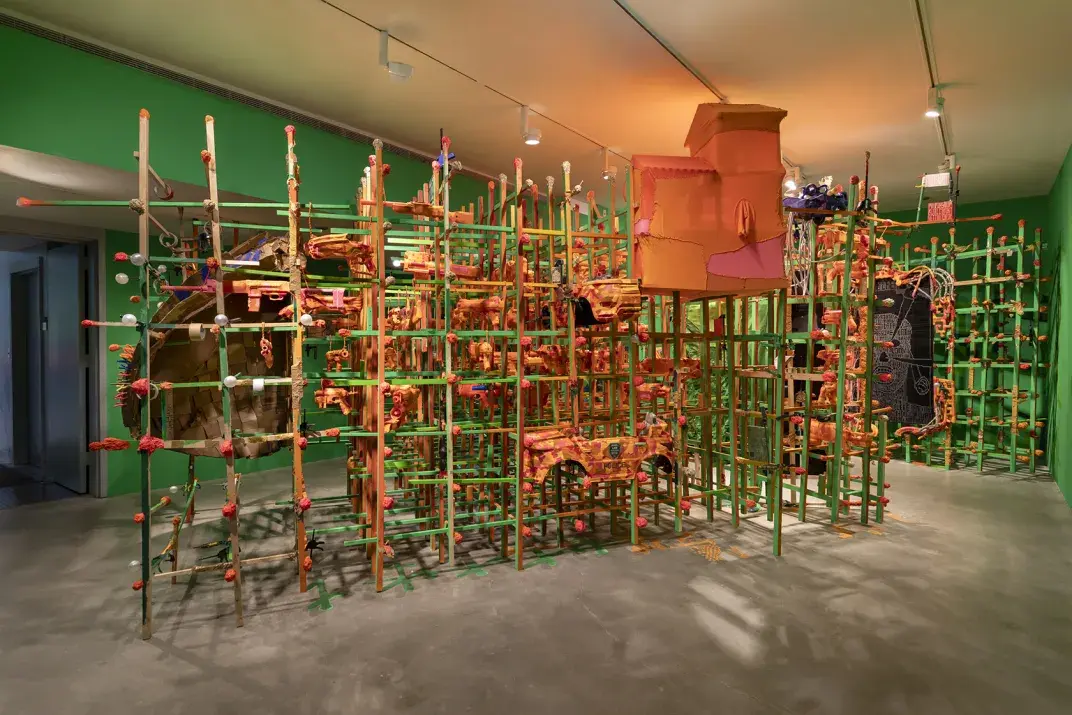
Fall also incorporates historical references that broaden the political significance of her objects. Some of her textile motifs echo the patterns of quilts historically associated with the Underground Railroad, the clandestine network that helped enslaved people escape in the United States. Other recurring elements, such as peanut shapes, allude to the close relationship of this crop with the histories of colonialism and slavery in West Africa.
Thus, technology does not appear in Fall's work as an isolated or exclusively contemporary phenomenon. Its mechanisms of control connect with much older histories of surveillance, exploitation, and resistance, while escape strategies span different eras and contexts.


You may be
interested
...