Exhibitions
A Mesoamerican skull returns to Oaxaca and reclaims its place in the memory of its territory
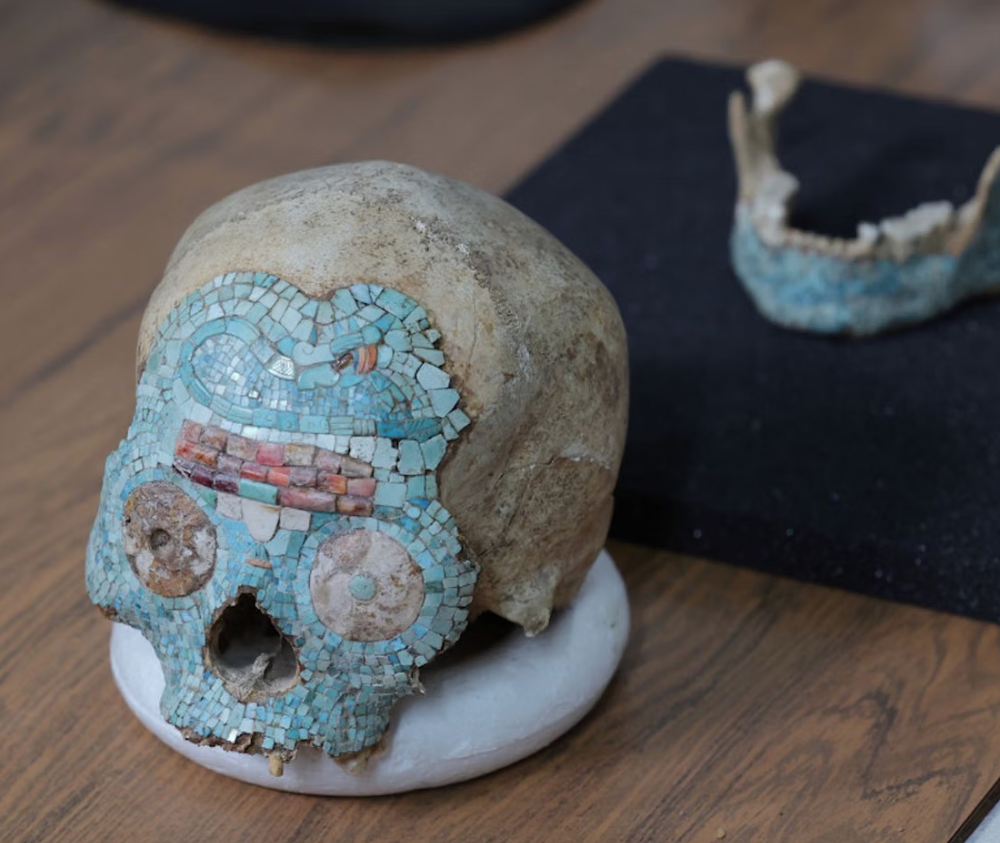
An ancient Mesoamerican skull has returned to Mexico after spending decades in the Netherlands and is now preparing to begin a new chapter connected to its homeland. The National Institute of Anthropology and History (INAH) currently holds the skull in its custody, and it is scheduled to be on display starting in April 2027 at the Yucu Saa Community Museum in Villa de Tututepec, Oaxaca.
The piece features a unique decoration made with turquoise, quartz, and jadeite, applied using small tesserae that form a design associated with a serpent. Analyses conducted after its return to Mexico have confirmed that both the materials used in the ornament and the skull itself have a pre-Hispanic origin. Furthermore, the decorative technique has documented precedents in Mesoamerica during the Late Postclassic period, between 1200 and 1521 CE.
The scientific study has also made it possible to identify a later element: approximately 99% of the adhesive used in the decoration is modern, which points to an intervention carried out in contemporary times on the original remains.
The recent history of the piece is marked by its removal from Mexico and by a restitution process that began to take shape years later. The skull was acquired in 1964 by a museum in Leiden, in the Netherlands, through an American dealer and without any documentation to establish its provenance. Decades later, its presence in Europe would spark the interest of an Indigenous cultural group and a Mexican artist.
The turning point came in 2022, when contemporary artist Daniel Aguilar Ruvalcaba learned of the skull's existence during his residency at the Rijksakademie in Amsterdam. He then sought the collaboration of Nohivi Ñuu Savi, an Indigenous-led cultural collective, to launch a campaign aimed at its restitution.
The initiative subsequently found institutional support. In 2023, Mexican authorities formally submitted a repatriation request to the Netherlands. Dutch authorities confirmed in December 2024 that they would accept the return, and the skull was finally repatriated to Mexico in May 2025.
The INAH (National Institute of Anthropology and History) considers these to be pre-Hispanic human skeletal remains originating from Mexican territory, a circumstance that supported the official request for their restitution. Their return thus raises a question that transcends the recovery of an archaeological piece: the restitution of human remains also implies returning them to a historical, cultural, and community context.
Following the repatriation, the inhabitants of Tututepec launched a petition to demand recognition of the role played by the Nohivi Ñuu Savi collective in the process and to emphasize the importance of the remains returning to the region with which they are linked.
Its upcoming exhibition at the Yucu Saa Community Museum, scheduled for April 2027, will, in a way, bring to a close a long journey that began long before the piece arrived in Europe. The skull will cease to be merely an object preserved in a foreign institution and will instead be incorporated once again into a narrative constructed from its territory of origin, highlighting the relationships between heritage, memory, restitution, and Indigenous communities.



You may be
interested
...