Exhibitions
Carlos Bunga and the poetics of transformation: after the fire, another life
The Portuguese artist presents the Cubic space of the Miró Foundation Mallorca New life after fire, an expanded installation where painting, architecture, sculpture and performance come together in a reflection on destruction, memory and rebirth.
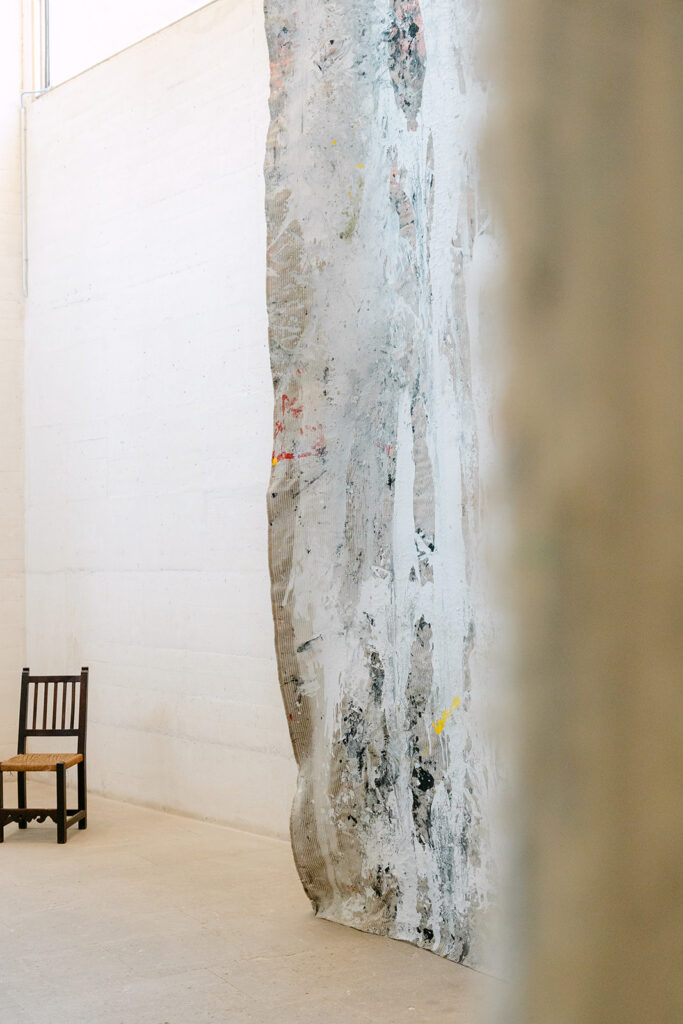
There are artists who construct works, and there are others who construct spaces of transit. Carlos Bunga (Porto, 1976) clearly belongs to this second category. His practice is not understood from the fixedness of the object, but from the constant transformation: of the material, of the space, of the gaze and, even, of time. In New life after fire , the project he presents at the Cubic Space of the Miró Foundation Mallorca, this way of doing things unfolds with all its intensity in a proposal of a strong installative character, where painting, sculpture, architecture and performance intertwine to turn fire into the symbolic and structural axis of the exhibition.
Fire appears there with a deliberate ambivalence. It is a destructive force, but also a creative energy; it is a threat, but at the same time a possibility of regeneration; it is a trace of ruin and, at the same time, a principle of metamorphosis. In Bunga's universe, fire is not only an iconographic element or a poetic reference, but a conceptual tool that activates the tension between what disappears and what begins again. The title of the exhibition already points in this direction: a new life after fire, an idea that refers to both devastation and persistence, to both loss and the ability to recompose forms, bodies and spaces.
Bunga's work has been situated for years at a disciplinary crossroads that defies conventional categories. His practice inhabits the intermediate space between architecture, painting, sculpture and performative action, but also between deeper oppositions: making and unmaking, the micro and the macro, the intimate gesture and the structural dimension, the everyday and the transcendent. This oscillation is one of the keys to his language. Nothing ever appears completely stable in his pieces; everything seems to be subject to a provisional, fragile condition, in the process of construction or collapse. And it is precisely in this precariousness —more existential than formal— that his work finds one of its greatest powers.
In the project conceived for the Fundació Miró Mallorca, which will be on view from April 15 to September 6, Bunga also establishes a subtle dialogue with the universe of Joan Miró. The artist is interested in incorporating traditional everyday objects and elements linked to craftsmanship into the exhibition, in a clear evocation of the objects that Miró kept in his homes and workshops, as well as his interest in manual processes and disciplines such as tapestry. This gesture is not anecdotal: it allows Bunga to connect his research on materiality and transformation with an artistic genealogy that understands the object not only as form, but as a sediment of memory, use and material culture.
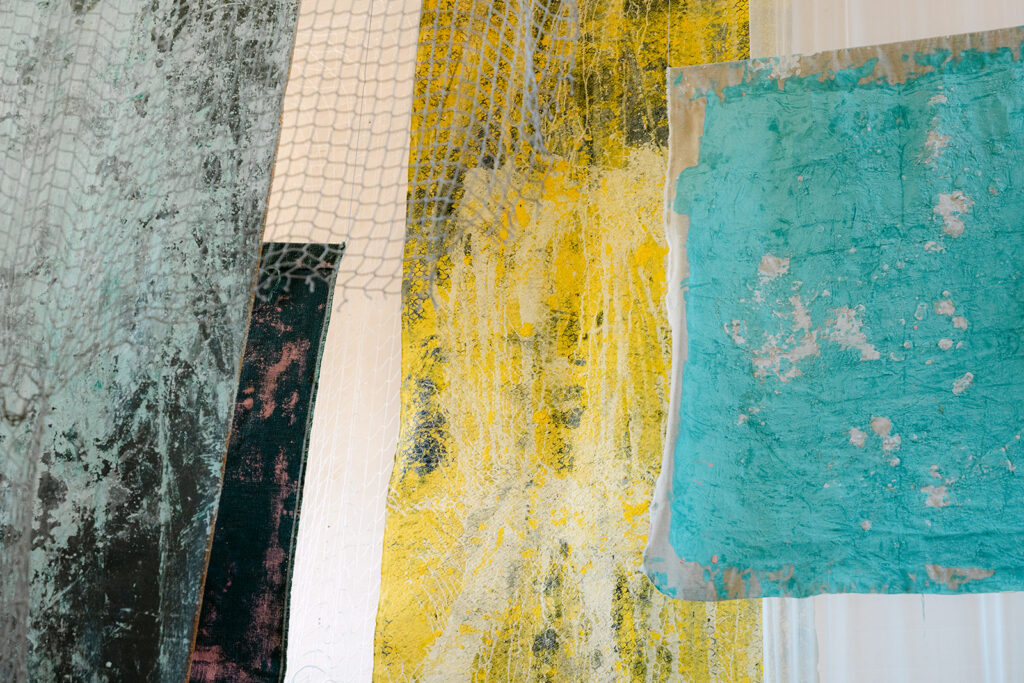
Carlos Bunga, New life after fire, 2026 ©Eva Plasencia.
This artisanal dimension, far from functioning as a simple decorative or ethnographic reference, acquires in his work a particular symbolic density. The objects and materials evoke stories of work, fragility and survival, and are inserted into a scenography where the exhibition space ceases to be a container to become a living, mutable body, affected by visible and invisible forces. In this sense, Bunga does not propose an exhibition to be contemplated from a distance, but a spatial experience that forces the visitor to go through a state of transformation: a before, an alteration and an after.
The presence of fire, despite not revealing itself literally or narratively, runs through the project as a powerful intuition. Fire is there as an image, as a metaphor and as a ritual possibility. It purifies, transforms, devours and at the same time fecundates. Although it is not known exactly what this fire will consume or regenerate within the exhibition, the internal logic of Bunga's work suggests that this combustion will be less an end than an opening. In his work, destruction is never entirely negative: it is a condition for the reconfiguration of forms, a way of thinking about vulnerability as a space of power.
This reading is also reinforced in the artist's words, who has expressed his joy of 'being alive' in a moment that he defines as unique for humanity. The phrase, far from sounding circumstantial, resonates strongly within the framework of his practice. Bunga works from an acute awareness of the fragility of the present, but without falling into catastrophism. There is a form of resistance in his work that involves accepting the instability of the world and, from there, imagining new forms of life. When he states that "works of art are mirrors in which we live", he does not appeal only to the reflective capacity of art, but to its condition as a habitable space, a surface on which to project what we are, what we lose and what we could still become.
In New life after fire , this idea takes shape in a proposal that moves between ruin and reconstruction, between material memory and symbolic imagination. Rather than offering a closed narrative, the exhibition opens up a field of tensions where materials, objects and forms dialogue with history, with architecture and with a certain spirituality of gesture. Bunga does not illustrate fire: he summons it as a latent force, as a mechanism of passage, as a possibility of rebirth.
The result is an exhibition that reaffirms the uniqueness of an artist who has managed to turn fragility into language and transformation into method. In times marked by uncertainty, his work does not offer consolation, but it does offer a lucid and sensitive image of what it means to inhabit a world in constant mutation. And this is perhaps where his strength lies: in reminding us that, after the fire, it is still possible to imagine another life.
You may be
interested
...