News
Visual arts reclaim culture as a driver of democratic health
The first plenary session of the Public System of Visual Arts Facilities brings together nearly eighty professionals to reflect on cultural rights, artistic mediation and the future of a network that wants to strengthen contemporary creation throughout Catalonia.
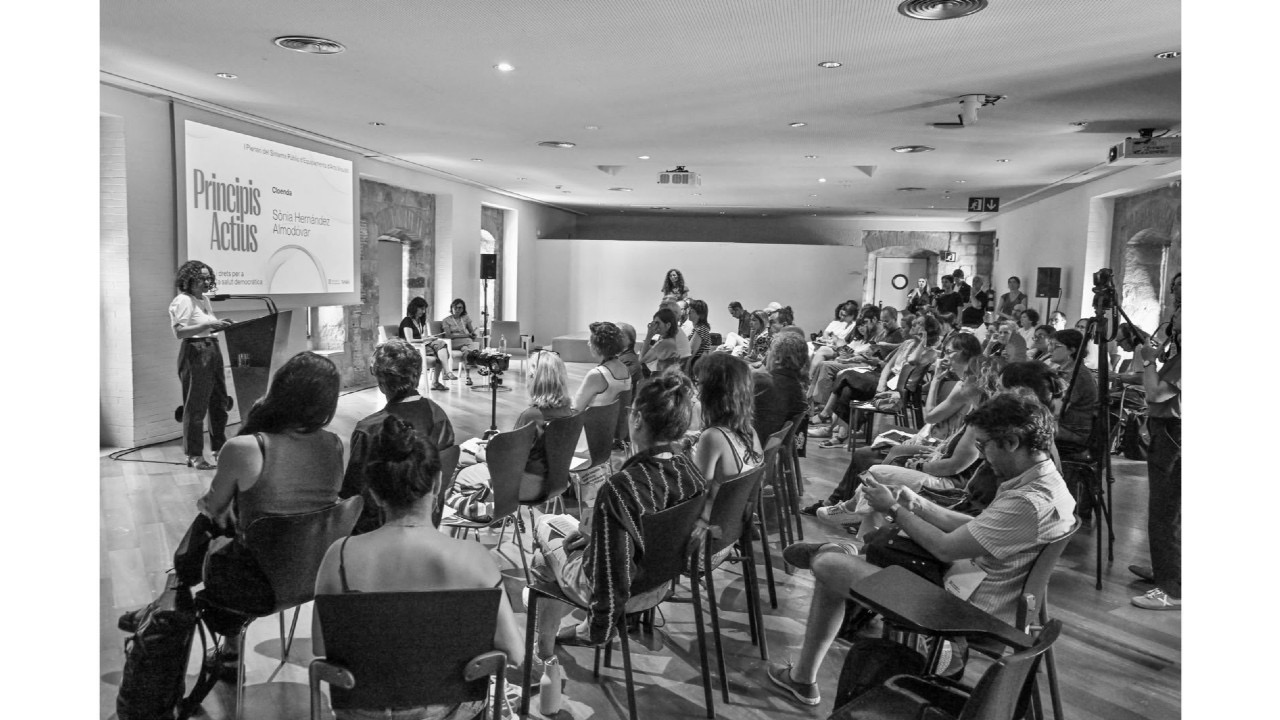
The first Plenary of the Public System of Visual Arts Facilities (SPEAV) has marked a turning point in the consolidation of a network that aspires to strengthen the role of contemporary visual arts as a tool for social transformation. Held in the Auditorium of the Convent of MACBA, the meeting brought together nearly eighty representatives of facilities, creative centers, foundations, galleries and professional associations in a day dedicated to rethinking the role of culture in a context of growing social and democratic challenges.
Under the motto Active Principles. Culture and rights for democratic health , the plenary, promoted by the Department of Culture through the General Directorate of Cultural Rights, Creation and Libraries, has placed two inseparable issues at the center of the debate: cultural rights as fundamental rights of citizenship and the contribution of the visual arts to individual, collective and community well-being.
At the inauguration, the Minister of Culture, Sònia Hernández, vindicated the visual arts as "an essential tool for understanding and transforming the world", highlighting that the SPEAV represents a strategic instrument to guarantee universal access to culture and move towards a more territorially balanced model. According to Hernández, the network is experiencing "a moment of growth and maturity", and the celebration of this first plenary session symbolizes the will to strengthen the links between institutions and professionals in the sector.
The conference, led by the general director of Cultural Rights, Creation and Libraries, Xavier Fina, was structured into two large debate blocks that linked artistic practices, research, education and community.
The first space for reflection addressed the connections between visual arts and community health. Professor and researcher Sergi Blancafort and family doctor Montserrat Verdú Arnal presented the Intra-actions project, an initiative jointly developed by CAP Poblenou, the Maria Espinalt Institute and La Escocesa that explores new forms of collaboration between artistic creation, education and public health. The proposal exemplifies how creative processes can become spaces for participation, care and social cohesion.
The creators' perspective took over in a conversation moderated by cultural manager José Antonio Delgado, with contributions from artist and teacher Gemma París and Felipe G. Gil, founder of Zemos98. The participants claimed the potential of artistic practices to generate cultural mediation processes capable of building critical thinking, fostering citizen participation and strengthening collective commitment.
The second block delved into the dimension of cultural rights. Javier Rodrigo, researcher and co-director of Transductores, and artist Quim Packard shared experiences that demonstrate how artistic mediation can become an effective tool for community work and inclusion.
Subsequently, curator Amanda Cuesta moderated a conversation with Nerea Campo and Mar Sureda on the obstacles that still hinder the exercise of cultural rights, especially in rural environments and among minority groups. The interventions agreed in pointing out that access to culture constitutes an indicator of democratic quality and an indispensable condition for building more egalitarian societies.
One of the highlights of the plenary session was the presentation of the new Professional Scales prepared by the Department of Culture, by curator and critic Montse Badia. The report establishes guiding criteria to improve the hiring conditions of visual arts professionals, promote greater transparency in labor relations and contribute to the sustainability of a sector that has often denounced the precariousness of its working conditions.
Beyond the debate, the meeting also served to consolidate the identity of the Public System of Visual Arts Facilities, a structure that articulates the main public centers dedicated to contemporary art in Catalonia. MACBA acts as its reference center, accompanied by the eight major territorial centers —ACVIC, Bòlit, La Fabra Center for Contemporary Art, M|A|C Mataró Art Contemporani, Mèdol, Center for Art La Panera, Lo Pati and Tecla Sala— as well as an extensive network of more than twenty local spaces distributed throughout the territory.
The aim of the system is to strengthen cooperation between facilities, share resources, promote joint programming and guarantee a more accessible and territorially balanced contemporary artistic offer. In short, a network designed to turn culture into an effective right and not just a one-off opportunity.

You may be
interested
...