Exhibitions
Cartographies of modern failure
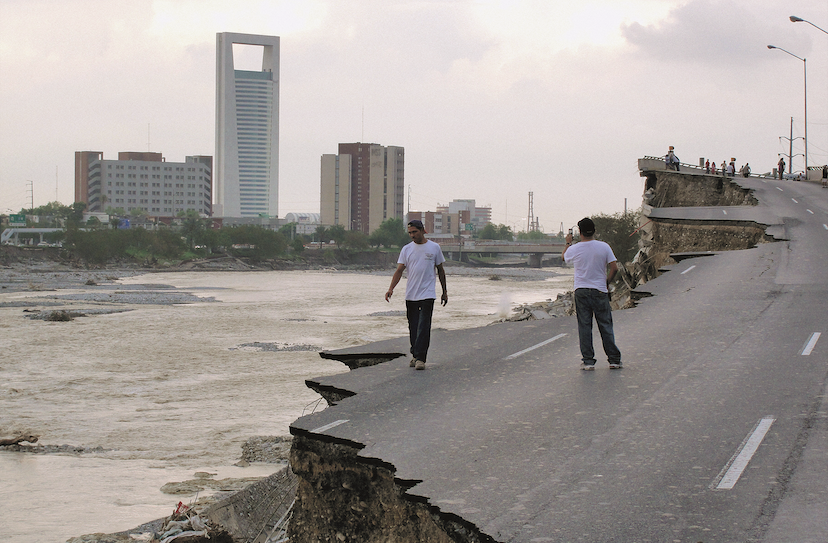
The Mapfre Foundation presents in Madrid one of the most comprehensive overviews to date of the work of Alejandro Cartagena (Santo Domingo, 1977), a photographer based in Monterrey since his adolescence. Ground Rules , curated by Shana Lopes (SFMOMA), does not simply review his career: it organizes a system of visual thought where the image ceases to be mere testimony and becomes a critical structure.
The exhibition is structured around more than twenty series grouped into six major areas —early works, the Mexico-United States border, housing and infrastructure, the malleability of the image, climate crisis and photobook—, but its real strength lies not in the taxonomy, but in the artist's methodological insistence: working by accumulation, repetition and variation, shifting the meaning from the individual image to the whole.
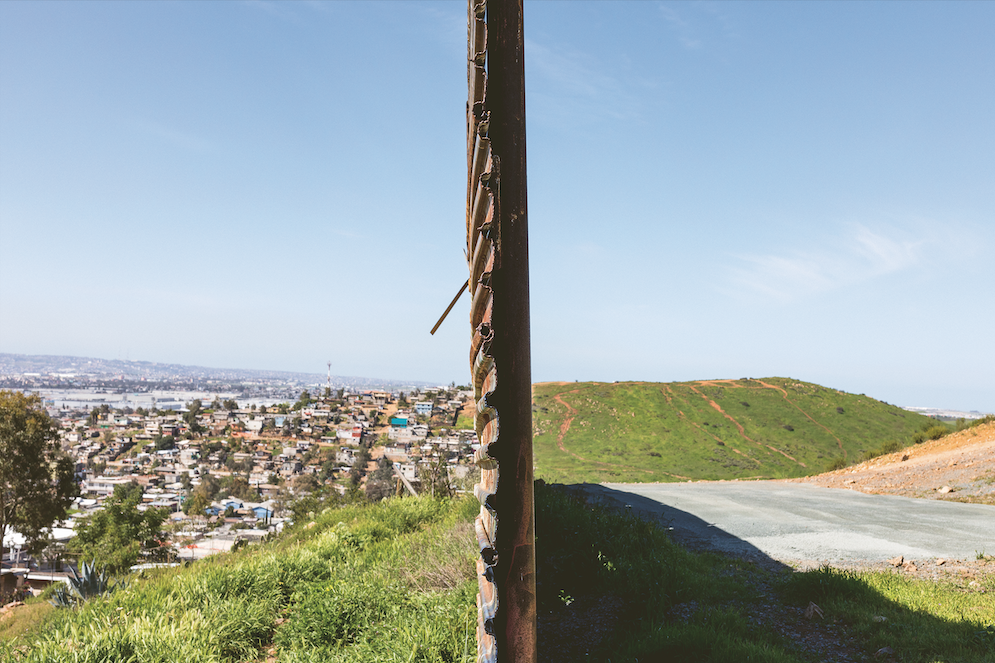
Alejandro Cartagena, Invisible Line #4, from the Without Walls series, 2017, Courtesy of the artist © Alejandro Cartagena.
From the beginning, Cartagena's work has focused on analyzing territory as a political and economic construct. In series such as Suburbia Mexicana , Carpoolers , and Suburban Bus , the outskirts of Monterrey appear as a laboratory for neoliberal urbanism: sprawling housing developments, modular homes repeated to the point of visual exhaustion, incomplete infrastructure, and a promise of progress that systematically fails.
Rather than documenting the city, Cartagena deconstructs it. Its images don't describe a landscape: they interrogate it as a symptom. The repetition of motifs—roads, identical houses, daily commutes—generates a kind of grammar of urban failure, where the territory is revealed as a product of economic decisions rather than as a habitable space.
Within this framework, the exhibition also underscores a key shift in her practice: the crisis of documentary photography as a tool for truth. Cartagena has repeatedly expressed her skepticism regarding the image's capacity to produce a direct understanding of reality. Ground Rules makes this questioning visible by incorporating collages, found images, digital processes, artificial intelligence, and other devices that challenge the traditional notion of the document.
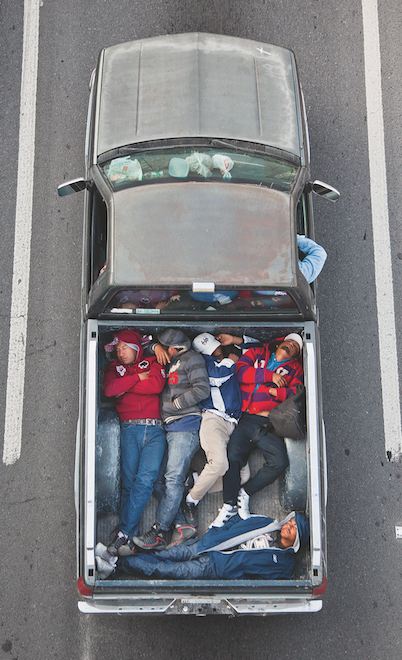
Alejandro Cartagena, Carpoolers #21, from the Carpoolers series, 2011-2012, Courtesy of the artist © Alejandro Cartagena.
Photography no longer appears here as evidence, but as a construct. And in that transformation, a more uncomfortable question arises: not what the image shows, but how it participates in the fabrication of what we call reality.
The photobook occupies a central place in this exhibition. For Cartagena, the book is not a secondary medium, but a tool for thought. In it, the sequence of images, the rhythm, and the relationship with the text allow for the construction of narratives that are alternatives to those of the exhibition space. In contrast to the dispersion of the wall, the book introduces duration, structure, and reading.
This editorial dimension reveals a key idea: meaning resides not in the isolated image, but in its organization. The photobook thus functions as a laboratory where photography approaches writing and where the author controls, almost musically, the cadence of the gaze.
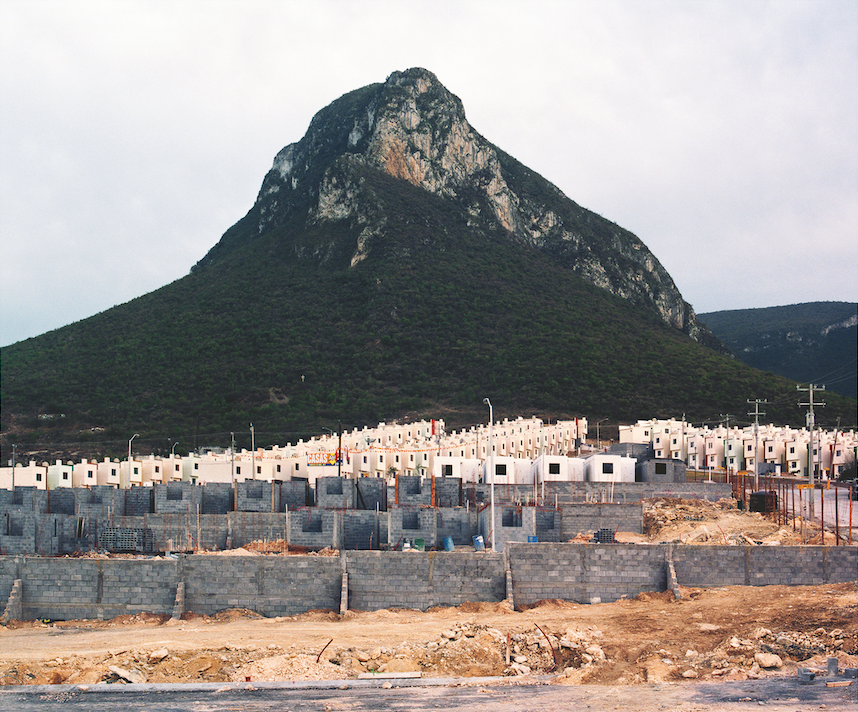
Alejandro Cartagena, Fragmented Cities, Escobedo, from the Mexican Suburbia series, 2005-2010, Courtesy of the artist © Alejandro Cartagena.
The exhibition's title, Ground Rules , functions as a double key. On the one hand, it refers to the self-imposed rules of the artist: working in series, limiting variables, and focusing on certain territories or visual problems. On the other, it alludes to the invisible rules that organize contemporary social, economic, and political life.
The exhibition suggests that these two dimensions are inseparable. The rules of art and the rules of the world reflect each other, and Cartagena's work is situated precisely in this zone of friction, where the image can both reproduce and destabilize the systems it purports to represent.


You may be
interested
...