Exhibitions
Guggenheim Bilbao: Jasper Johns in perspective
With a Pair of Balls In 1960, Jasper Johns created Painting with Two Balls, an abstract canvas that imitates the gestural strokes of Action Painting, but worked with encaustic and collage techniques, to which he added a seemingly incongruous element: two wooden balls fitted into an opening in the canvas. These balls contained an ironic allusion to the painters of the previous generation, those of Abstract Expressionism, and their much-vaunted virility. In their famous gatherings at the Cedar Tavern in Greenwich Village, where the New York group regularly met to drink, exchange ideas, and seek romantic adventures, the Expressionists, who boasted of being potent “sexual machos,” often remarked that a good painting should have “a pair of balls.” A few years earlier, in the mid-1950s, Johns had begun his now-famous series of flags (Flag, 1954-55) and targets (Target with Four Faces, 1955), numbers (Gray Numbers, 1958), and letters (Alphabet, 1959), followed by maps (Map, 1961)—iconic images executed with an ironically impassioned style that played on the ambiguity of identifying the motif with the representation, abstraction with figuration, the painting with the sign or emblem to which it alluded. And in the same decade, he would create his first three-dimensional works reproducing flashlights (Flashlight, 1958) or light bulbs (Light Bulb, 1958), followed by others that replicated beer cans or paintbrush holders (Painted Bronze, 1960)—pieces that occupied an ambiguous space between sculpture and object. A whole iconography of facticity, inspired by Duchamp's ready-made, would pave the way for the art of appropriation and the aestheticization of the vulgar in Pop Art. With these works, as well as his assemblages and collages from the same years, reminiscent of the Combine Paintings of his colleague and romantic partner Robert Rauschenberg, Johns definitively declared the end of abstract expressionism, which had dominated the postwar period, and opened the way to the new, cool trends of the 1960s: post-painterly abstraction, minimalism, and pop art. From an art of action and emotion, of dripping and the vigorous, energetic strokes of a Pollock, a Motherwell, or a Kline, we would move to rationality and control, the clean, unmarked execution of the cool abstraction of an Ad Reinhardt, a Kenneth Noland, or a Frank Stella. The excess and baroque style of a Jackson Pollock were replaced by the simplicity and reductionism of Post-Painterly Abstraction or Minimalism. The subjectivity and expressiveness of Action Painting gave way to the impersonality and aseptic quality of Pop Art, to individualism and the exaltation of originality, an art based on copying, imitation, and kitsch. Action painters were producers; Pop artists were consumers. If the Expressionist painter embodied passion, strength, and masculinity—that is, the virtues of the Vir Heroicus Sublimus in Barnett Newman's famous painting—the Pop artist personified frigidity and homosexuality—as in the case of Warhol, Hockney, or even Rauschenberg and Johns. The dark nation that had lived through the post-World War II era and McCarthyism was finally behind them, giving way to the brand-new America of prosperity and consumerism in the 1960s. A retrospective curated by Enrique Juncosa, the retrospective presented by the Guggenheim Museum Bilbao, Jasper Johns: The Night Driver, spans five decades of the career of this pivotal artist, bridging generations and trends, from his iconic Neo-Dadaist pieces of the 1950s—flags, targets, assemblages, and object-sculptures—to his more recent work of the 1990s and 2000s. It offers an opportunity to revisit his best-known work, placing it within a broader timeline, and to trace his subsequent evolution through his more contemporary and lesser-known pieces. Jasper Johns in all his tonal breadth, Jasper Johns in perspective.
With a pair of balls
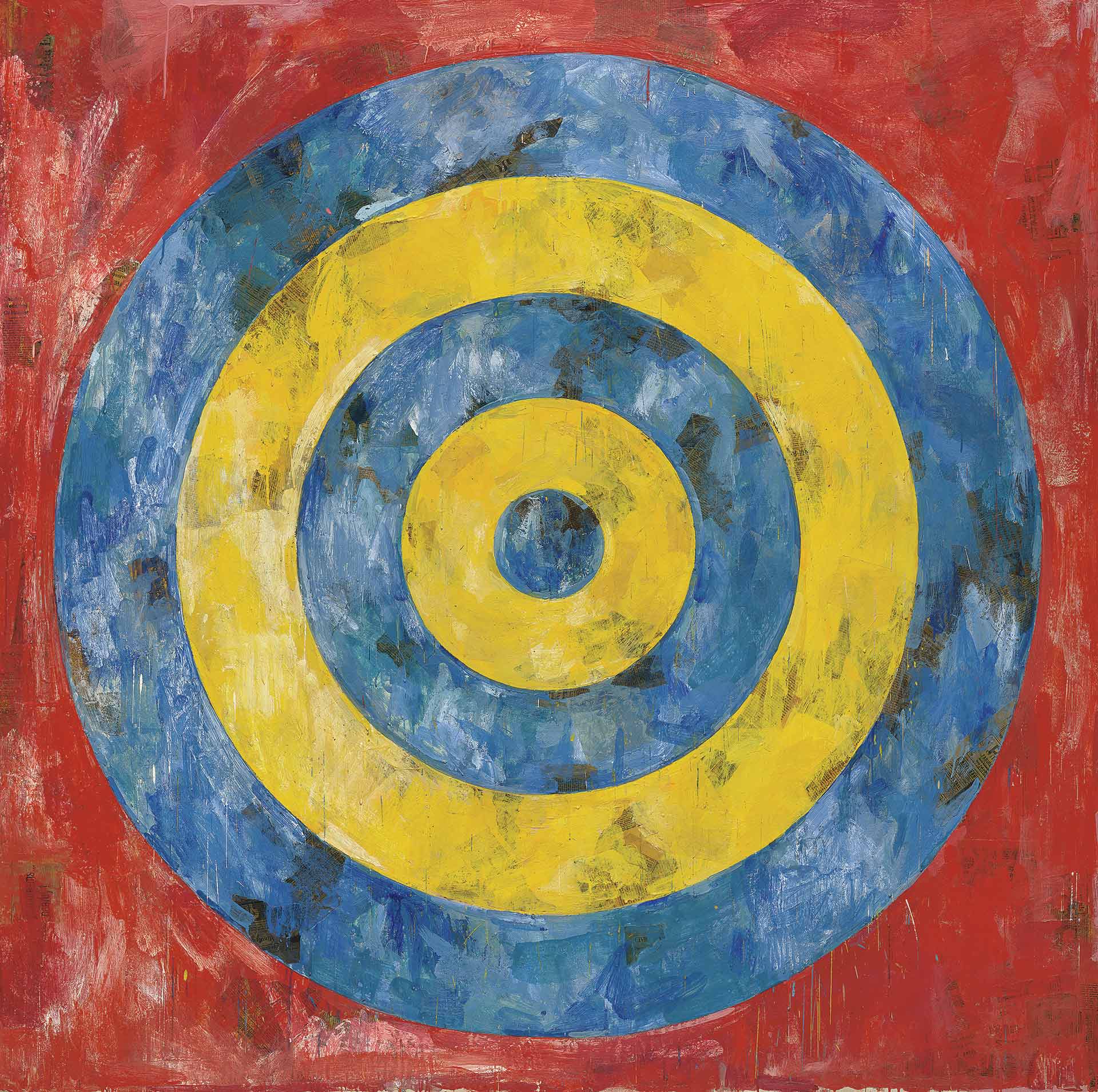
In 1960, Jasper Johns created Painting with Two Balls, an abstract canvas that imitates the gestural strokes of Action Painting, but worked with the encaustic technique and
The collage, to which he adds a seemingly incongruous element: two wooden balls fitted into an opening in the canvas. These balls contained an ironic allusion to the painters of the previous generation, those of Abstract Expressionism, and their much-vaunted virility. In their famous gatherings at the Cedar Tavern in Greenwich Village, where the New York group regularly met to drink, exchange ideas, and seek amorous adventures, the Expressionists, who boasted of being potent “sexual machos,” often remarked that a good painting should have “a pair of balls.”
A few years earlier, in the mid-1950s, Johns had begun his now famous series
From flags (Flag, 1954-55) and targets (Target with Four Faces, 1955), numbers (Gray Numbers, 1958) and letters (Alphabet, 1959), to maps (Map, 1961), iconic images executed with an ironically impassioned style that played on the ambiguity of identifying the motif with the representation, abstraction with figuration, the painting with the sign or emblem to which it alluded. And in the same decade, he would create his first three-dimensional works that reproduced flashlights (Flashlight, 1958) or light bulbs (Light Bulb, 1958), followed by others that replicated beer cans or paintbrush holders (Painted Bronze, 1960), pieces that moved in an ambiguous space between sculpture and object. A whole iconography of facticity, inspired by Duchamp's ready-made, which would clear the way for the art of appropriation and the aestheticization of the vulgar in Pop Art.
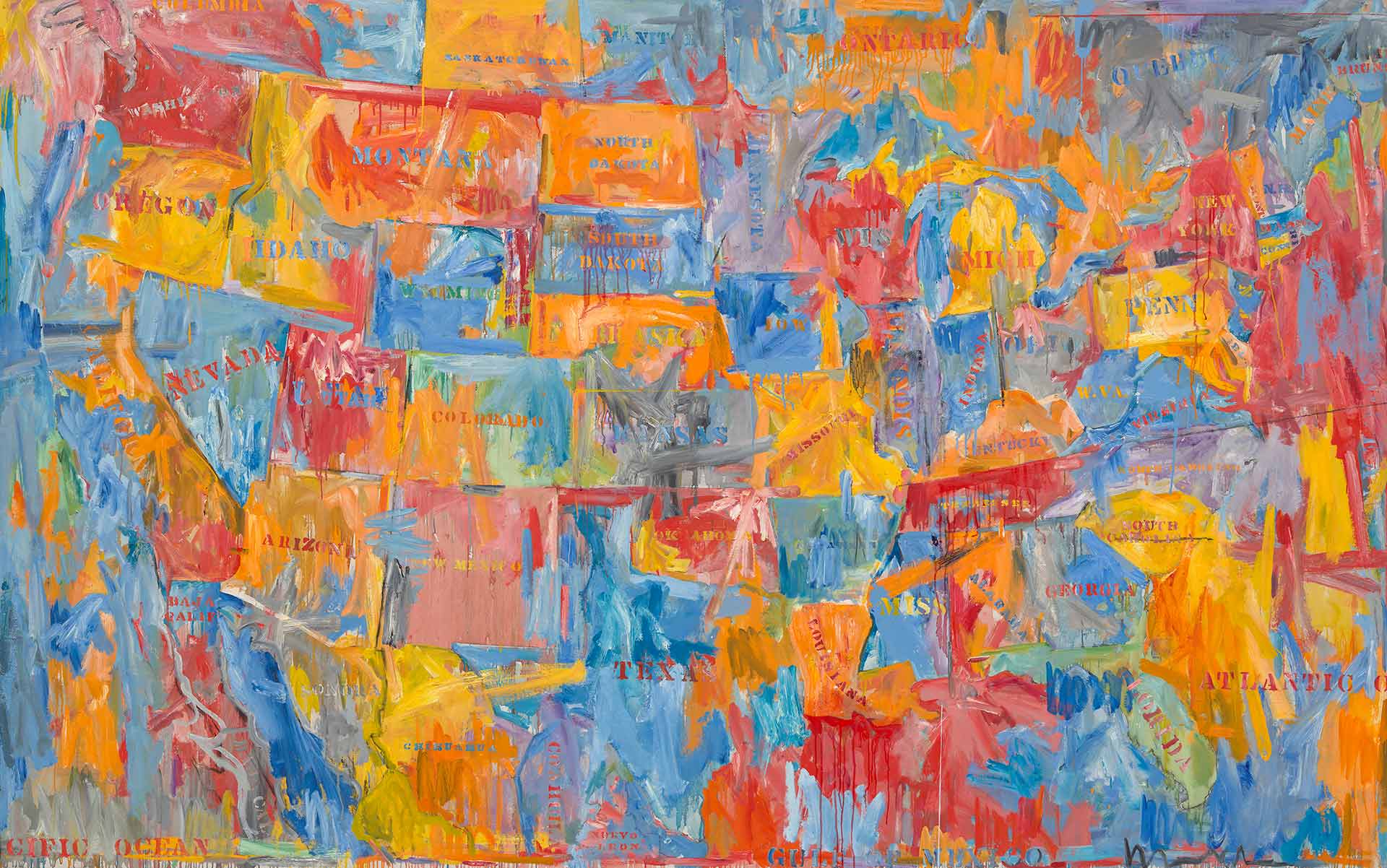
Jasper Johns, Mapa (Map), 1961, The Museum of Modern Art, New York.
Donation of Mr. and Mrs. Robert C. Scull, 1963 © Jasper Johns, VEGAP, Bilbao, 2026 © 2026 Digital image, The Museum of Modern Art, New York/Scala, Florence.
The cooling
With these works, as well as with his assemblages and collages from the same years, close to the Combine Paintings of his colleague and romantic partner Robert Rauschenberg, Johns gave a definitive death certificate to abstract expressionism, which had dominated the post-war world, and opened the way to the new cold trends of the 1960s: post-painterly abstraction, minimalism, pop.
From an art of action and emotion, of dripping and vigorous and energetic strokes
From a Pollock, a Motherwell, or a Kline, we would move to rationality and control, the clean, uncluttered execution of the cool abstraction of an Ad Reinhardt, a Kenneth Noland, or a Frank Stella. The excess and baroque style of a Jackson Pollock were replaced by the simplicity and reductionism of Post-Painterly Abstraction or Minimalism. The subjectivity and expressiveness of Action Painting would give way to the impersonality and asepsis of Pop Art, to individualism and the exaltation of originality, an art based on copying, imitation, and kitsch. Action painters were producers; Pop artists were consumers. If the Expressionist painter embodied passion, strength, and masculinity—that is, the virtues of the Vir Heroicus Sublimus in Barnett Newman's famous painting—the Pop artist personified frigidity and homosexuality—as in the case of Warhol, Hockney, or even Rauschenberg and Johns. The dark nation that had lived through the post-war period and McCarthyism was finally left behind, to welcome the brand-new America of prosperity and consumption in the 1960s.
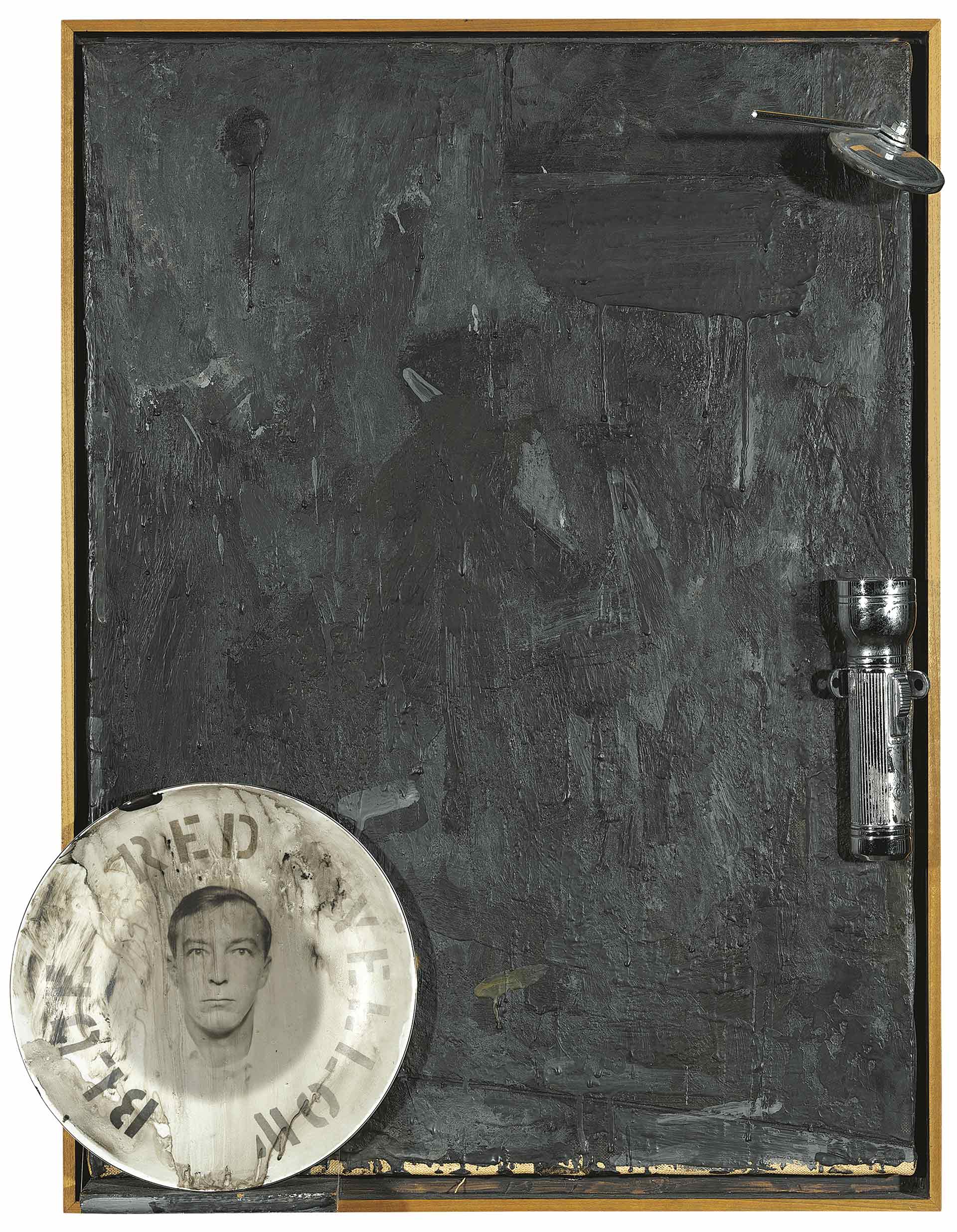
Jasper Johns, Souvenir, 1964, Artist's Collection © Jasper Johns, VEGAP, Bilbao, 2026
Art Institute of Chicago, photo by Jamie Stukenberg, Professional Graphics, Inc., Rockford, Illinois.
A look back
Curated by Enrique Juncosa, the retrospective at the Guggenheim Museum Bilbao, Jasper Johns: The Night Driver, spans five decades of the career of this pivotal artist, bridging generations and trends, from his iconic Neo-Dadaist pieces of the 1950s—flags, targets, assemblages, and object-sculptures—to his more recent work of the 1990s and 2000s. It offers an opportunity to revisit his best-known work, placing it within a broader timeline, and to trace his subsequent evolution through his more contemporary and lesser-known pieces. Jasper Johns in all his tonal breadth, Jasper Johns in perspective.


You may be
interested
...