Exhibitions
Lúa Coderch: the clucking eye
Between blindness and revelation, Lúa Coderch turns the closed eye into a metaphor for memory, perception and the need to imagine new ways of looking at the world.
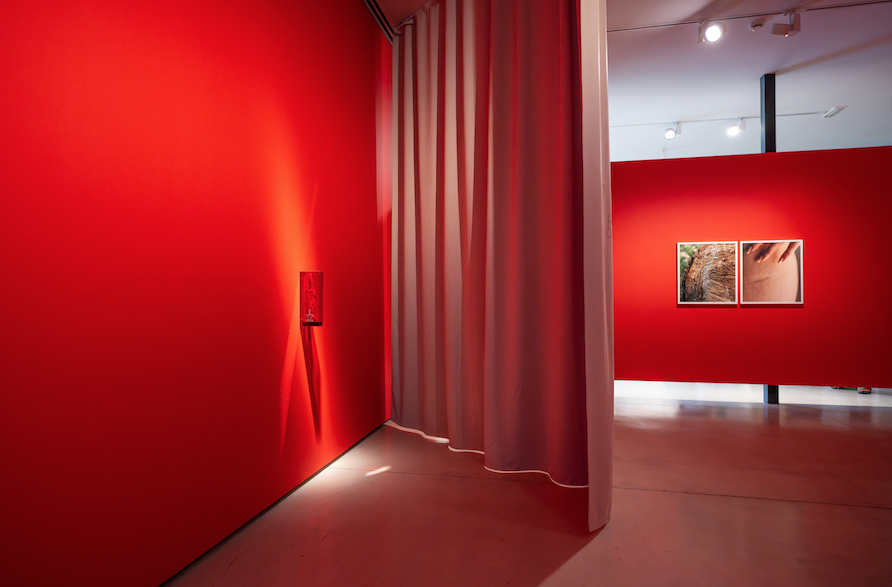
The Vila Casas Foundation at the Can Framis Museum has inaugurated a new exhibition space that will host special proposals. It is inaugurated with Lúa Coderch, who won the ARCO 2025 Antoni Vila Casas award. The award entailed the acquisition of work and a future exhibition of the artist in this new space of the museum.
The installation consists of six related stimuli. Lúa Coderch says that we are inside an eye. She tells us that the eye is closed and we must look inside.
The first stimulus is seen outside: attached to a curtain that darkens the room is a synthetic hair eyelid. The thick curtains do not let in the light from the large window in the room, painted red, a clear allusion to bloodshed. The second stimulus is a video where the artist, in a voice-over, explains to his son some wonderful secrets of nature. Among them, a branch with two leaves that are two eyes. The reality incorporates the imagination and legend of the Christian martyr Lucia of Syracuse, painted by Francesco del Cossa in the 15th century. This sacrificial removal of the eyes suggests to him the need for a rebirth of vision. Be it in its visionary aspect or as the eyes that are to come. The eyes of the renewal of the gaze on the world.
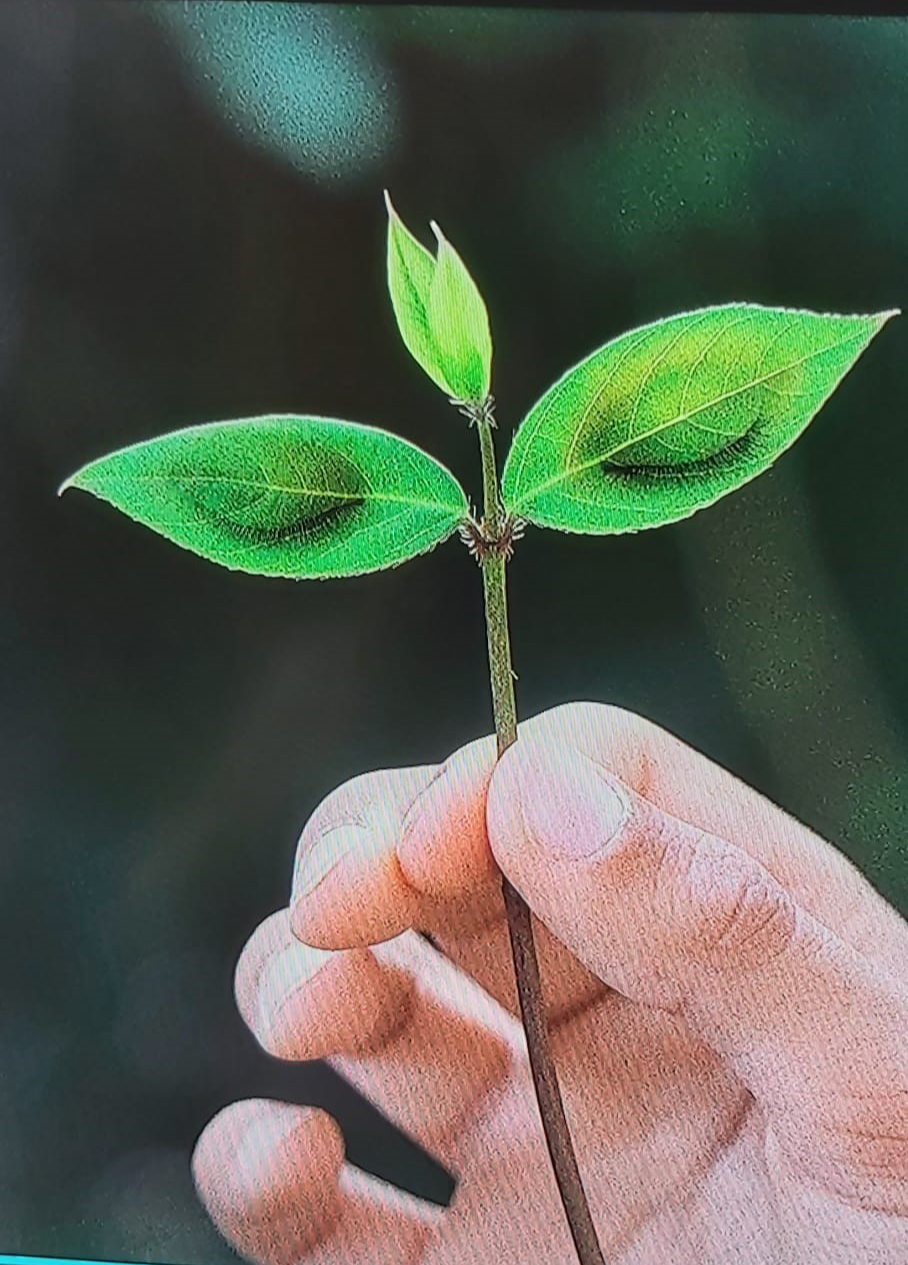
The third stimulus is a subtle impression of a drawing on another curtain. This reproduces one of the characteristic shapes that we see when our eyes are closed: blood vessels, vitreous humor, phosphenes, flies, filaments and a kind of paramecium that move around endlessly. Lúa Coderch has chosen an arboreal shape, a tiny branch, to reproduce it in the textile.
The fourth stimulus comes a little out of the narrative because they are just cubes, small minimalist and geometric sculptures that serve as seats to watch the video.
The fifth stimulus is a mini display case that captures the fossilization of the moment when lightning strikes the sand and petrifies it. Fulgurite is the name of this matter created in an instant, in a nanosecond of light hitting the silica.
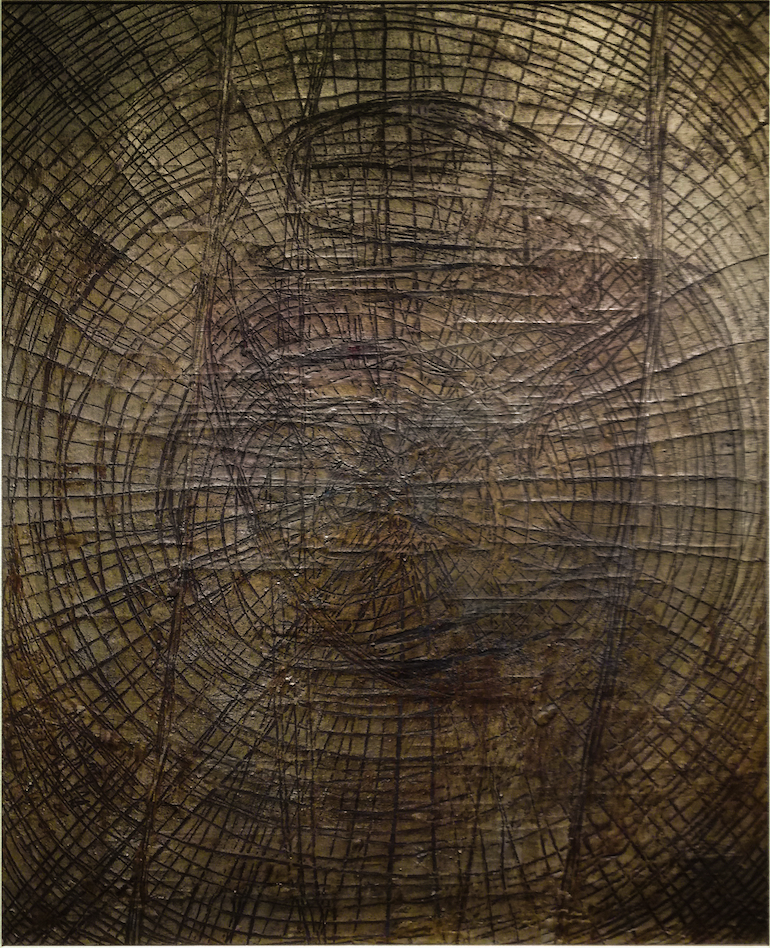
The sixth and final are two prints on paper of an image of the cut trunk of a pine tree with sentimental charge for the artist and its concentric circles, those that indicate growth. The touch of the freshly cut trunk gave off the moisture of a wound and this reminds him of the scar of an eye-shaped wound that the artist has on his skin.
With this installation, Lúa Coderch has created a sum of what is personal and what is epochal. On the one hand, emotional involvement, memories and carnal experience; on the other, an attempt to portray our time and propose some solution for the future, when she says: “The new eyes that sprout are not mine, they are the eyes that are yet to come.”
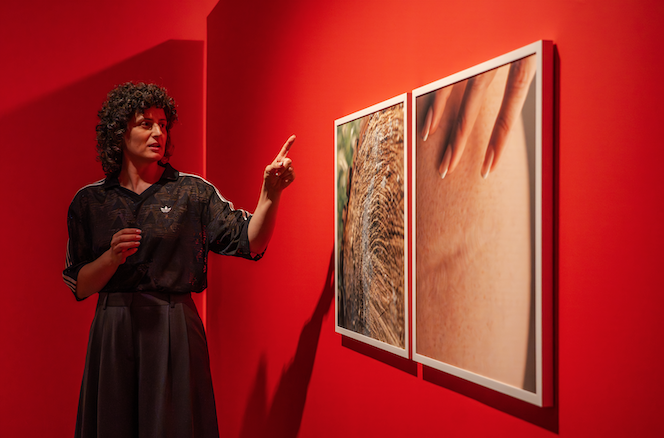
Photo by Pau Bruguera.
Beyond Lúa Coderch's personal perspective, her proposal must be referenced with a concern that periodically appears as one of the causes of human unrest; I am referring to the body and, more specifically, to the eye and the loss of vision.
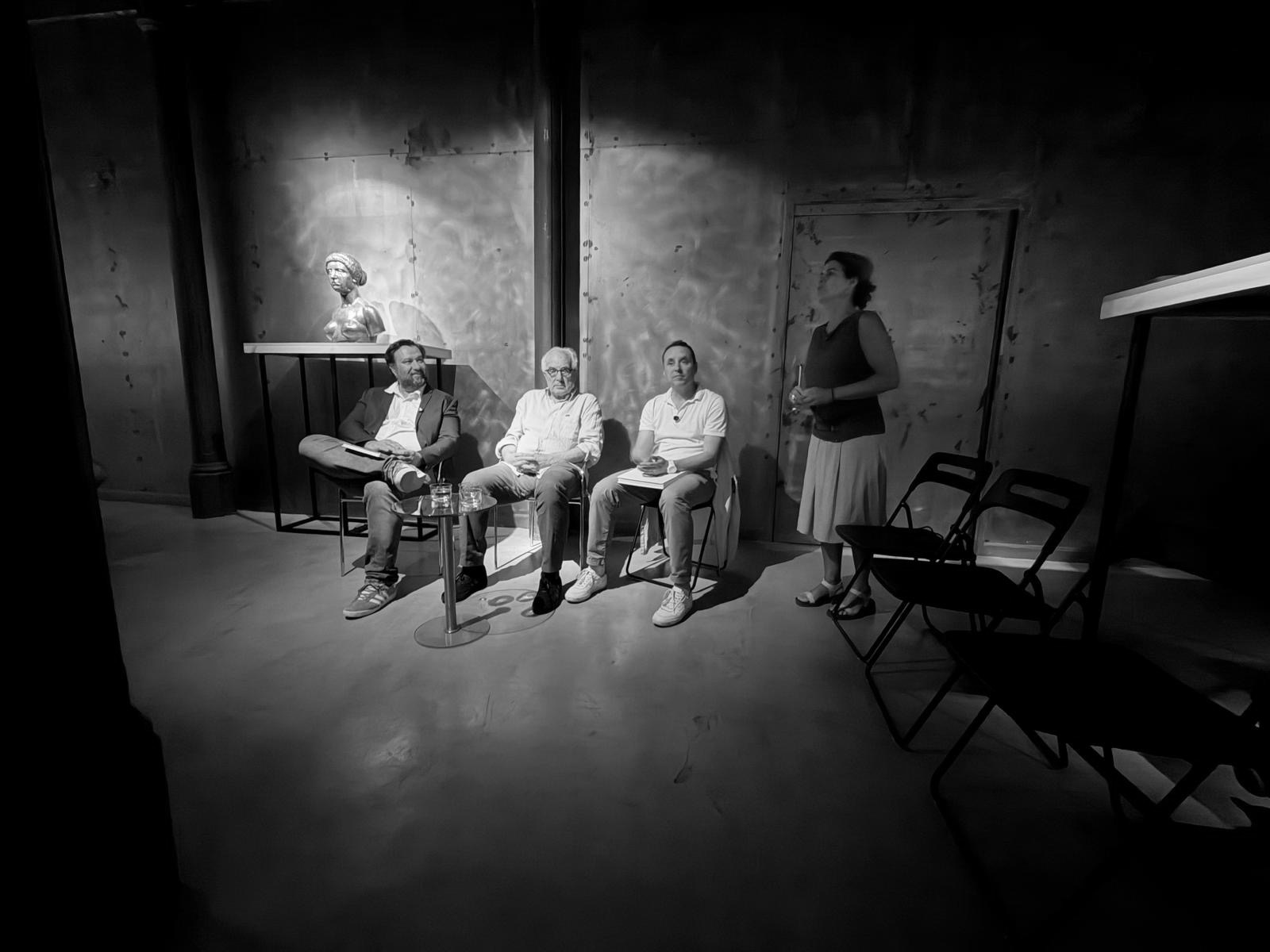
Recently, thanks to the generosity of my colleague Pilar Parcerisas, I have had the opportunity to present his book “Tàpies and Blindness” (SM Edicions) on three occasions, one of them at the Tàpies Museum, coinciding with the centenary exhibition. Borja-Villel, in the presentation text of the commemorative exhibition, highlighted the role of the eyes and blindness due to an eye disease, a maculopathy. Borja-Villel, in the presentation text of the exhibition, includes a statement by Tàpies: “I started by painting eyes and I will end by painting eyes!” This desire is confirmed by Pilar Parcerisas when she assures that the eyes and eyelids at the end are not a rarity, that they have been there since Dau al Set.
One of the book's highlights is the part dedicated to the blind photographer Evgen Bavčar, as Pilar facilitated and experienced first-hand the visit that the photographer made to Antoni Tàpies in 1998.
The passage between centuries that interests me so much reflected the interest in this photographer and in blindness, as shown in the exhibition "Cegueses" (1997), curated by Glòria Bosch for four months at the Girona Art Museum, the Casa de Cultura and the Josep Trueta hospital, and in which students from the Massana School participated, with professor Ignasi Aballí.
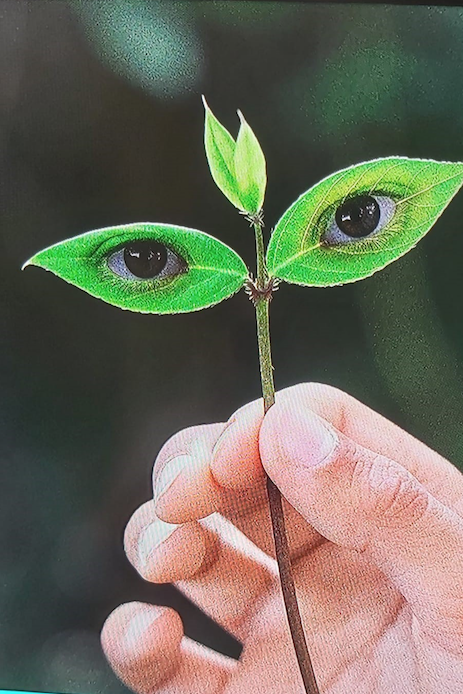
Towards the nineties, attention was focused on the issue of blindness, probably as a result of the exhibition that Jacques Derrida organized at the Louvre Museum in 1990: "Memories of a Blind Man: Self-Portrait and Ruins", a very clear message in favor of the artist taking his eyes off reality and painting from memory and with a clear longing for the invisible.
These same limits between imagination and reality of the squinting eye are the main theme of this magnificent installation by Lúa Coderch. Its purpose is diverse, as diverse and at the same time enrichingly contradictory is current thought. In this sense we find an ode to the inner, intuitive gaze, which goes beyond the sense of vision, a squinting eye, but at the same time and necessarily a song to the intense and attentive perception of the gaze towards the outside: flowers, nature or petrified ray. Also, on the one hand, a praise of the present seen with attention, but at the same time a prophetic will to improve the world, in the words of Lúa Coderch: “We need to imagine worlds that are still habitable, that are kinder and more just than the ones we know. Without this, action is not possible”.
We are left with the enigma of knowing whether or not the gaze of the clucking eye, the inner vision, requires that the circumstances surrounding it be better. I think of the closed eyes of the mystics, of the austerity of the monasteries, of non-action, of Bodhidharma cutting off his eyelids, and of the joy of non-vision. We will soon find out.
You may be
interested
...