Exhibitions
Three virtuous circles: Charo Pradas at the Marc Domènech Gallery
The hypnotic circularity in the work of Charo Pradas as a way of contemplation and search for a permanent center of gravity in contemporary painting.
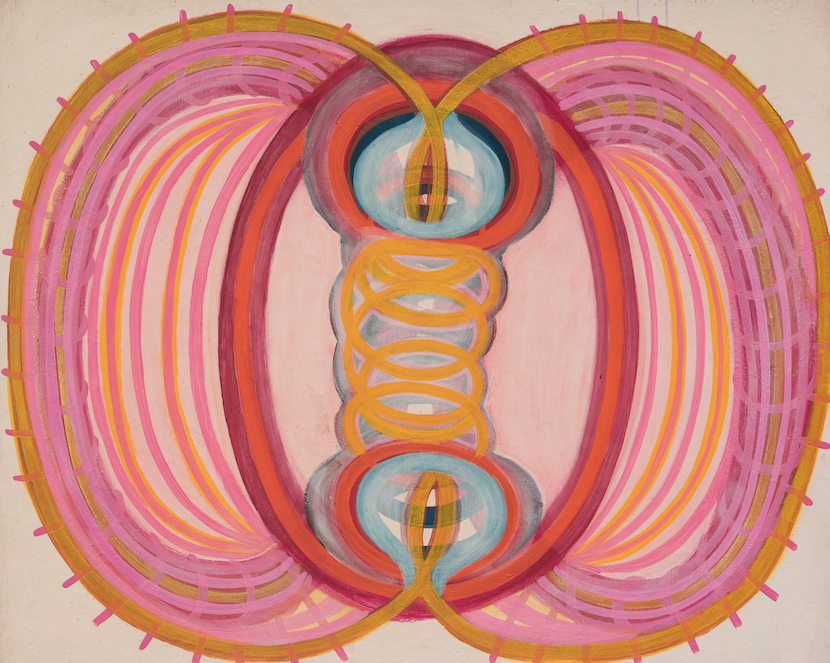
The Marc Domènech gallery is going from success to success. Its exhibitions on the heroes of contemporaneity have turned it into a bastion of artistic values that have stood the test of time. Each new exhibition confirms this. The installations are impeccable and the atmosphere that breathes is one of contained contemporaneity, works from which time has removed what was superfluous, the exuberant, and allows them to be relived with tranquility. There are always well-edited catalogues that guide the visit, a reading and documentation space. There is also a comfortable place to sit, something that is increasingly necessary in fairs and galleries to be able to enhance attention to the works and give rest to the gaze. On this occasion, Charo Pradas (Terol, 1960) is exhibiting his works from the eighties, fifteen paintings and eighteen drawings, selected by the gallerist Marc Domènech himself.
In the Barcelona of the turbulent 'eighties', everything was going through a new impetus for painting. I myself claimed it from the pages of La Vanguardia with an article proclaiming La pintura como espejo (1984). An era that JM Bonet ended up defining as 'the painted years'. Charo Pradas was linked, not formally, but by proximity, as a partner of Xavier Grau, with the Aragonese axis of José Manuel Broto and Gonzalo Tena, also from Teruel. They formed the Trama group, were formalist painters and maintained the theoretical postulates of the "Support-Surface" movement. All those who painted at that time went through the Miguel Marcos Gallery, an essential reference for understanding those years of painting-painting.
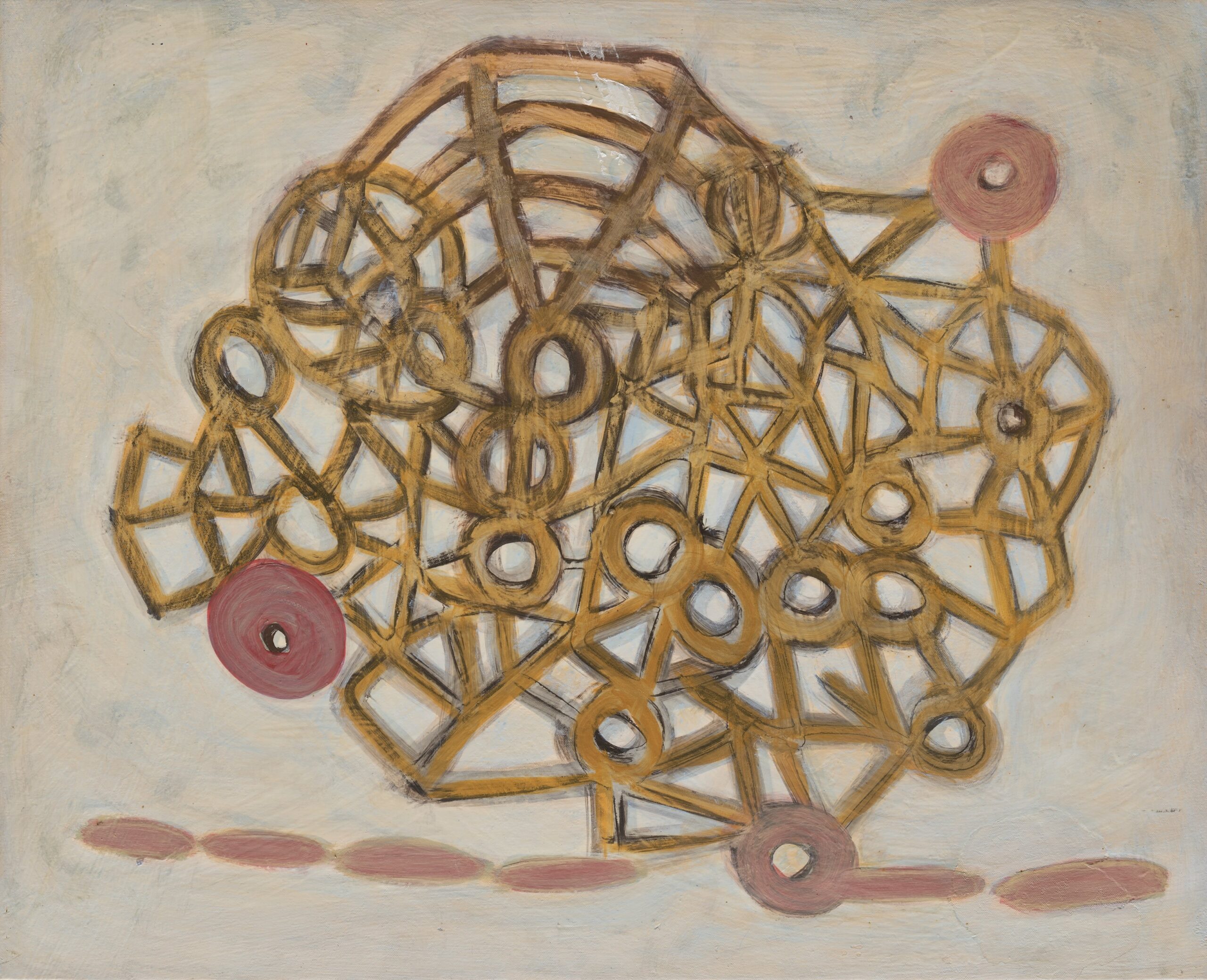
Charo Pradas, ST, 1980.
"A permanent center of gravity"
Enrique Juncosa writes the introductory text of the catalogue and, first of all, before getting into the painting, I want to highlight this fact. I am referring to the happy encounter between the critic and the artist over many years. In 1993, with the text Fractal Zoom , in 2001 with Esfera Imagen and currently with Un centro de gravedad permanente . This magnetization is mutual, it indicates a certain continuity of reciprocal interests and I consider it something very relevant in a time when we instrumentalize everything, an era of using and throwing away. Loyalty speaks to us of someone who knows the artist's work well and offers us some keys as a privileged interpreter of his work.
The title of Enrique's text for the catalogue is already very revealing, it seems to speak of something that not only affects both of them, but also affects an entire generation. I am referring to the search for A permanent center of gravity , alluding to Franco Battiato's famous musical theme in his “Echoes of Sufi Dance”. The demand for novelty, the accelerated precipitation of media, the often contradictory or paralyzing fact of time and space that are, on the other hand, permanent. Postmodern culture made us experience it this way, in a special and intense way. The decade of the eighties, the period covered by this exhibition, was marked by the law of aesthetic acceleration and by an inevitable tendency towards haste. The seduction of the postmodern ephemeral already augured the need to end, in something more absolute and immobile, the search for another law: the law of immobility and firm principles. The permanent tradition of the symbolic values of art, the modern tradition itself, needs a permanent center of gravity that, despite constant movement, does not vary with time or circumstances.
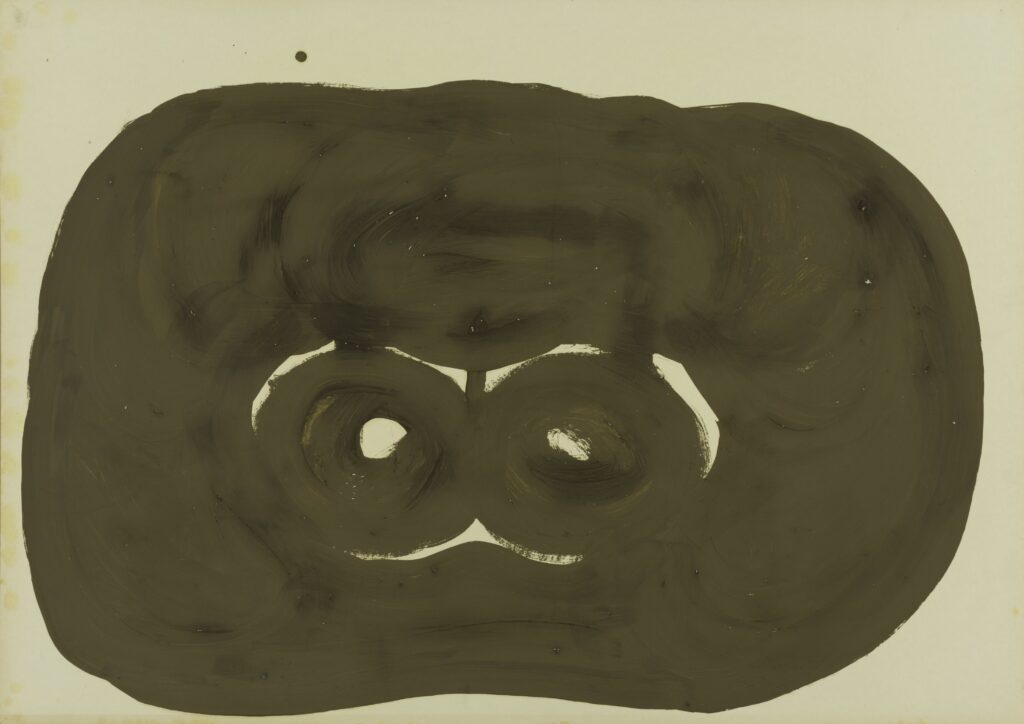
Charo Pradas, ST, 1985.
The static circle
Acceleration and return to the same is represented schematically through the circle. This is one of the first and main sensations we have when we stand before the paintings of Charo Pradas. Over the years, Enrique Juncosa has been giving us reliable keys that are easy to corroborate with our own experience. The static circularity is verified by what Juncosa wrote in 1993 about the painting of Ch. P.: “the circle also becomes a spiral, the perfect image of static dynamism”.
The colors are never strident, they are soft. A soft envelope, of shapes and colors. She achieves this with mixed techniques, perhaps glazes, but always on canvas. On the contrary, in the drawings she seeks more roundness and applies oil on paper, which gives it a dense, very dark, almost opaque unctuousness, as in numbers 27 to 40 of the catalog. She paints with an evident sensuality, they seem to be made forms as oriental calligraphies are made, in circular movements that involve the arm and the body completely. Charo Pradas' planimetric painting has defined profiles, continuous lines that do not produce shadows. I have the feeling that her shapes, despite occupying the entire space of the canvas, do not want to impose their presence: they are silent.
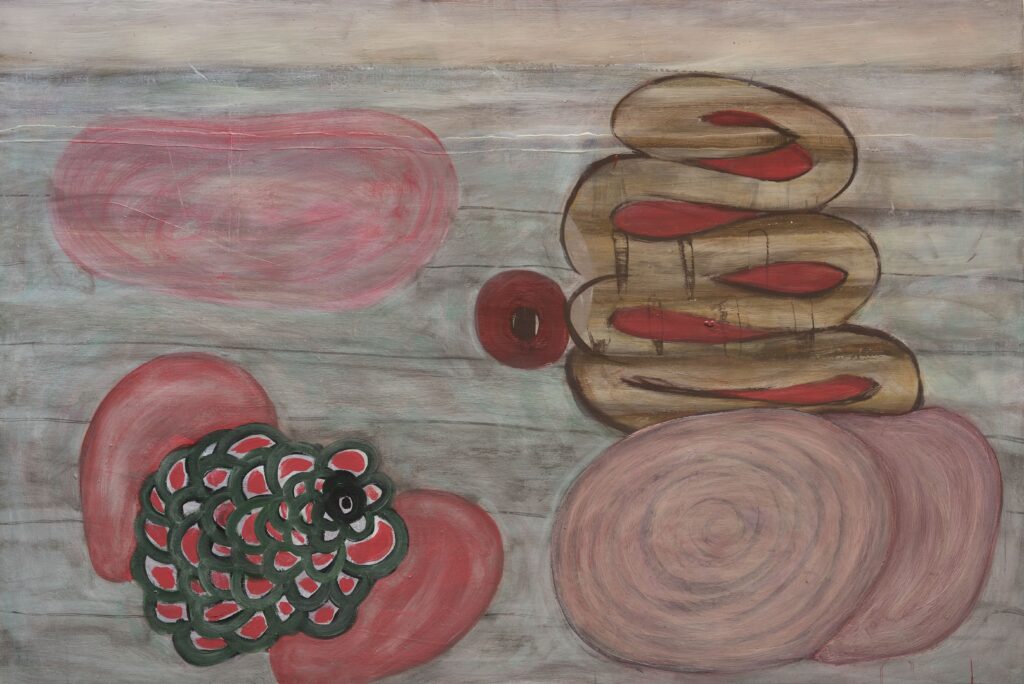
Charo Pradas, Annunciation, 1988.
The hypnotic circle
We tend to look for coincident paths in the path of an artist, but not as a demerit, but to emphasize the common path of research towards the cause of art. Pinks, whitish, ochres and greys correspond to the softness of the forms; the sinuous strokes create rounded, organic, tubular and to a certain extent Mandelic shapes, diagrammatic shapes and soft geometries, as in works 05, 06 or 14 of the catalogue. It is in this sense that I see proximity to Philip Guston, Terry Winters, Juan Uslé and Javier Puértolas who also abound in circular and biological microforms, in which what is close is seen with the same “zoom-gaze”, cosmological gazes. Charo Pradas' paintings possess the same hypnotic capacity as Marcel Duchamp's roto-reliefs. This circularity, this pictorialist geometry, is based on the concept of networks and meshes, a kind of spiritualized geometry, not in the manner of formalist or constructivist artists, much less of optical art, but rather in the hermetic tradition of Hilma af Klint (1862–1944), recently recovered from oblivion by the Guggenheim in Bilbao.
Perhaps the concentric circles produce the same unknown hypnotic effects, a state of consciousness suitable for entering the world hidden behind the forms. Juncosa writes in 1993 about Pradas: “Spirals that generate resonances and echoes with hypnotic ability, representing both order and chaos.”
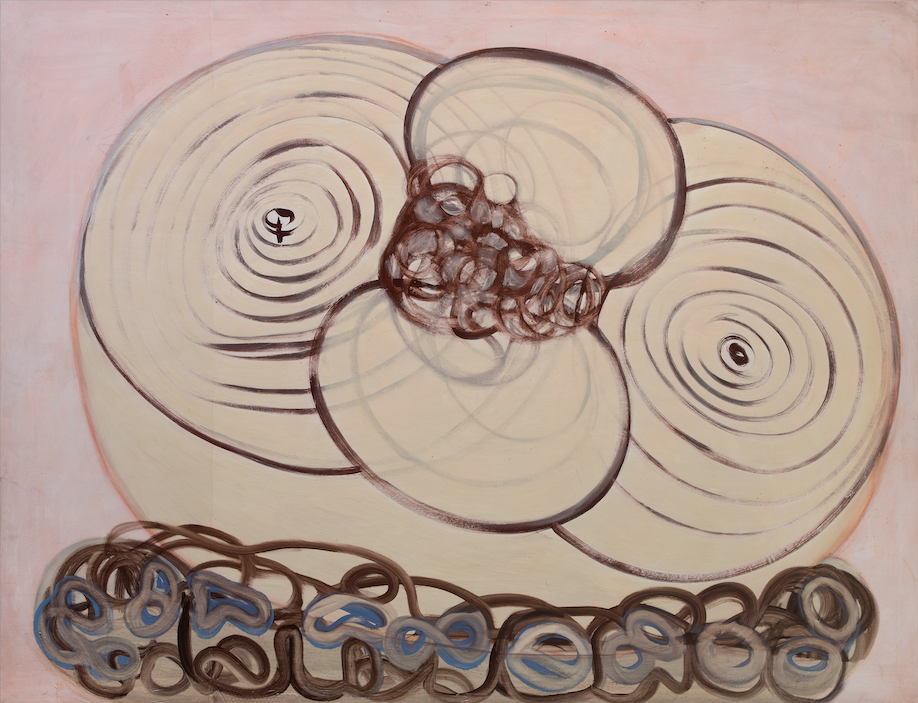
Charo Pradas, ST, 1989.
The virtuous circle
The eye as a circle and an ellipse is the most obvious theme in Charo Pradas' painting. Circular movement, like other rotating actions, as the stars do, or as the Sufi dancers understood it, becomes the first and main symbol of the original. It is a virtuous circle, in the sense used by Klint, and her four companions in the “Fem” group; they and other visionary women can visualize the invisible and it is always circular. Circular movement, like other rotating actions, acquire in these spiritual visions an image of the divinity itself. In Plato, when Socrates suggests that the first inhabitants of Greece considered the stars (sun, moon, earth, stars, sky) to be "gods" (theous) because they observed that they were always moving and "running" (theonta), thus deriving the name theos from their nature of "running" or "flowing" (thein). Always in perpetual circle. This relationship with the intangible perhaps leads Juncosa to interpret that Charo Pradas achieves “the representation of what cannot be represented.” I was struck by this revealing phrase.
Enrique Juncosa writes about Charo Pradas' paintings as some of what I consider the greatest achievements for the cause of art: “inner visions”… “that remind us of meditation or contemplation techniques”… and “the inner journey as a powerful possibility for the knowledge of the world”. Eyes, light, structures and meshes, hypnotic effects, circularity, organs-entrails, cosmos and Mandelic structures, contemplation, energies, come close to the methods necessary for us to enter this secret and encourage us to find the paradoxical keys to that which cannot be represented and which moves in an infinite circle.
You may be
interested
...