
Exhibitions
Antoni Cumella. Sculptural thought
The Artur Ramon Art Gallery is showing Architecture of Forms until March 13 to vindicate Cumella's pioneering work and place the figure and the work in the realms of 20th century sculpture.
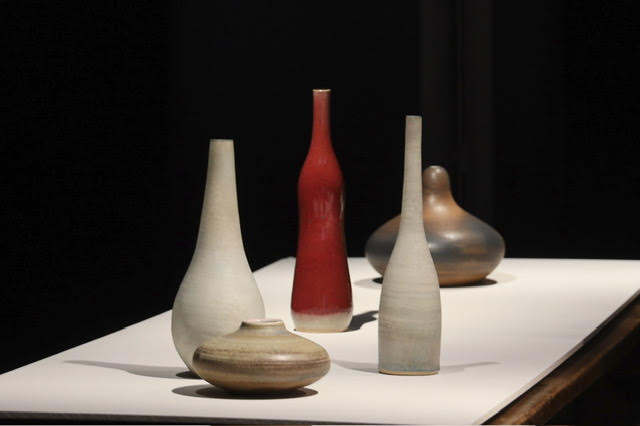
"Ceramics is a sculpture of revolution", this phrase by Antoni Cumella i Serret (Granollers, 1913- Barcelona, 1985) himself becomes the main focus of the exhibition Antoni Cumella. Architecture of Forms which, curated by Ricard Bru, reviews his ceramic work as a sculptural fact; as a practice that intervenes in space whether it is lathe pieces, objects, murals or reliefs. Fascinated by volumes and committed to the innovation of his time, he was one of the creators who made this language participate in new approaches, new treatments and a new morphology, freeing it, definitively, from its original utilitarianism. A firm will to research, together with the practice of a good craft and the entanglements of tradition resulted in ceramics conceived as a pure art, which defends the material with all its palpitation and intrinsic qualities. His main contribution was to find a perfect balance between the need for permanence and that of research; between classicist desire and the push towards contemporary rupture.
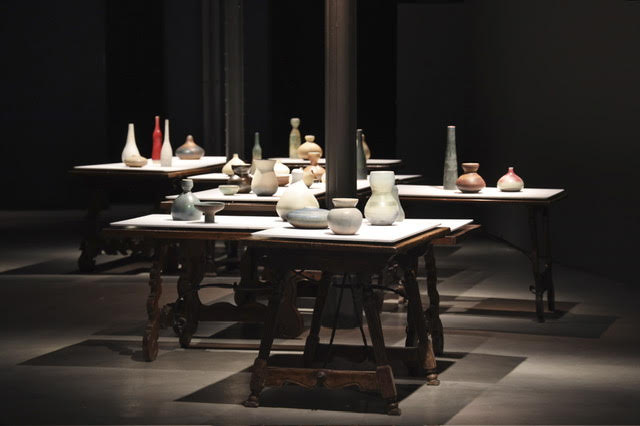
The exhibition Architecture of Forms presented by Artur Ramon Art shows autonomous pieces with volumetric poetry and plates designed to integrate into the architectural space. Both lines share the same conceptual coherence where form and matter are constructed from a unified thought.
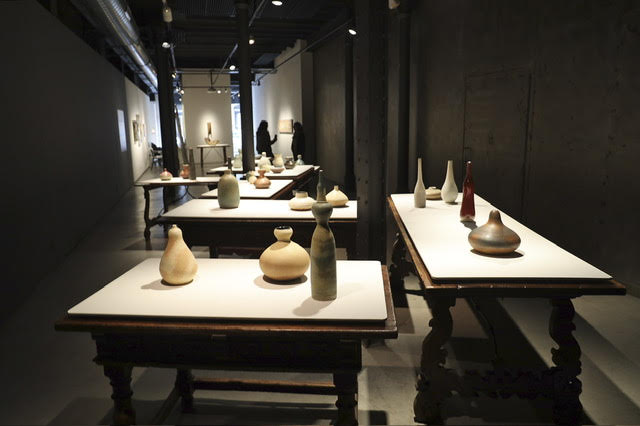
The specific concept of sculpture is revealed in Cumella since his artistic beginnings and will configure the common denominator of all his works. In this sense, he found a language of his own that connected him with the concerns of international sculpture and architecture. The relationship of many of his results with the work of Hans Arp, Max Bill, Naum Gabo or Henry Moore and the heritage of the Catalan Llorens Artigas, shows how he was able to achieve free forms with a traditional material in close relation to the avant-garde, becoming one of the undisputed innovators of European ceramics. Ceramics that are clay, water and fire, or mutation of matter, will be for Cumella a material -in particular stoneware- that can be turned, modeled, engraved, sculpted or glazed, breaking the barrier between what has been called "applied arts" and three-dimensional aesthetic creation in its highest meaning.
In his essential forms (glasses, bowls, vases) inspired by the austerity, sobriety and stylization of oriental ceramics, with harmonious profiles, soft contours and modeled and severely proportioned volumes, the artist gave his works a concept of three-dimensional speculation. With an extreme perfection of the surfaces -matte or shiny- and authentically epidermal qualities, Cumella treated them with a deliberate limitation of glazes, with subtle monochromatic gradations in order to intervene basically in the sculptural fact. Cumella understood the material (clay and stoneware) as a "living interlocutor", listening to its possibilities and limitations. This led him to constant experimentation with glazes and high-temperature firings that gave his pieces a unique life and vibration.
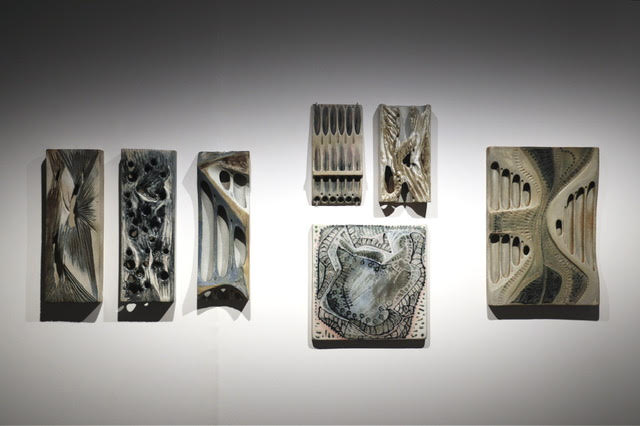
From the 1950s, from the humble potter's wheel, which models utilitarian forms, he came to create ceramic reliefs built in relation to architecture; the isolated module, the material plate or the abstract sculpture, always from strict spatial requirements. The artist models the ceramics in such a way that the different pieces play and recreate themselves with empty and perforated spaces both interior and exterior, uniting form and matter to transcend conventional formulas.
As for his mural reliefs, they refer us to an abstract representation of nature, to geological formations and even to a flora petrified in time. Bold and open works to space that investigate the possibilities of form with a character that is both optical and tactile. His approach was based on the expressiveness of matter (expressive skin) and volume to create a direct dialogue with the built space.
Cumella's most outstanding intervention was the monumental mural for the Spanish Pavilion for the New York World's Fair (1964-1965), designed by architect Javier Carvajal. It was a milestone that consolidated his international prestige, capable of elevating this material to a purely architectural language. The mural was conceived as a tribute to Gaudí, integrating textures and reliefs that dialogued with light and shadow; a constant in Cumella's work that sought to give architecture a vibrant skin. For Cumella, New York represented one of the three geographical vertices of his career (along with Rome and Madrid), and marked his evolution towards an industrialized ceramics, but with an artisanal soul that today continues in the family workshop with the help of his son Toni Cumella.
Biographical notes
Antoni Cumella i Serret (Granollers 1913-1985) is considered an internationally known ceramist who learned the trade in the family workshop together with his older brother Joaquim Cumella. His training continued at the Escola del Treball in Barcelona with Josep Maria Jujol and Josep Lluís Sert and where he learned the work of Gaudí. He married Agnès Vendrell in 1942 and they had two children. In 1936 he exhibited individually for the first time in Barcelona and was awarded a scholarship by the Generalitat to study in Paris, but the arrival of the Civil War did not allow him to stay there. During the war he worked as a health worker and finally ended up in the Porta Coeli concentration camp in Valencia, where he studied German, Latin and mathematics and from which he was released on probation and without rights in 1940.
In the 1950s he began a career of exhibitions in Madrid, where he came into contact with intellectuals critical of Francoism, and actively collaborated with the R Group, getting involved in the field of architecture as another aspect of his creation: art and built space are part of the same living organism. From his participation in the Milan Triennials (1936, 1951 and 1957), he was recognized throughout Europe for his enameled stoneware pieces of great purity and formal beauty. In 1956 he traveled to Germany, where he worked on murals and exhibitions and received academic offers. In 1958 he participated in the creation of the first museum of contemporary art in Barcelona and in 1959 he founded, with Alexandre Cirici and Romà Vallès, the FAD Art School, in addition to collaborating with Subirachs on the mural Les Taules de la Llei at the Faculty of Law of the UB.
In Barcelona, the mural for the old Sandoz building, located on Gran Via de les Corts Catalanes, stands out. The ceramic murals in the lobby stand out for their organic texture and the use of enamels with ochre tones, characteristic of his informalist period. The recent rehabilitation has generated debate due to its new arrangement and visibility. He also executed unique works such as the cap of an Osborne bottle designed by Dalí. From the eighties onwards, he worked on lithographs and medals, among which the one for the Parliament of Catalonia stands out. He was recognized with the Gold Medal of the Milan Triennial (1936, 1951, 1957); the National Prize for Plastic Arts (1980), awarded by the Ministry of Culture; the Creu de Sant Jordi (1981), the Gold Medal for Artistic Merit (1982), received from the City Council; the FAD Gold Medal (1982) and the title of favorite son of Granollers.
Antoni Cumella. Architecture of forms
Arthur Ramon Art. Bailén, 19. Barcelona
From January 29 to March 13, 2026
You may be
interested
...