Exhibitions
Intrastories around the centenary of Martín Chirino at the CAAM
Centenary of the soul of the wind in the heart of the MAAC
Year after year, in the month of August I usually visit the Centro Atlántico de Arte Moderno (CAAM), located in the Vegueta neighborhood of the city of Las Palmas de Gran Canaria (island of Gran Canaria). This year, the CAAM celebrates the centenary of the artist Martín Chirino (Las Palmas, 1925-Madrid, 2019) with an anthological exhibition entitled Martín Chirino. Chronicle of the Century . A commemorative project that, thanks to the impetus of the Fundación de Arte y Pensamiento Martín Chirino, is part of the ten exhibitions planned around art centers, museums, cultural institutions and art galleries. The curators Fernando Castro Flórez and Jesús María Castaño aim to bring the imagination of the Gran Canarian artist closer to the public, from a more essentialist and symbolic revision of wrought iron. It remains to assess the opinions of a respectable public who, with great luck, have dared to enter a series of immaculate functionalist temples of contemporary art.
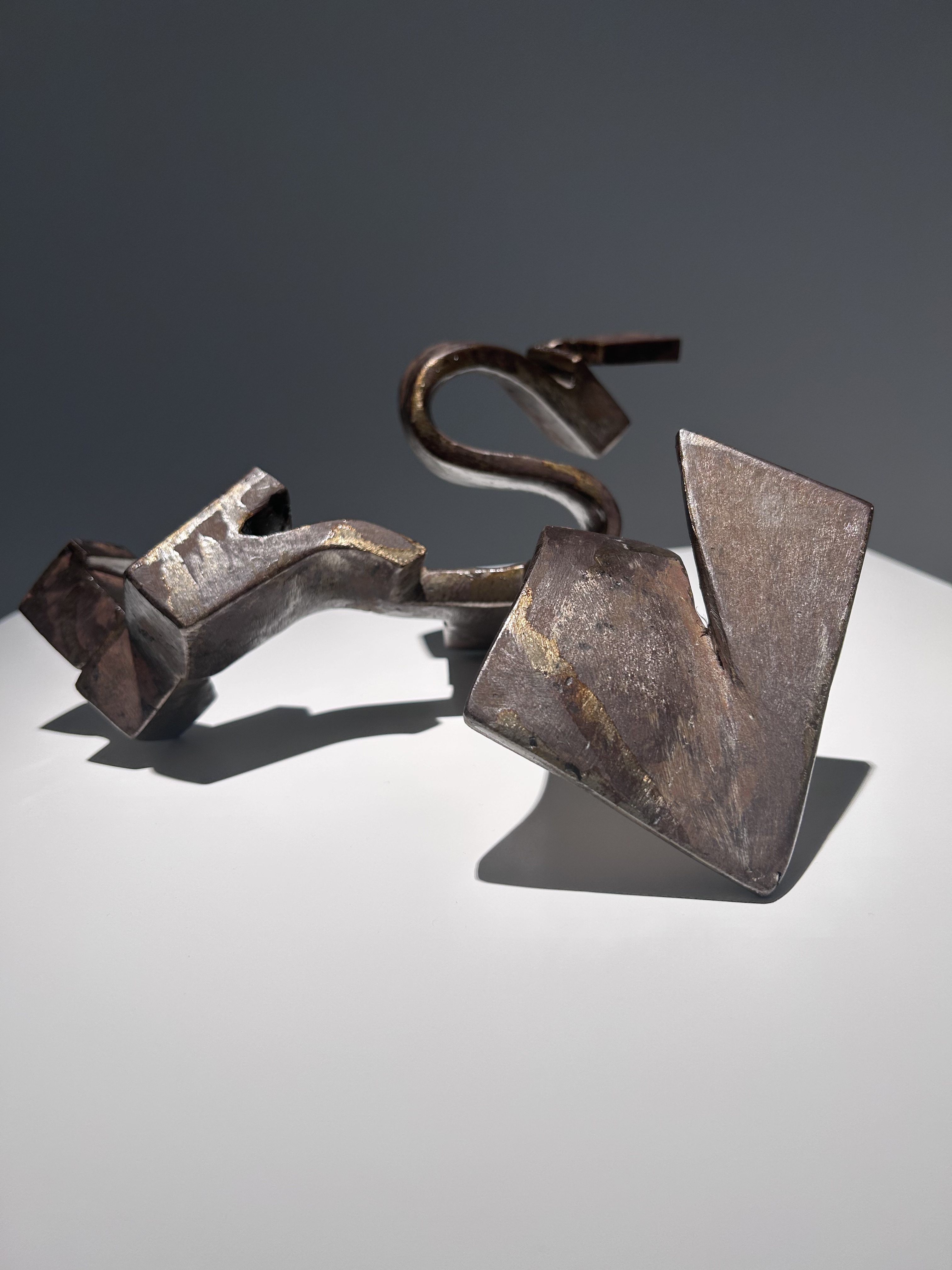
Tribute to Julio González, 1955. Wrought iron, IVAM.
A very significant exhibition tribute to the Canary archipelago and, specifically, to his native island; Gran Canaria. Not only because he represented the revival of modern Spanish and Canarian sculpture during the Franco dictatorship, but because his art has always been linked to the island's popular and aboriginal culture. The repeated sculptures of the Espirals series, begun in the sixties, beyond responding to a grammar indebted to an international abstract trend, known as informalist poetics, refer to the footprints left by the wind on the beach of Las Canteras and, especially, to the ancestral marks engraved on basalt rock in the archaeological sites of Julan (on the island of Hierro), or Roque de Teneguía (on the island of La Palma). A gesture of recovery, preservation and cultural resistance that, despite the distances, shares affinities with his teenage friend, the artist Manuel Millares, exemplified in the series Pintures negres (1946-1948) or Pictografies Canàries (1949-1950).
Otherwise, Chirino is part of a generation of iron sculptors -like Chillida or Alfaro- heir to national masters of the stature of Oteiza, González or Gargallo. His sculptures caress the wind, play with the surrounding space and, at the same time, humanize abstract language with the appropriation of popular traditions and peasant tools. From this background, Martín Chirino did not hesitate to commemorate some of his aesthetic references, which in the museum are represented with the work Homenatge a Julio González (1955), located on floor -1, and with the Composition. Homenatge a Joan Miró (1953), a piece located on the ground floor. Two pieces of refined wrought iron that dare to reflect a rudimentary rhythmic language of the air, belonging to the period of his first sculptural works and travels through Europe. The moment when the artist first discovered González's work, during his stay in Paris, in 1952.
Chronicle of a guided tour
Access to the modern facilities of the CAAM is particularly pleasant, thanks to the decisive treatment of the reception staff, Patri being a clear example, and the efficiency of a relevant (but invisible) external staff of the museum who, from the anonymity and daily work, develop essential tasks of attention to the public, advice, maintenance, cleaning and security of the museum. Without their contributions, the daily operation of the CAAM - like that of any other - would be unthinkable. A theme that the American feminist artist Mierle Laderman Ukeles made evident with her performance Maintenance Art (1979-1980), which consisted of cleaning galleries and museums, as an act of questioning the traditional roles of care assigned to women.
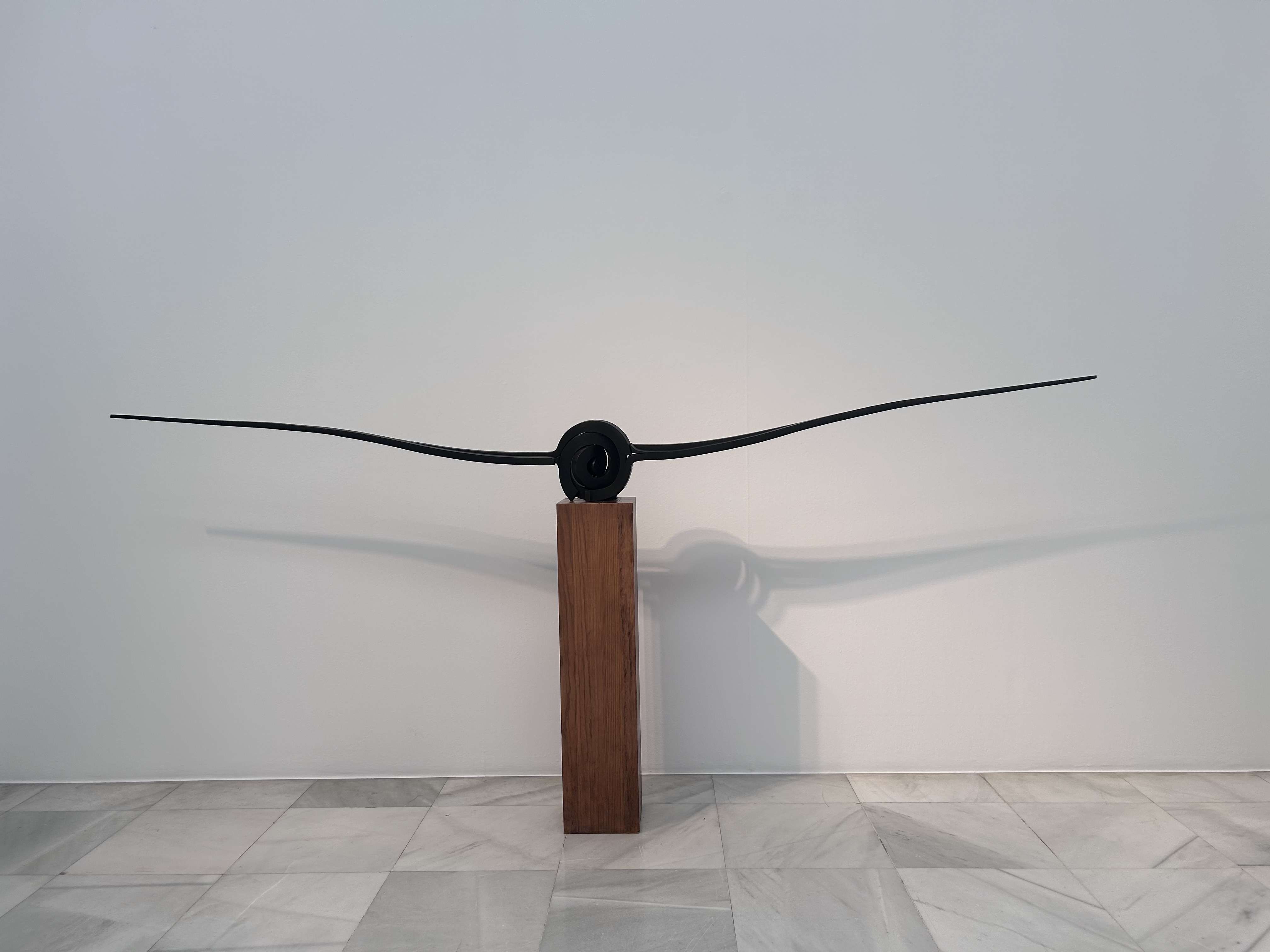
Aeróvoro (18), 1981. Blued wrought iron. RNR Collection.
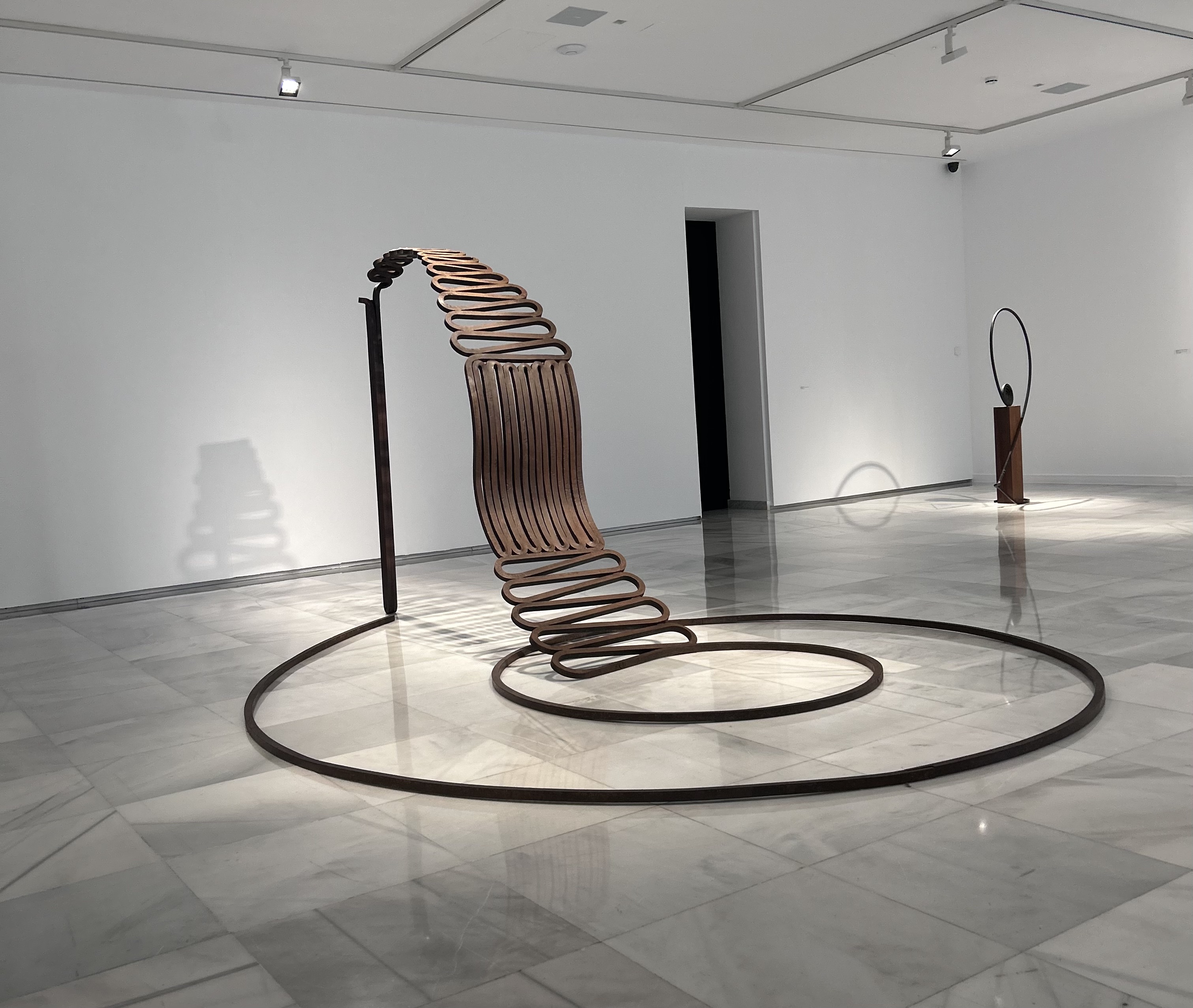
After fifteen minutes, from a discreet door - almost secret to me - one of the museum's curators, Carmen Rodríguez, emerged, who, thanks to the receptionist's efforts, kindly agreed to give me a guided tour of the four floors of the CAAM. On this private tour, my senses were captivated by the large sculptures and their explanations, but above all by the presence of a soft and captivating perfume (without the intention of advertising it) that my hostess wore. The visit began from floor -1, where the curator narrated the formative years and the first stage in Madrid. Throughout the rest of the floors, the visiting public will be challenged in terms of beauty, hardness, fire, fragility or sensitivity, through the articulation of prolific series of bronze, iron, wood, red lava... ( Aeróvoro, Alfaguara, Afrocán, Arrel, Cangrafia, Paisatge, Pentrecanes ...) which, broadly speaking, reincarnate the creative spirit, occupy the space and, ultimately, bring everyday and traditional aspects into dialogue with magical and symbolic elements of indigenous ancestral culture.
In the middle of the visit, Rodríguez emphasized the enormous effort that had been involved in gathering at the CAAM, bibliographical and biographical documentation (letters, books and magazines), collages, drawings, video art installations (created by visual artists Miguel G. Morales and Dácil Manrique Lara), prototypes, display cases, and sculptural pieces of different formats, coming from museum institutions, private foundations, art galleries and private collections. A titanic work, in which she herself, together with the other curator, Cristina Déniz, and the two curators, actively participated in the coordination and supervision of the acquisition and good condition of the pieces and, at the same time, of their careful assembly throughout the four floors of the museum.
Although the complexity of any exhibition installation is indisputable, since each work and material lent requires an exhaustive handling and conservation protocol, material stories, symbolic frames of reference and, in some cases, episodes with melodramatic overtones are also added. An example is a piece from the Black Queens series, which was only exhibited on the day of the inauguration and which, by express decision of its owner, was immediately withdrawn.
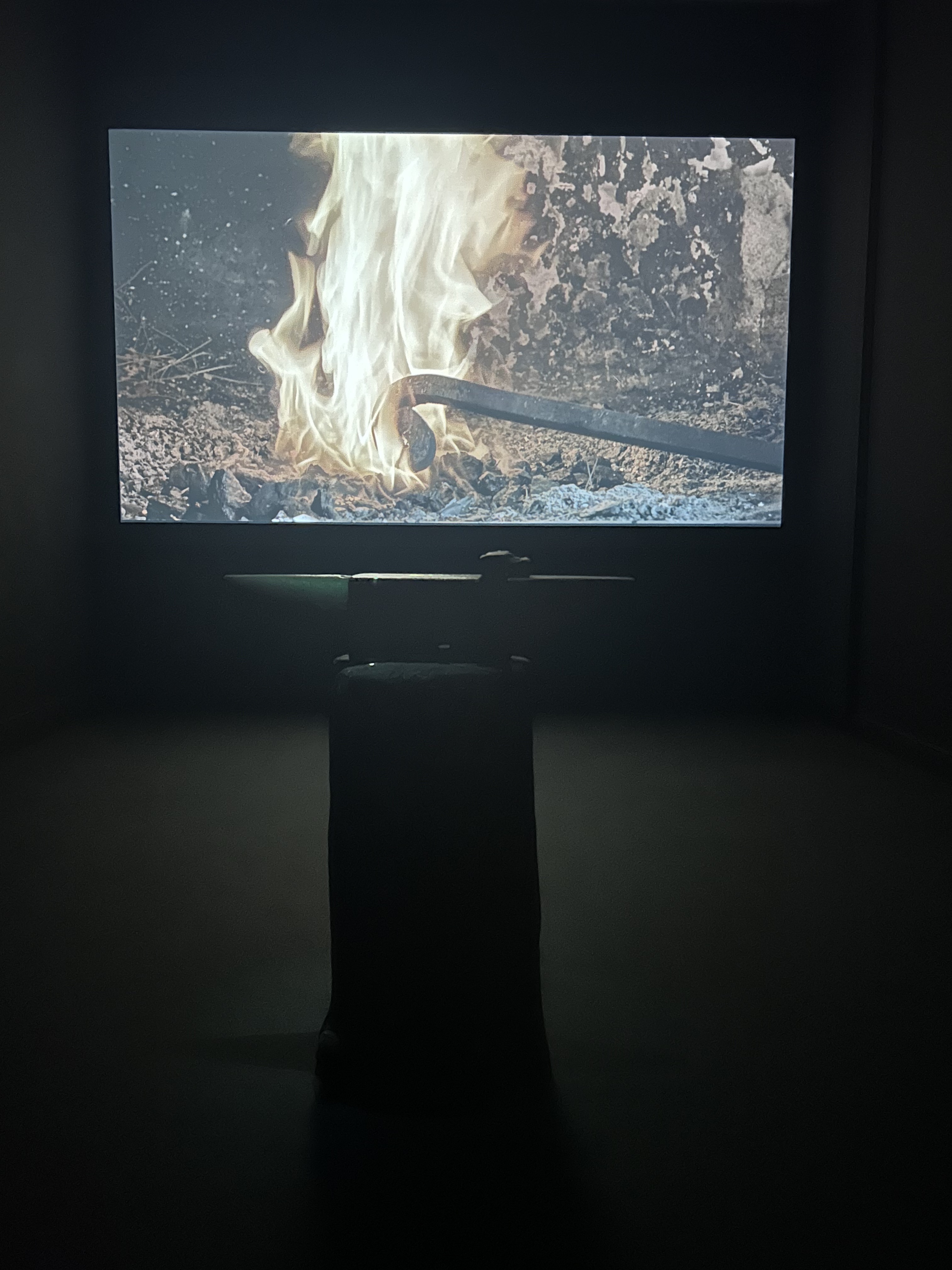
Dácil Manrique Lara (2024-2025). Martín Chirino, home and workshop. Fragment of the video installation.
In the midst of the explanations, the visit was interrupted on a couple of occasions by other visitors to the exhibition who, taking advantage of the curator's presence, were encouraged to share impressions (illustrated with images from their mobile phones) or to formulate specific doubts about the works. Carmen Rodríguez, with a natural and resolute disposition, did not hesitate to attend to and integrate these spontaneous interventions into the discourse of this private itinerary.
Finally, when the time came to say goodbye, I was overcome with a certain sadness when I thought about the delight of that time so well spent, nourished by the masterful explanations of the curator, a great specialist in the Chiriquí universe and passionate about her work.
More than forty years in Madrid
Faced with the insular isolation of the post-war period, many people restless for culture and with artistic ambitions - such as Manolo Millares, Elvireta Escobio, Manuel Padorno... - decided to try their luck in Madrid and, from there, travel to other European cities. Chirino, after learning the profession of sculptor at the Manuel Ramos Academy (Las Palmas), entered the Escuela Superior de Bellas Artes de San Fernando in Madrid. From that moment on, his career was defined by the assimilation of the European avant-garde, his successes in national and international exhibitions, his membership of the El Paso group (1957-1960), the obtaining of numerous awards... Regarding his incursion into El Paso, the Castillo de la Luz (headquarters of the Fundación de Arte y Pensamiento Martín Chirino) is hosting a synthetic exhibition of twelve works under the title El Paso. Avant-garde and commitment .
Despite the years he spent in Madrid, Chirino has always kept his culture of origin in mind. This explains both his frequent trips to the archipelago and his desire to fuse modern art, postcolonial Canarian customs and aboriginal culture, while dignifying the material culture of the Canarian countryside. In other words, the sculptor reinterpreted and recontextualized tools of agricultural work with works such as the evocative Poetic and Useless Tool (3) from 1956-1957; the subsistence crop of the time: corn, represented here by the suspended installation of The Ear (2) from 1956; or the most common means of transport, symbolized by The Cart (1) from 1956-1957. A sculpture outlined by threadlike lines of wrought iron. This set of pieces can be viewed on the ground floor of the museum.
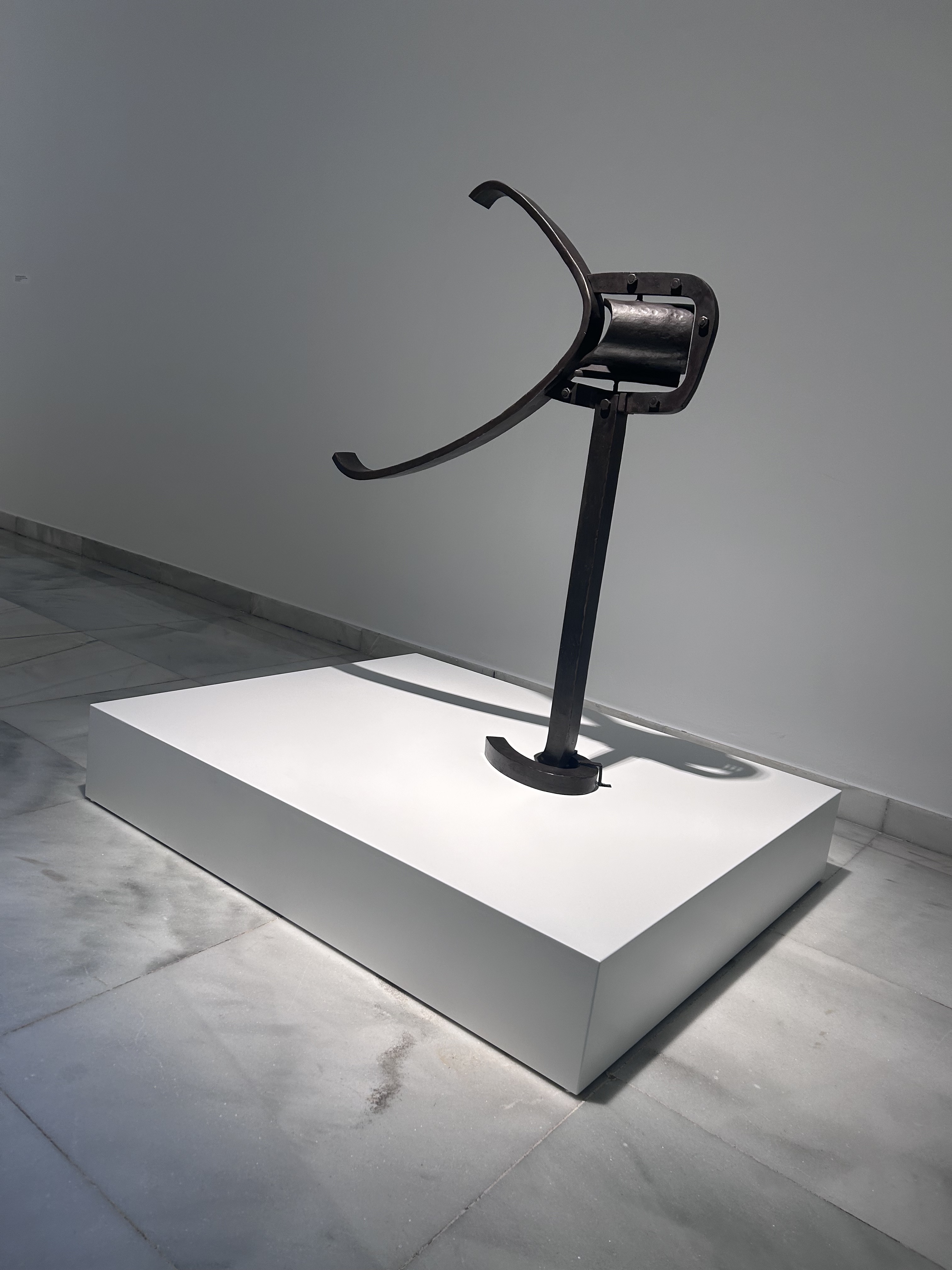
Tribute to Julio González, 1955. Wrought iron, IVAM.
Following his work experience with the Puerto de la Luz ships, which allowed him to travel to numerous places on the African coasts of Equatorial Guinea, Mauritania, Morocco, Sahara and Senegal, he conceived the series Reines negres in the mid-1950s. A set of small stylized female figures that, in my opinion, belongs to the Western tradition of colonizing (synthesizing) the concept of Africanity in a sort of more cosmopolitan and Western plastic language, represented by abstract art.
In the 1970s, the artist inaugurated new typologies of works with the Aeróboros and Afrocán series (located on the ground floor and second floor of the CAAM), which dialogue with the most ancestral craft traditions of the original peoples and, at the same time, explore the expressive possibilities of iron. The Aeróboros are pieces that, keeping a certain kinetic similarity with Calder's mobiles, twist, twist and plan firmly on a raised horizontal plane, without any apparent difficulty. And, in the Afrocán turn, they are works that defy gravity with voluminous, compact and oval shapes that, at least, tend to inflate upwards, becoming a compact surface that recalls a shield or an African mask.
And finally, occupying the ground floor, his most personal graphic language is exhibited with the series of Cangrafías (or Canarian writing), developed during the decades of the eighties and nineties. During these years, the author transferred primitive symbols, spirals and aboriginal pictograms into a varied graphic production, which includes collages, engravings, paintings and mixed techniques.
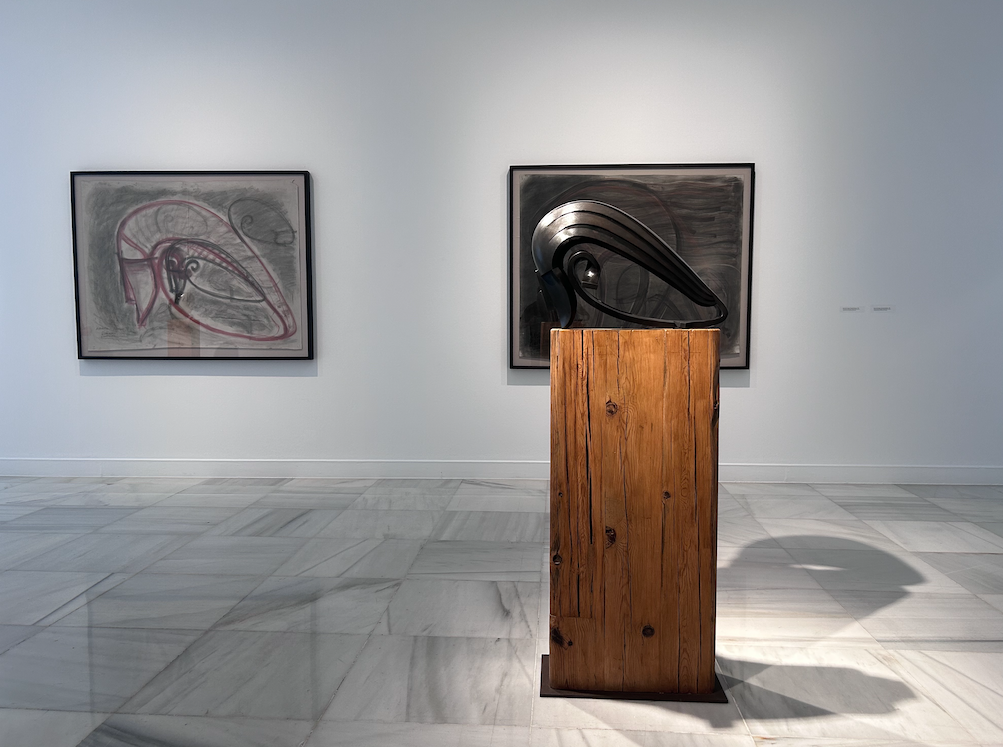
Room interior, CAAM.
The cultural legacy
Chirino worked as a cultural activist, disseminating his plastic poetics in magazine articles ( Papeles de Son Armadans , Arteguía, Revista de Arte y Pensamiento) , conferences, manifestos ( Documento Afrocán , 1976) and cultural initiatives such as the creation of the Contemporary Art Workshops and intergenerational seminars, during his presidency of the Círculo de Bellas Artes in Madrid (1983-1992). From the city of Las Palmas, with the intention of decentralizing contemporary art in the archipelago, he founded the CAAM (1989), being the first president (1989 and 2002), and, later, the Fundación de Arte y Pensamiento Martín Chirino (2015). His artistic legacy, currently co-managed by his daughter Marta Chirino and the director of the Foundation, continues to promote contemporary artistic creation, research into the tangible and intangible heritage of the person honored, and the preservation of the Canary Islands' memory and cultural identity.

You may be
interested
...