Exhibitions
The great Salvador Dalí is on display at the Thyssen
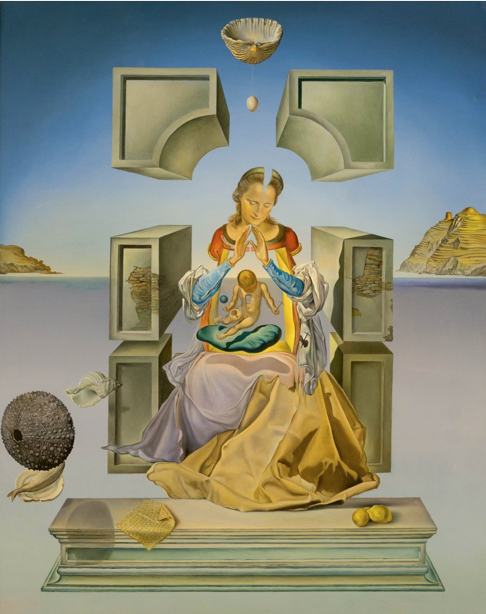
During the 1920s, while Salvador Dalí was carving out a niche for himself and becoming one of the most respected figures in the Surrealist movement, Federico García Lorca was writing "Ode to Salvador Dalí" (1926). From that era of complicity and tension to artistic immortality, the painter's figure has continued to inspire interpretation. A century later, Dalí is once again in the spotlight. On October 20, the Thyssen Museum in Madrid will open the exhibition "Dalí's Freudian Universe ," curated by Jaime Brihuega, who has previously explored the obsessive relationship between the painter and the psychoanalyst.
At first glance, it might seem that, in times like these, Dalí and Freud are once again challenging us. At a time when the construction of masculinity is being re-examined, revisiting two figures who articulated much of their respective universes through the dissection of desire, repression, and trauma is no coincidence. Even so, the retrospective presented at the Thyssen is particularly interesting because it approaches Dalí's work from a Freudian perspective perhaps never before explored with such vehemence. This connection, despite being obvious, remains essential for understanding the keys to his imagery.
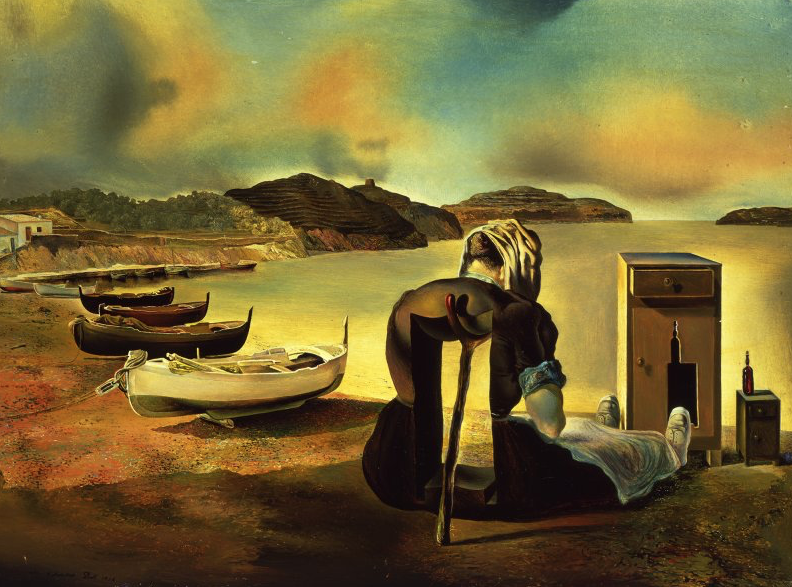
Salvador Dalí, The Weaning of the Furniture-Food, 1934, Collection of The Dalí Museum, St. Petersburg, Florida (USA); Gift of A. Reynolds and Eleanor Morse © Salvador Dalí, Gala-Salvador Dalí Foundation, VEGAP, Madrid.
Jaime Brihuega constructs a chronological journey that allows the public to recognize the artist's painful experiences and interpret them beyond their function as visual material. Although the exhibition unfolds sequentially, its purpose is not merely to order the works by stages, but to highlight the decisive moments in the painter's life and show how he reworks them through his mastery of the subconscious, transforming them into the raw material of his creations. Biography thus ceases to be a simple context and becomes a tool for interpreting the images.
From the idea of being the reincarnation of his prematurely deceased brother Salvador to his meeting with Freud in 1938, when the psychoanalyst described him as little more than a young Spanish artist, despite his limited visionary capacity to anticipate his transcendence, the exhibition unfolds the various dimensions of the relationship between the two. Dalí's work centered on his own traumas imbued his paintings with recognizable symbolism, as seen in Unsatisfied Desires (1928), where sexual frustration surfaces, or in The Great Paranoiac (1936), a work linked to the development of the paranoiac-critical method that would mark his career.
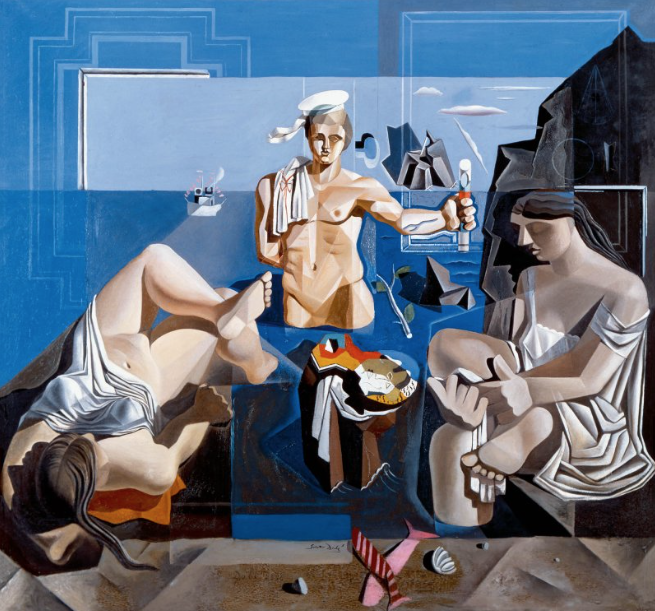
Salvador Dalí, Composition with three figures. Neo-Cubist Academy, 1926, Museu de Montserrat, donation Josefina Cusí, 1999 © Museu de Montserrat © Salvador Dalí, Fundació Gala-Salvador Dalí, VEGAP, Madrid, 2026.
The choice of a chronological order facilitates the understanding of works whose complexity arises precisely from the superimposition of biographical experiences, symbolic associations, and unconscious mechanisms. It is here that the exhibition gains strength. Brihuega finds a way to reconstruct a familiar story with meticulous precision, so that the viewer simultaneously advances in their knowledge of Dalí and in their understanding of Freudian theories. The exhibition's narrative does not reduce the images to the illustration of a psychological diagnosis, but rather establishes a dialogue between the artist's personal experience and his ability to transform it into visual language.
Without losing sight of the Freudian interpretation, the works reveal other obsessions of Dalí, including his relationships with Luis Buñuel and Federico García Lorca, as well as his interest in Santiago Ramón y Cajal's drawings of neural tissue. These references demonstrate both the painter's anatomical knowledge and his ability to establish convergences between scientific research and surrealist imagery. In works such as Cenicitas (1927-1928), linked to the exploration of the corporeal and the fragmentary, Dalí's imaginary world seems to find a territory where organic matter, perception, and the unconscious merge. Los difíciles estériles also participates in this universe where the body and its representations become stages of unease.
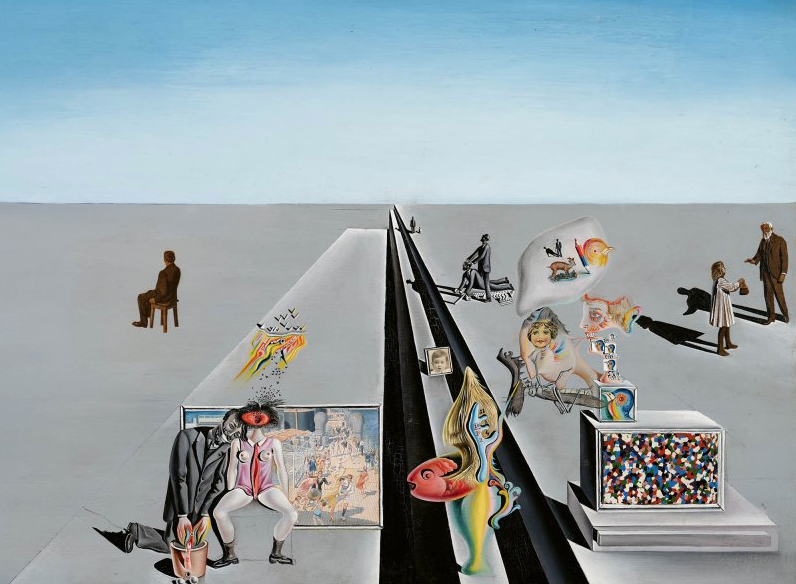
Salvador Dalí, The First Days of Spring, 1929, The Dalí Museum, St. Petersburg, Florida, gift of A. Reynolds and Eleanor Morse, 2000.21 © The Dalí Museum, St. Petersburg, Florida/ Photo: Oriol Tarridas, 2024 © Salvador Dalí, Fundació Gala-Salvador Dalí VEGAP, Madrid, 2026.
Brihuega's research is so meticulous and measured that it almost seems like an exercise in artistic mediation, allowing us to approach Dalí from the perspective the painter himself would have wanted his work interpreted. The choice of the backdrop from Tristan Maddened (1944) to welcome and bid farewell to the public reinforces this circular structure, made up of returns, contradictions, and resonances, and poses an inevitable question: would Dalí be the artist we know today if he had never read Sigmund Freud?
In any case, this ode to the exhibition demonstrates that the intellectual hero Freud represented for Dalí ultimately contributed to the construction of a unique, influential, and irreplaceable artistic figure. The Thyssen exhibition not only recovers a crucial relationship for understanding Surrealism, but also invites us to reconsider the extent to which art can transform the darkest corners of human experience into images capable of transcending time. In this transition between trauma and representation, between desire and its staging, Dalí continues to find new ways to engage with contemporary society.


You may be
interested
...