Exhibitions
The soul as a spiritual source
The exhibition "Instruments of the soul. Matter and spirit in medieval Catalonia", at the Girona Art Museum, explores the relationship between objects, the body and the sacred dimension during the Middle Ages through pieces from various Catalan institutions.
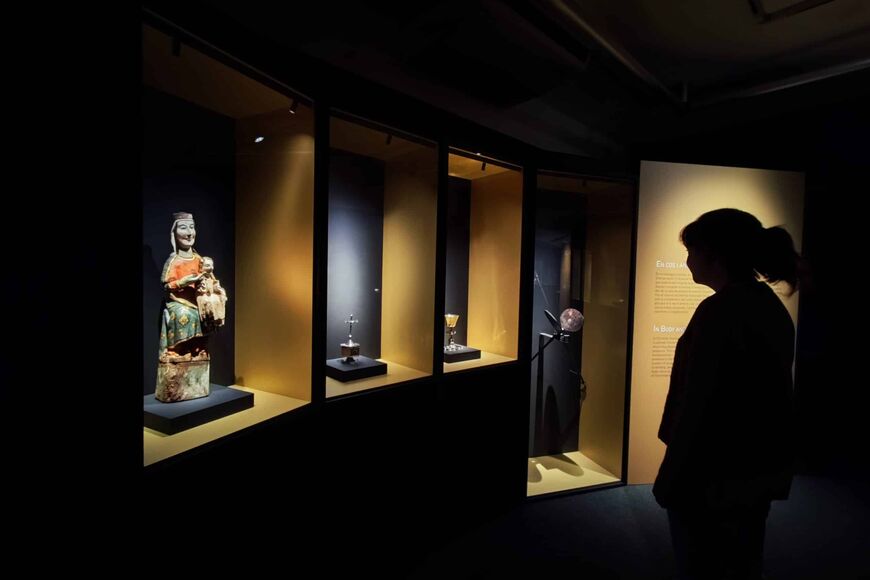
The Girona Art Museum presents the exhibition Instruments of the Soul. Matter and Spirit in Medieval Catalonia , with pieces also from other Catalan museum institutions, such as the Episcopal Museum of Vic, the Museum of Lleida and the Diocesan and Regional Museum of Solsona. The exhibition aims to explore how religion and objects were part of the Christian imagination and reflected the beliefs and practices of such a transcendental era for religious history as the Middle Ages. Despite the "Platonic foundation that opposed matter and spirit, Christianity soon claimed matter as a possible place for divine manifestation".
The exhibition is divided into several areas, such as With the Five Senses , The Language of Matter , In Body and Soul , Windows of Heaven , Living with the Sacred and Transcultural Instruments . The first serves to delve into the world of sensory experiences and the way in which the five senses allowed humans to approach what heaven represented, that is, the divine dimension. At the same time, this area shows how, in the Middle Ages, religious experience was linked to the precepts and practices of the liturgy. Among the pieces on display are a wrought iron altar candelabra from the early 15th century and a lipsanotheca, a small box or reliquary of molded, carved and engraved stucco, from the 11th century.
The section The Language of Matter presents several pieces that, through the iconography and the materials with which they are made, allow us to understand the ideals of wealth of their owners. These objects conveyed messages that went beyond their material function and expressed symbolic, social and religious values. Among the works that exemplify this conception is a Gospel book with silver covers from the last quarter of the 14th century, from the cathedral of Vic.
The third area focuses on the concept of incarnation, that is, on the idea that Christ becomes man and assumes the human condition. This conception explains the importance of the tangible presence of the sacred in the Eucharist and in cult images, as well as in relics. One of the pieces that reflects this dimension is a reliquary of Saint Lucia in gilded silver, embossed and chiseled, with glass, from the 15th century.
Finestres del cel exhibits a tempera painting on wood, with gilding, from the altarpiece of the Trinity in the Manresa cathedral and entitled Crist Baró de Dolors i les Arma Christi , from the late 15th century. This work exemplifies the desire to make the invisible visible through representations of God, the Virgin Mary and the saints, which allowed the faithful to approach the divine dimension through images.
In contrast, Living with the Sacred focuses particularly on the late Middle Ages and the presence of piety in domestic spaces. In this context, religious images acquired a special importance in everyday life and contributed to making spirituality present in the private sphere. For this reason, many of the pieces in this section are small in size, such as an ivory carving with remains of polychrome and gilding representing Saint John the Baptist, or a small carved and polychrome wooden altarpiece, attributed to the Master of Roussillon, from the early 15th century.
Finally, the Transcultural Instruments area brings together objects from diverse origins, linked by their cultural and symbolic relationships. This set allows us to broaden our perspective on spirituality and explore different ways of understanding the relationship between matter, the human being and transcendence, with the idea of recovering the original dimension of the human condition.

You may be
interested
...